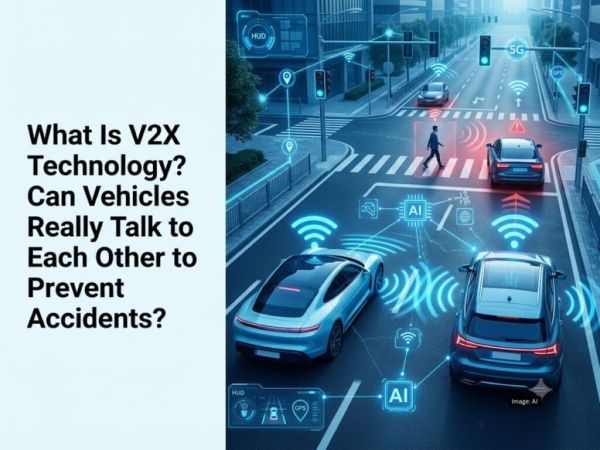
Do you know that vehicles can also communicate? Yes, there is a technology called V2X, which is the short form of Vehicle-to-Everything. It is a communication system that lets vehicles exchange real-time information with everything around them, such as other vehicles, traffic infrastructure, pedestrians, and even the wider network. Cars equipped with V2X can essentially “talk” to their surroundings, sharing data like speed, location, direction, and braking status several times a second by using a mix of dedicated short-range communication and cellular technology.
Break V2X down and it’s really a handful of smaller connections working together. V2V, or Vehicle-to-Vehicle, is what lets one car warn another about hard braking up ahead or a sudden lane change. V2I, or Vehicle-to-Infrastructure, links vehicles to the traffic lights, road signs, and toll booths around them. Then there’s V2P, Vehicle-to-Pedestrian, which picks up on people crossing the road; it is particularly useful when visibility is poor. None of these pieces does much alone, but stitched together, they give a car a stream of awareness that goes well beyond what a driver’s eyes or the vehicle’s own sensors could ever catch on their own.
Talks between the vehicles are not just marketing language, as the communication is real and functional. They can even communicate a warning to the car that is approaching a blind curve that another car or vehicle is coming from the opposite direction before both drivers can physically see it. It can also communicate about the vehicle which is ahead and brake hard for the cars connected through V2X as they get an instant alert, even before their own cameras or radar detect the slowdown.
The biggest advantage lies in early warning. V2X can flag hazards like stalled vehicles, sudden traffic pile-ups, or pedestrians stepping onto the road, giving drivers precious extra seconds to react. It also helps in poor visibility conditions like fog or heavy rain, where traditional sensors struggle. Beyond safety, it can improve traffic flow by coordinating signal timings and reducing unnecessary stop-and-go driving.
Even after it is said that it is promising, V2X is not foolproof. It will give successful results if most people are using it, as a single connected car which is surrounded by multiple non-connected vehicles can’t get any type of benefits. To support the V2X system, the infrastructure costs are high, as the roads need sensors, signal upgrades and also network coverage. There are also concerns around data privacy, cybersecurity risks, and the need for standardised protocols across manufacturers and regions.
While V2X won’t eliminate accidents on its own, it adds a valuable layer of predictive awareness that human reflexes and standalone sensors can’t match. As more vehicles and cities adopt this connected infrastructure, the technology could meaningfully cut down on collision rates, particularly in scenarios where visibility or reaction time is the deciding factor between a near-miss and a crash.
The post What Is V2X Technology? Can Vehicles Really Talk To Each Other To Prevent Accidents? appeared first on NewsX.