In the age of Squad Cost Ratio (SCR), loans have become a useful tool for clubs that do not have endless piles of money, but where did the whole idea actually begin?
“Who on earth is A.H. Chequer?” That was the question spectators asked when they spotted an unfamiliar name on the Wanderers team sheet before the first ever FA Cup final, played between Wanderers and Royal Engineers in March 1872.
In reality, ‘A.H. Chequer’ was an assumed name used by Morton Betts, who normally represented Harrow Chequers (hence ‘A Harrow Chequer’). The Chequers had withdrawn from the tournament after the first round, but that did not stop Betts from turning out in the final.
As expected, he scored the match’s only goal.
Player loans were fairly common in football’s early amateur era, although – as the use of the assumed name shows – the practice of bringing in ringers for major games was looked down upon as rather unsporting.
More often than not, though, loans were arranged out of necessity. If an away side arrived with one or two men short, perhaps because of injuries or travel issues, they would borrow players from the home team to make up the numbers. Loaning players did not really become a problem until football became professional, and players were tied by contract to their parent clubs.
In 1885, Blackburn named three loan players – Great Lever captain Tot Rostron, Preston forward Fred Dewhurst and Accrington half-back George Haworth (or Howarth, according to some sources) – for an FA Cup quarter-final against West Brom.
However, after a “secret meeting” in Blackburn, the FA stepped in to stop the loanees from taking part. Even without them, Rovers won 2-0 and went through to the semi-final, and then the final, where they met Scottish pioneers Queen’s Park.
After a “secret meeting” in Blackburn, the FA intervened to stop three loanees from playing in an FA Cup quarter-final
Surprisingly, George Haworth, openly described in newspaper match previews as “George Haworth of Accrington”, was permitted to play for Blackburn in the final, and he helped his adopted side to another 2-0 victory. Rovers were accused of having “sacrificed any pride” by “begging permission” from the FA to field Haworth.
But, as one newspaper noted, opponents Queen’s Park were no strangers to borrowing players and could summon “all the good players in Scotland”. So Rovers had only done what they needed to do “in order to vanquish their formidable opponents”.
Leading sports paper Athletic News was strongly critical of player loans for cup ties, calling them an “objectionable and unfair proceeding”. The paper argued that borrowing players did not only hand teams an unfair edge, but also created “unhealthy competition” for the services of the best players, deepening the “evil of professionalism”.
Clubs were often making disruptive approaches for players, and players were becoming mercenaries, appearing for whichever clubs paid the most. After the Football League was formed and later expanded to include a second and third division, teams started borrowing players before potentially profitable “test matches” – the original relegation and promotion play-offs.
The best features, fun and footballing quizzes, straight to your inbox every week.
“When will something be done to check the wholesale system of borrowing players to help a club to escape or pull through the test fixtures?” asked one football journalist in 1898. This came after Manchester City borrowed England full-back Tommy Clare from Burslem Port Vale for a crucial end-of-season match at Newcastle. City actually lost that game and missed out on the test matches, but the entire episode was seen as “nothing short of a scandal”.
When will something be done to check the wholesale system of borrowing players to help a club to escape or pull through the test fixtures?
At a meeting in April 1898, the FA banned “the loaning and borrowing of players for special matches”. Not every club followed the ban. In 1901, Middlesbrough and Glossop were reprimanded after the loan transfer of goalkeeper James Saunders to Boro, and Preston were fined £5 for signing John Wilkie on loan from Partick Thistle. In the uproar that followed, it was repeated that such loans were not permitted under FA and Football League rules, and any club involved would be “severely dealt with”.
Loans came back during the Second World War, when Football League competition was suspended and replaced by a regional Wartime League. Many footballers joined the armed forces and clubs found it difficult to field teams from their much smaller player pools, so a ‘guest player’ system was introduced, allowing clubs to loan players on a match-by-match basis.
This produced some unlikely appearances by some of football’s biggest names for rival clubs. Stan Mortensen of Blackpool guested for Arsenal, Eddie Hapgood of Arsenal guested for Chelsea, and Stan Cullis of Wolves guested for Liverpool, while another notable Liverpool loanee was Preston’s Bill Shankly. The future Reds manager appeared as a Liverpool player in a 1942 win over Everton.
The best players were in huge demand during wartime, and some turned out for different clubs within the same week, or even on the same day. On Christmas Day 1940, future England international Len Shackleton played for Bradford Park Avenue in the morning and then for Bradford City in the afternoon, scoring in both games.
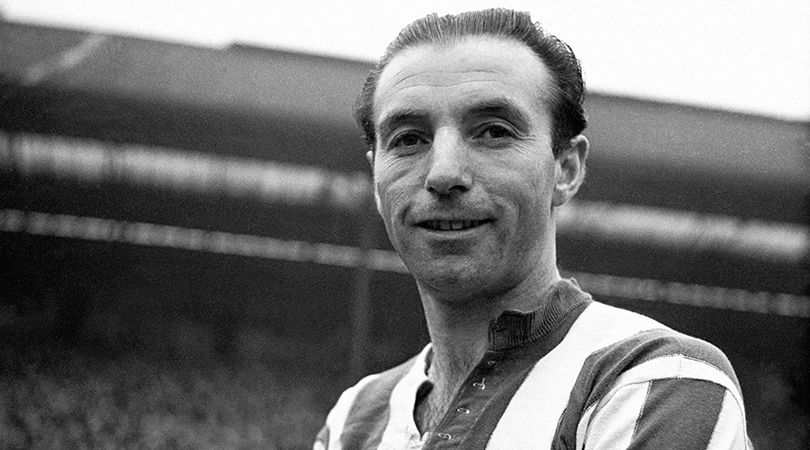
One of the most high-profile wartime loanees was Stoke City’s Stanley Matthews, described as “England’s number one football personality”. Matthews joined the RAF and was stationed near Blackpool, making more than 80 guest appearances for the Seasiders before later joining the club permanently. The England wide man also played some wartime matches for Manchester United and Arsenal, and even made an international guest appearance for Scotland.
Several professional players were based at the Aldershot Garrison army training camp, which was excellent news for the original Aldershot FC. The struggling third-division side were able to call on England senior internationals Stan Cullis, Joe Mercer, Cliff Britton, Tommy Lawton and Frank Swift, plus Scotland’s Matt Busby, to assemble what must surely have been the most powerful loan side ever put together.
After the war, as football got back on its feet and clubs rebuilt their squads, the guest player system was phased out, and loans were largely off the table once again. They were only properly approved after the end of football’s ‘retain and transfer’ system, which was abolished in 1963, bringing some relaxation in the restrictions around players’ contracts and also ending the maximum wage cap.
Then, in 1966, the Football League made what newspapers called a “most startling proposal” to allow the “temporary transfer of players” – with certain limits. Each club could complete only two loan transfers per season, transfer fees could not be paid, loans had to last at least three months, and they could only be arranged between clubs in different divisions.
The rules on loan transfers would be altered over the following years, especially in 1995 after the Bosman ruling – which transformed the whole transfer system – and then in 2003 when the restriction that loans had to be between clubs in different divisions was lifted. There were also temporary bans, such as in 1980, when loan transfers of players other than goalkeepers were prohibited. But the 1966 proposal effectively established the loan system as it is known today.
In 1967, Torquay United signed 19-year-old winger John Docker on loan from Coventry. Docker scored twice on his Torquay debut, a 3-0 win over local rivals Exeter, but played only three more matches during his loan spell and never played for Coventry at all. So while his career was hardly a glittering one, Docker can perhaps be remembered as the first signing under the new loan transfer system.