1 August 2026
As figures across football eagerly circulated Gianni Infantino’s embarrassing retreat, with many prepared to stay awake deep into the early hours of Saturday, one feeling only became stronger.
The view was clear: step one had been completed. Now came step two: “He’s still got to go.”
Much of Infantino’s support base has plainly fallen away, perhaps even extending to the backing of Donald Trump. When the US president was asked on Friday whether he had been consulted over the plan, Trump brushed it aside – and, by implication, a man he has previously praised in unusual terms – with a single word. “No.”
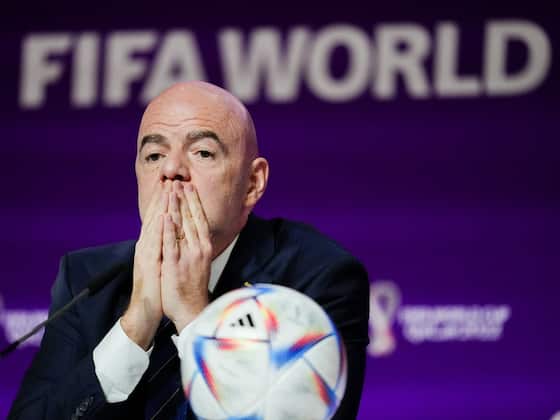
Gianni Infantino’s future as Fifa president is suddenly uncertain.
And that was that. This may now truly be the moment.
Uefa has already announced that it has “lost confidence”.
One senior figure described how “his leadership has been exposed as poor, his character questionable, his interests self-interested and he is absolutely the wrong person to lead Fifa”.
Even by football’s standards, and by the standards of everything that tends to surround Infantino, it has been an extraordinary week.
Infantino has been seriously damaged by the chaos surrounding his World Cup sell-off plan.
On Monday, he looked to be in an apparently untouchable position and was moving towards another presidential term, to the extent that he was rebuking the media for criticism.
By Friday, his world was falling apart and criticism was coming from across the globe in a manner not previously seen.
No other serious organisation could endure this level of public embarrassment, with its credibility so badly eroded, without resignations and a full cultural reckoning.
That is why “step three” ought to matter even more than steps one or two: ensuring genuine accountability and recognising that this is ultimately about far more than one individual and one week.
Fifa executive Kevin Lamour, one of the few people to emerge from this episode with an enhanced reputation, captured that perfectly in a Friday statement widely viewed as the decisive blow to Infantino. “Regarding this project and what comes next, everyone must take responsibility.”
Infantino has been facing criticism from every direction.
In that sense, it has been a classic week of political collapse, with some in football comparing it to the downfall of Margaret Thatcher. The decline can take time, but when it happens, it happens fast.
It also explains why, however grim such a week may first appear in exposing the bleak forces shaping the game, it can also reveal some positives. Football executives, so often accused of inertia, were said to be “electrified”.
It is likewise a significant moral victory that the future and character of the World Cup were not settled at something resembling an invitation-only billionaires’ gathering such as the Allen & Co Conference, where the framework of this plan was worked out last year. The audacity of such people, especially in trying to exploit the people’s game, is astonishing.
Uefa president Aleksander Ceferin, who can fairly be criticised for some of the same failings as Infantino, was able to demonstrate what he does best.
As in the Super League episode, he spoke impressively and with force. But, as with the Super League, many of the underlying issues that created this situation still remain.
Uefa president Aleksander Ceferin spoke forcefully in his rebuke of Infantino.
When one football figure started listing the problems for which Infantino has been responsible, they suddenly stopped and laughed, saying that “the list is so long it’s ridiculous”.
Those issues stretch across a broad spectrum, from outright failures of governance to questions of style and conduct. There was the Qatar press conference, the “governance by Instagram”, the attempt to make the Israel and Palestine delegates shake hands, and telling everyone to “chill”. And that does not even include the justified criticism over more concrete developments, such as the initial involvement in the Super League; the attempt at earlier private equity moves and a strange obsession with crypto; the process behind the Club World Cup; the damage to sporting integrity caused by Inter Miami’s inclusion in that event and the reduction of Cristiano Ronaldo’s World Cup suspension; the hydration breaks; the Folarin Balogun affair; the broader ingratiation with questionable political figures and autocratic leaders; and, perhaps above all, the process that delivered Saudi Arabia 2034.
Yet even if Infantino now leaves, everyone must still live with the consequences of those decisions. The football world will still have to head to Saudi Arabia in eight years’ time, while revisiting many of the same arguments about human rights and migrant labour that surrounded Qatar.
Infantino has brought the 2034 World Cup to Saudi Arabia, raising many of the same concerns that surrounded the 2022 tournament in Qatar.
And that is because Infantino was permitted to do all this by many of the same football politicians who are now condemning him.
One reason he felt confident enough to lash out at media criticism as recently as Monday was that he had become unused to criticism from within the game itself.
As one source put it, “not enough national associations stood up to the unacceptable” – until it became impossible to tolerate. The Fifa Council plainly failed to exercise oversight, to the extent that it was left in the dark on almost everything. Infantino was allowed to go far too far without proper checks.
This is not entirely down to individual failings. The structure of Fifa – and Uefa – gives the president excessive authority, allowing governance by decree, while everything is shaped by a revenue redistribution model that becomes a mechanism for winning votes. Everyone understands that the consequences of opposing the president – as some Uefa nations felt even before Thursday’s meeting – can be severe for their own organisation. You can lose the right to stage major events.
Lamour referred to “contempt and intimidation”. That is also why there has been a sense of “thrill” at the failure of Infantino’s cynically exaggerated use of this system.
Infantino became close to Donald Trump in the build-up to the World Cup.
The feeling inside football was that he believed he could simply push this privatisation plan through because that is how the system normally works. It was a textbook case of overreach born from overconfidence.
As one member association head said: “I’m glad this ridiculous patronage system is exposed for what it is – the money rightfully belongs to the members anyway, not for buying votes.”
That is why reform – the kind that did not happen when Infantino succeeded Sepp Blatter in 2016 – should now be the priority, along with a proper separation of powers so that the president is nowhere near as dominant.
Will that actually happen? It would require Ceferin, so central to the events of this week and now taking the opportunity to remove a major rival, to accept limits on his own authority. Uefa’s statement called for a “thorough and fundamental” review of Fifa leadership, but what about its own leadership structure?
There must be genuine checks and balances.
There is already a sense that football is simply moving to the next phase, namely submitting presidential nominations before the November deadline ahead of the March election. In other words, business as usual: new names operating within an old system.
Would Ceferin really reform Uefa rather than only criticising Fifa?
As Norwegian FA president Lise Klaveness said: “This cannot end as merely another power struggle conducted behind closed doors. All our efforts must be directed towards improving governance.”
That echoed Lamour, who said that “the time has now come for football political leaders to ask themselves the right questions and make the right decisions”.
The issue, then, is not necessarily who should replace Infantino, but what system should replace the current one.
Some would go even further, arguing that a Swiss association – “designed for a local bowls club” – can no longer be left to run a multibillion-dollar international business. What is needed, they argue, is a limited company in a transparent jurisdiction with a proper board.
For the moment, most attention remains on removing Infantino. Executives are pointing out that this episode shows he has failed on two of Fifa’s own presidential statutes, especially the obligation to “aim to foster a positive image of Fifa” and to seek “to maintain and develop good relations” among the relevant parties. There is currently an effort to persuade countries to withdraw their earlier letters of endorsement. He has many of them.
By the same measure, there was also a revealing slip in Infantino’s statement on Saturday morning. After repeatedly speaking in terms of “we”, he suddenly referred to “my intent”.
Football needs to get out of this cycle. It needs to think on a much bigger scale.