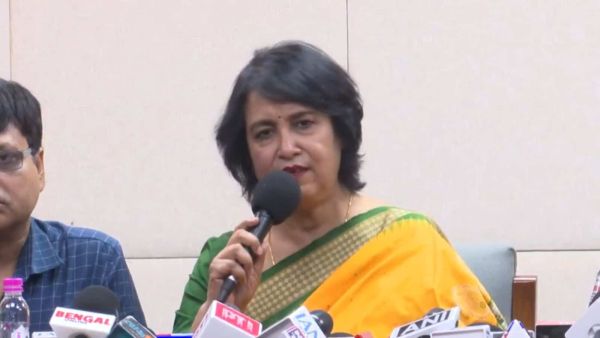
Kolkata: Exiled Bangladeshi author Taslima Nasreen on Sunday, August 2, strongly pitched for the implementation of the Uniform Civil Code in India, asserting that such a law was essential to eliminate discrimination, particularly against women.
She also stressed the need for such a law in neighbouring Bangladesh and Pakistan.
“All advanced countries have UCC-like laws. Bangladesh, Pakistan and India need a Uniform Civil Code. There should be equal laws for everyone. Women face a great deal of discrimination, and much of it can be removed through a UCC. It is essential,” Nasreen told reporters at a press conference here.

Her remark comes after the West Bengal government had constituted a high-level committee to examine a draft Uniform Civil Code (UCC) for the state.
A government notification said the panel was formed in view of the “wide ramifications and voluminous nature” of the proposed legislation. The committee will undertake a comprehensive examination of the draft Bill before any further steps are taken, it said.
Referring to Bangladesh, the 63-year-old writer said equality was the cornerstone of civilisation, but many women continued to face discrimination.
“In Bangladesh, Hindu women do not have equal rights. They cannot inherit their father’s property. If Hindu women are to enjoy freedom and equal rights, a Uniform Civil Code is necessary,” she said.
Nasreen, who returned to Kolkata after nearly 19 years, was felicitated at a state government programme at Rabindra Sadan here on Saturday.
She had left Kolkata in 2007, when protests over the publication of her book ‘Dwikhandito’ (Split: A Life) forced the then Left Front government to move her out of the city.
The writer expressed anguish over the disruption during her felicitation ceremony in the city a day ago, saying she felt “insulted” after noted poet Joy Goswami was forced to leave the stage amid protests by a section of the audience.
“Not only was Joy insulted, but I was also insulted because I had invited him,” Nasreen told reporters.
The controversy erupted when she invited Goswami onto the stage and requested him to address the gathering. However, loud objections from a section of the audience forced the celebrated poet to step down without speaking.
Recalling the incident, the writer said, “In my speech, I had spoken about freedom of expression. Everyone should be allowed to speak. It is not right to stop anyone from expressing their views.”
Questioning the conduct of the protesters, she said, “Those who appreciated my speech were the ones who did not allow him to come on the stage. Didn’t they also question me? It is contradictory. When someone speaks about freedom of expression, people support it, but when a poet is invited to speak, they do not want to hear him. That is not right.”