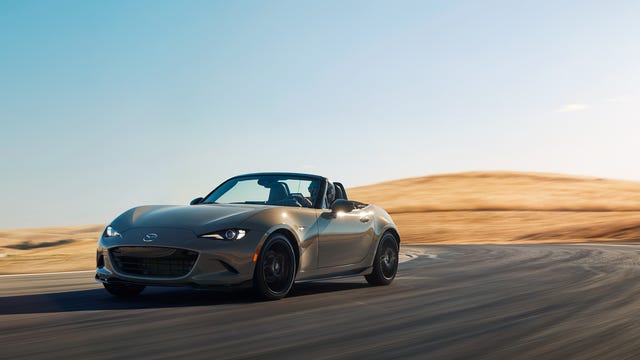
The fourth-generation Mazda MX-5 has been on sale since 2015, so it is hardly surprising that Mazda’s top management is already thinking seriously about the Miata’s future. And as per a new report from Auto Motor und Sport, battery-electric power is very much being considered.
During a conversation with Mazda CEO Masahiro Moro, the German publication asked about the future of the Miata’s powertrain. Mazda had earlier confirmed that the next-generation roadster will use the new 2.5-litre SkyActiv-Z engine, but that does not rule out some level of hybridisation. In fact, as Moro indicated, the car’s electrification could go even further than that.
“The successor must also be ready for a scenario without a combustion engine. The challenge for us is to make the basic structure lighter without using exotic materials like carbon fibre,” Moro told Auto Motor und Sport.
Keeping weight down has been central to the Miata philosophy ever since the model first arrived in 1990, but an electric powertrain could put real pressure on that formula in such a compact sports car. A 2026 Mazda MX-5 Club tips the scales at a relatively light 2366 pounds, which is only about 200 pounds more than a 1990 model-year Miata. Speaking to Road & Track in 2025, Mazda chief technical officer Ryuichi Umeshita made it clear that this focus on low weight cannot be compromised.
“I would say the most important thing is that it is lightweight, and that the second most important thing is that it is lightweight. That is the key — whatever the future MX-5 is, it must be very light,” Umeshita told R&T.
The possibility of needing a battery-electric powertrain makes Mazda’s ideal kerb weight target for the next generation even more difficult to achieve. Mazda design chief Masashi Nakayama said the target figures for the fifth-generation Miata are 2200 pounds and 157 inches. That would actually make it lighter than the current version. Even a small-capacity hybrid battery pack would inevitably add meaningful weight to the roadster, and a larger battery for full-electric driving would add even more.
The issue is made more challenging by Mazda’s commitment to keeping the Miata affordable. The starting price of a 2026 Mazda MX-5 is $31,665, which is lower than the $13,800 base price of a 1990 Mazda Miata after adjusting for inflation. Introducing carbon fibre or other lightweight, high-strength materials would likely push Mazda to increase the Miata’s price.
No matter what form the next-generation Miata ultimately takes, the Japanese carmaker remains committed to offering a manual transmission in the MX-5. Umeshita had previously stressed that direct driver involvement is a core part of the Miata’s identity, and that Mazda wants to keep the stick shift alive for as long as it can.
“Manual transmission has the direct feeling, the sense of jinba ittai,” Umeshita said, referring to Mazda’s phrase for the unity between car and driver. “It is key for the package, at least for the MX-5.”