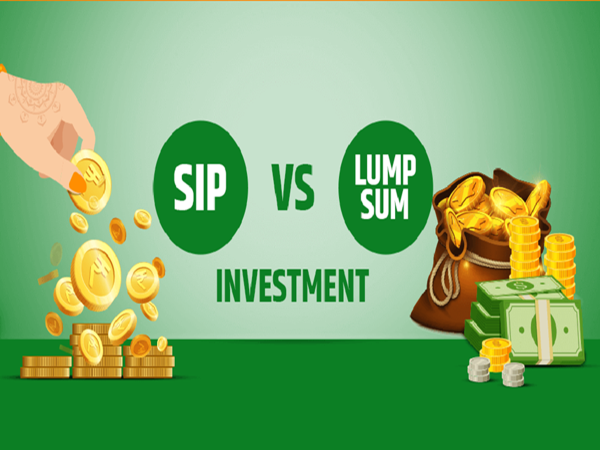
SIP vs. Lumpsum: When a child is young, concerns about their education, college, or career seem like a distant prospect. However, time flies. The child currently in your arms could, in 15–20 years, be dreaming of pursuing engineering, medicine, an MBA, or studies abroad. In such a scenario, if you do not start investing in time, amassing a large lump sum later will not be easy.
This raises a question: If you have ₹2 lakh today, should you invest it all at once? Or would it be wiser to start a monthly SIP of ₹2,000? Both approaches have their own advantages. Let us understand this through simple language and calculations.
What is the difference between SIP and Lumpsum?
In an SIP (Systematic Investment Plan), you invest a fixed amount every month. This fosters an investment habit and helps balance out the impact of market volatility to some extent.
In contrast, with a lump-sum investment, the entire amount is invested at once. If the investment is long-term, the full amount begins to benefit from the power of compounding right from day one.
Let’s understand this with an example.
Suppose your child is currently young, and you wish to start investing for their future. You have two options: start a monthly SIP of ₹2,000 or make a lump-sum investment of ₹2 lakh today. Let us assume an average annual return of 12% on both investments.
How much will the money grow to over 15, 20, and 25 years?
Investment Method 15 Years 20 Years 25 Years
Estimated fund from ₹2,000 SIP ₹10.09 lakh ₹19.98 lakh ₹37.95 lakh
Your total SIP investment ₹3.60 lakh ₹4.80 lakh ₹6.00 lakh
Lumpsum investment of ₹2 lakh ₹10.95 lakh ₹19.29 lakh ₹34.00 lakh
Estimated profit from lumpsum ₹8.95 lakh ₹17.29 lakh ₹32.00 lakh
Note: This calculation is based on an estimated annual return of 12%. Mutual funds are subject to market risks; therefore, actual returns may be higher or lower.
Why is there a difference in the returns?
Over 15 years, a lumpsum investment of ₹2 lakh appears slightly ahead of a ₹2,000 SIP. However, as the time horizon extends, the SIP corpus grows larger. This is not because the SIP offers a higher rate of return, but because fresh capital is added to the SIP every month.
For instance, over 25 years, you would have invested a total of ₹6 lakh through SIP, whereas the lumpsum investment was only ₹2 lakh. Therefore, when comparing the two, one should consider the total investment amount, not just the final corpus.
If you have ₹2 lakh available today...
Suppose you have received a bonus, sold a piece of land, or an FD has matured. If you do not need this money for the next 20–25 years, investing it for the long term is better than letting it sit idle in a bank account. This way, the entire amount starts working for you from day one.
If saving monthly is easier...
Not every family has ₹2 lakh available as a lump sum, but setting aside ₹2,000 a month is feasible for many. In such cases, SIP is a better option; it does not disrupt the household budget and allows you to gradually build a substantial corpus.
What if you can do both?
Suppose you have ₹2 lakh and also the capacity to save ₹2,000 every month; in that case, you can leverage both.
Invest the ₹2 lakh today, and start a monthly SIP of ₹2,000 from the following month. This way, the lump sum will compound over the long term, while fresh investments are added each month.
Time plays the most crucial role.
People often spend months searching for the perfect mutual fund but never actually start investing. The truth, however, is that time is even more powerful than the fund itself.
If your child is currently three years old and you start investing today, you have a horizon of 15 to 20 years. It is this time factor that transforms small amounts into a substantial corpus.
Therefore, if you are thinking of waiting until next year to start, that could prove to be a costly mistake. Whether you begin with ₹2,000 a month or invest ₹2 lakh upfront, the most important thing is to start early—the sooner you begin, the easier your financial future can be.
Disclaimer: This content has been sourced and edited from Money Control. While we have made modifications for clarity and presentation, the original content belongs to its respective authors and website. We do not claim ownership of the content.