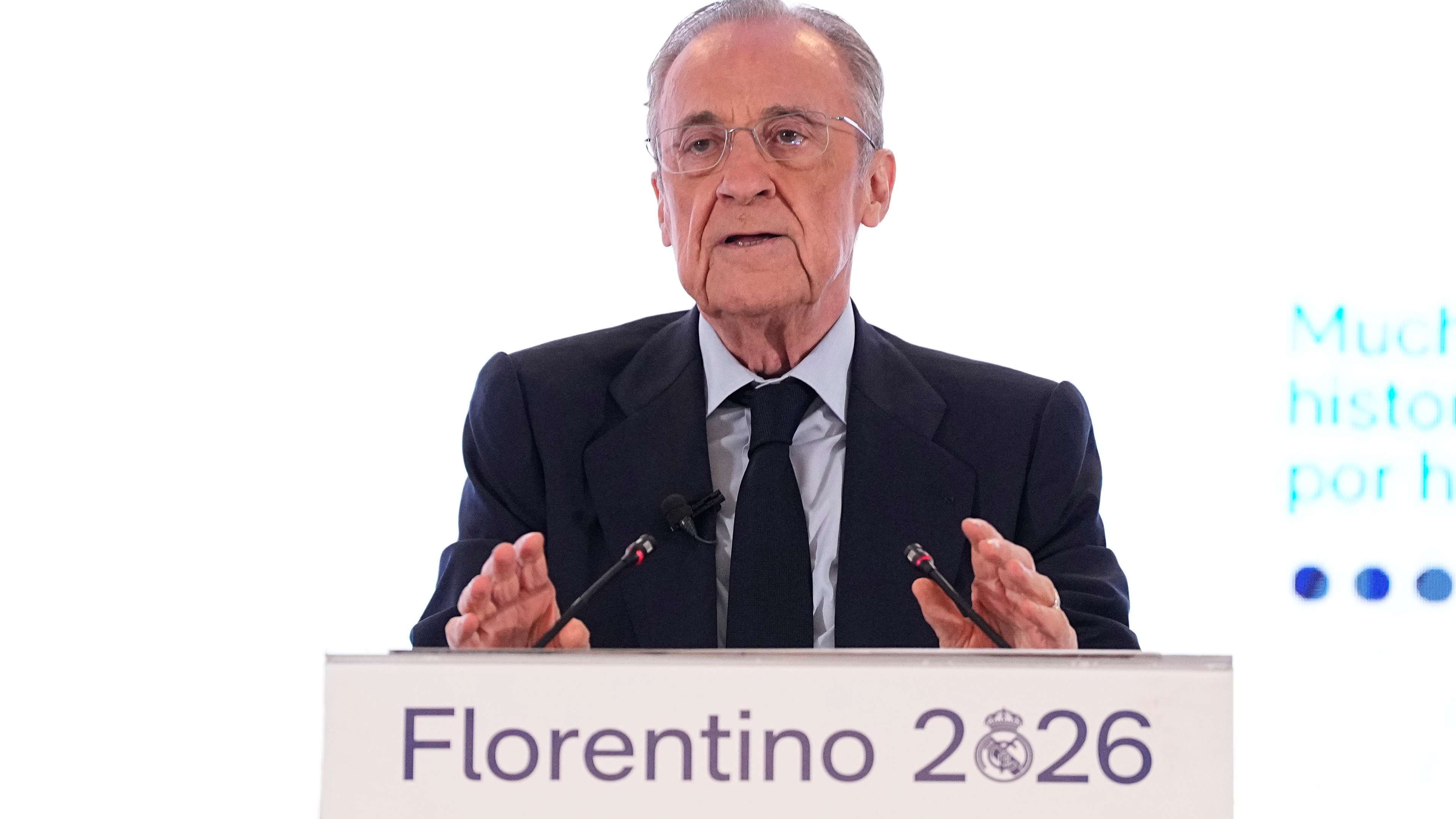
La Liga president Javier Tebas has launched a fierce attack on Real Madrid president Florentino Perez, questioning whether he has the credibility to speak about the future of football. The outburst came after the Spanish giants issued a formal statement on FIFA’s recent U-turn over the privatisation of tournament rights.
Tebas calls Perez ‘the not-so-superior being’
The long-running feud between Tebas and Perez has now reached another flashpoint after Real Madrid publicly reacted to FIFA’s internal policy changes.
After Los Blancos released a statement backing the decision to stop the privatisation of World Cup rights, Tebas responded on social media with a stinging reply. He titled his message “The not-so-superior being”, an obvious reference to Perez’s “superior being” nickname in Spain, and the La Liga chief made no attempt to soften his criticism.
Tebas was especially sharp while questioning the club’s behind-the-scenes role, asking: “By the way, why has it taken so long to respond? What was Anas doing in New York during the week of the final? And is it a coincidence that, apparently, JP Morgan was also involved in this operation, as happened with the Super League?”
Although he accepted that the opening section of Madrid’s statement was “impeccable” in relation to FIFA’s inability to unilaterally dispose of future income, he quickly turned to what he sees as hypocrisy from the Real Madrid chief.
The hypocrisy of the CVC comparison
A key issue in Real Madrid’s original statement was the club’s comparison between FIFA’s shelved plan and La Liga’s CVC deal. Madrid have consistently opposed the CVC agreement, under which most Spanish clubs exchanged a percentage of future broadcasting revenue for immediate investment.
In their latest statement, the club said that “Any initiative aimed at seizing football’s future revenues without bearing the responsibilities that result from them is unacceptable, and it should never be proposed again in any form,” directly pointing to the deal struck by the Spanish league as a domestic example of this “unacceptable” model.
Tebas responded by stressing that the CVC operation was completely voluntary, unlike the proposed FIFA measure. “The operation was voluntary: each club decided freely if it adhered. Real Madrid did not do so, it is not linked and does not have a single euro of its income committed,” Tebas argued. He also pointed out that the move was approved by an overwhelming majority of clubs exercising the same autonomy that Real Madrid says it wants to protect.
Clashing visions for football’s future
The La Liga president then went a step further, accusing Perez of using a double standard when it comes to financial policy. He said: “When Real Madrid decides it freely, it is modernization and financial strategy; when the other clubs decide it freely, it is a mortgage.”
Tebas suggested that this “obsession” with La Liga’s leadership comes from the club’s repeated failure to win legal cases against the league in recent years.
The criticism also extended to the controversial Super League project, which remains one of the biggest sources of tension between the two men. Tebas mocked Perez’s earlier insistence that the breakaway competition was needed to rescue football from financial collapse. “The ‘not so superior being’ already has little credibility to give lessons on the future of football. Do you remember when the Super League came to save us because football was ruined? What a vision,” he added sarcastically.
The ongoing war between Perez and Tebas
This latest exchange is simply the newest episode in a rivalry that has shaped the politics of Spanish football for years. While Real Madrid presents itself as a protector of supporters and the “heritage” of the game, Tebas sees the club’s actions as a danger to the competitive balance of domestic leagues. Madrid’s statement had stressed that “International football and the World Cup represent, above all, events of public interest, and they constitute a heritage that belongs to nations, to fans and to society as a whole.”
Tebas, however, is not persuaded by that populist language. He continues to regard the Super League as a mechanism for the elite to concentrate power, in contrast to the collective growth strategies he says he has pursued in La Liga.
With Tebas reminding Perez about his run of failed lawsuits and Perez continuing to challenge the league’s commercial authority, the civil war within Spanish football appears nowhere near a ceasefire.