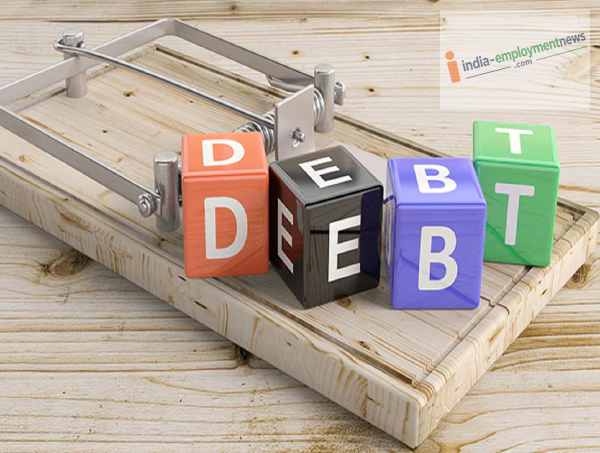
Debt Trap: Nowadays, obtaining a loan has become incredibly easy. You can get a personal or business loan with a single click on your mobile, secure an education loan in minutes, or—by simply submitting documents—get a loan worth lakhs for a wedding. However, this convenient process has now become a source of major financial distress for many. The habit of taking out loans for every little thing is destroying domestic harmony and peace of mind. One often realizes that a loan taken for a necessity has turned into a debt trap only when monthly EMIs consume a large chunk of one's salary and taking out a new loan becomes necessary just to repay an existing one. It can also be said that the rapid growth of digital lending in India has made access to credit much easier for people.
Why is loan uptake increasing?
Inflation, rising education and healthcare costs, and social obligations have driven people toward borrowing. Today, taking an education loan ranging from ₹4 lakh to ₹20 lakh for quality education has become commonplace. Meanwhile, people are also relying on personal loans for weddings, home renovations, foreign travel, and other major expenses. Trouble arises when people borrow amounts that exceed their salary. ₹4 lakh for education, ₹10 lakh for a wedding—people are getting caught in a debt trap; what are the solutions?
How does the debt cycle begin?
Suppose someone takes an education loan of ₹4 lakh for their studies. EMI payments begin after they land a job. Some time later, they take a personal loan of ₹10 lakh for a wedding. Then, they take an auto loan to buy a car and increase their reliance on credit cards to cover daily expenses. Eventually, a significant portion of income began to be consumed by a combination of various EMIs and credit card bills. Losing a job, facing a medical emergency, or experiencing a salary cut in any given month makes repaying EMIs difficult. In such situations, many people resort to taking out new loans to pay off old ones, and this is where the debt trap begins.
What mistakes often lead people into this trap?
Taking on EMI obligations that exceed one's income.
Taking personal loans for weddings, vacations, or luxuries.
Making only the minimum payment on credit cards.
Managing multiple loans and credit cards simultaneously.
Ignoring interest rates and total repayment amounts.
Agreeing to the terms of digital loan apps without reading them.
You should ensure that your total EMI payments do not exceed 35% to 40% of your monthly salary. It is risky if more than half of your salary goes towards EMIs. Take a personal loan only when absolutely necessary; whenever possible, use your savings first, as personal loan interest rates are significantly higher than those for home or education loans.
6 ways to avoid the debt trap:
1. Distinguish between needs and wants
Not every expense requires a loan. First, determine whether the expense is truly essential or if it can be postponed for a while.
2. EMI budget
Before taking a loan, calculate your salary and expenses thoroughly. Aim to keep your total EMI payments below 40% of your monthly salary.
3. Emergency fund
You should have a separate fund covering at least six months' worth of expenses. This prevents the need to take out a new loan during unexpected crises.
4. Credit cards
Try to pay off your entire credit card bill every month. Paying only the minimum amount due causes interest to accumulate rapidly.
5. Lower interest rates
If you must take a loan, compare interest rates offered by different banks and NBFCs. Do not take out an expensive loan simply to get quick cash.
6. Seek advice
If you are facing difficulties in repaying your EMI, discuss options like loan restructuring or extending the tenure with your bank. Instead of hiding the problem, look for a solution in time.
Note—
A loan is not bad in itself. A loan taken for the right purpose and after careful consideration can help with your education, buying a home, or starting a business. However, if borrowing becomes the default solution for every major expense, this facility can gradually turn into a burden. Therefore, before taking a loan, always ask yourself: "Can I repay this EMI for the next 5–10 years without stress?" Proceed only if the answer is yes.