National Conference president Farooq Abdullah on Tuesday said the reconstitution of Jammu and Kashmir into Union territories in 2019 had wider implications and that the BJP would repeat such moves in other states if it stayed in power.
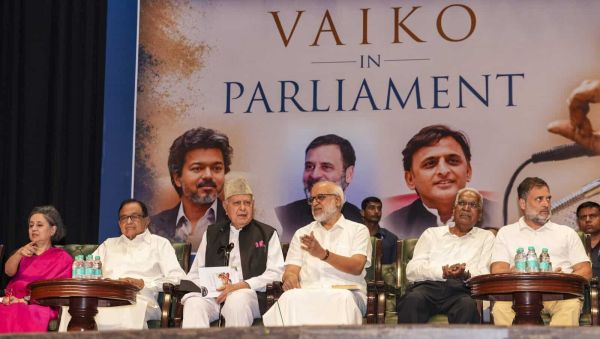
Abdullah made the remarks at the launch of MDMK leader Vaiko’s book “Vaiko in Parliament”, with Leader of Opposition Rahul Gandhi and several opposition leaders in attendance.
This comes a day before the seventh anniversary of the abrogation of Article 370 and the bifurcation of Jammu and Kashmir into two Union Territories.

Abdullah said the developments in Jammu and Kashmir had wider implications for India’s federal structure. “Look at Jammu and Kashmir… A state converted to a Union territory, completely against the fundamental laws… and they are going to do this with other states also, be sure, if they remain in power,” he said.
India’s diversity could survive only if states stood together, the former J-K CM said.
The National Conference leader also renewed his demand for restoration of statehood, saying the Union territory arrangement had left the elected government with “hardly any powers” while authority rested with the Centre.
Questioning the functioning of constitutional institutions, Abdullah said the Election Commission should have been autonomous and the judiciary should be “far more democratic and not dependent on the wishes of the government of the day”.
He also challenged the government’s development narrative, asking, “They may say we will be the third biggest economic power… but we still feed nearly 80 crore people with free ration. How will we become great?”
Pointing to the July 20 police action against students protesting in Delhi, Abdullah said the “brutal treatment” meted out underscored the need to resist what he described as “dictatorial policies”.
Echoing Abdullah’s thoughts, CPI(M) general secretary M A Baby said the August 5, 2019, decision to abrogate Article 270 amounted to “the most unconstitutional assault” on Jammu and Kashmir.
Baby described the erstwhile state as “a test case” for what he claimed was a broader assault on India’s federal structure.
Baby alleged that the Centre bypassed constitutional procedure by first dissolving the Jammu and Kashmir Assembly, vesting its powers in the governor and then using Parliament to revoke the state’s special status and divide it into two Union territories.
Warning that the precedent could be extended to other states, he said, “RSS realises no trick will work with Tamil Nadu. Tomorrow they can do with Tamil Nadu what they did with Jammu and Kashmir.”
Criticising the apex court over the pending challenge to the Article 370 revocation, he said, “The Supreme Court is sleeping over this matter. I’m willing to be dragged to the Supreme Court for contempt (on this).”
Referring to the police action on youth protesting exam irregularities in Delhi, Baby said it represented “an indescribable assault upon the peaceful, democratic struggle of students and youth” and recalled that Vaiko insisted on meeting injured SFI activists despite widespread disruption in Delhi, eventually meeting them at Surjeet Bhawan along with CPI(M) leaders.
Speaking at the function, both Abdullah and Baby linked the developments in Jammu and Kashmir with what they described as a wider weakening of democratic institutions and urged Opposition parties to remain united in defence of the Constitution and India’s federal structure.