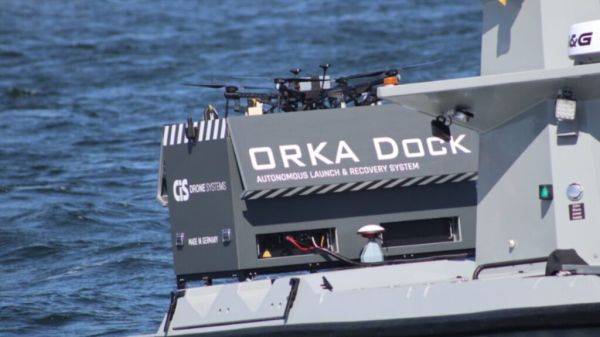
As drone technology improves, it’s becoming more autonomous and ubiquitous, especially across the world’s battlespaces. The Russo-Ukrainian War is evidence of this, as drones have been employed successfully by both sides of the conflict. Ukraine has been especially innovative with its drone technology, developing everything from massive drone swarms to a tiny “aircraft carrier” that’s only a meter long. A new drone technology developed by a German defense contractor takes that concept and substantially improves it for wider use.
CiS Drone Systems developed the ORKA Dock, which works in tandem with the company’s drone system to enable launch and recovery from crewless boats with pinpoint precision. Essentially, it’s a sealed box that can be installed onto the stern of an uncrewed surface vessel (USV). Once it opens, which takes only 30 seconds, it can dispatch drones into the air. What makes the technology impressive is its ability to catch its drones amidst a USV’s constant movement and pitching that would otherwise make recovery challenging, as landing on any moving platform takes precision.
It should be noted that the ORKA Dock is designed only for reconnaissance drones, so it’s not intended for use with one-way attack drones like the ones used across Ukraine and Russia throughout the conflict. When CiS unveiled the technology in May 2026, orders came rushing in to the point that the company is finding it difficult to meet the demand from the world’s navies. That alone demonstrates the necessity that the ORKA Dock provides, and because the tech comes out of a German manufacturer, numerous NATO allies have placed orders.
The ORKA Dock offers expanded reconnaissance functionality
On its own, a USV can be a powerful weapon, but USVs are also ideally suited for intelligence, surveillance, and reconnaissance (ISR). The ORKA Dock offers a significant expansion on a USV’s ISR capabilities by adding a remotely operated airborne option. This would extend the range of a USV’s abilities by turning it into a platform for reconnaissance drones to launch from and return to, which could be of huge benefit to the world’s navies.
The ORKA drone has an endurance of 75 minutes with a range of 62 miles, and because it can return to the dock, it could recharge and be reused from its USV. The drones are designed with specific payloads in mind, including cameras with a 250x optical zoom, integrated AI-powered tracking, thermal imagery, laser scanners, and loudspeakers, making it highly versatile in its capabilities. It also features a tethered mode, allowing for constant operation so long as the tether provides power, though it’s unclear how long the tether is.
Of course, the drone’s most notable capability is its ability to take off and land on moving vehicles, which it can do autonomously, taking the control out of operators’ hands. During its demonstration at SeaSEC 2026, the ORKA Dock operated aboard a FLANQ-Q Recon 24 built by the same German company that co-developed a torpedo-launched drone. The drone completed an automatic launch and recovery cycle numerous times while the USV moved along the waves at a steady 17.3 mph on the Baltic Sea.