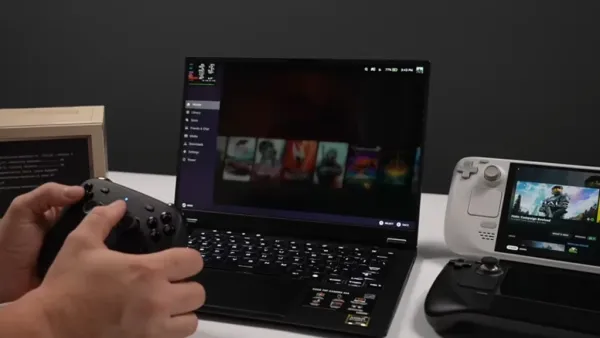
SteamOS has primarily been associated with the Steam Deck, but a new test shows how the operating system performs on a much more powerful gaming laptop. ETA Prime installed SteamOS 3.9 on an ASUS TUF Gaming A14 equipped with AMD’s Ryzen AI Max+ 392 and Radeon 8060S graphics. The results suggest that SteamOS can already provide a console-like gaming experience on modern AMD hardware, though some limitations remain.
The test was carried out on the 2026 ASUS TUF Gaming A14, which uses AMD’s Ryzen AI Max+ 392 processor with 12 Zen 5 CPU cores and integrated Radeon 8060S graphics. The system tested had 32GB of LPDDR5X-8000 memory, with 16GB allocated to the GPU, and a 2560×1600 display capable of running at up to 165Hz.
Rather than using an unofficial operating-system build, the test reportedly started with Valve’s official Steam Deck recovery image before switching to the SteamOS Main branch. Several core features worked without additional configuration, including Wi-Fi, Bluetooth, USB ports, the touchpad and the laptop’s built-in display.
Desktop mode was also functional, with applications available through KDE Discover. This gives the laptop a setup that goes beyond simply launching games and allows it to work as a more traditional Linux-based PC.
The most notable part of the test was gaming performance. The Radeon 8060S managed to run several demanding titles at 1440p, although settings and upscaling varied between games.
Spider-Man 2 averaged more than 80 FPS at 1440p High without FSR. Crimson Desert stayed above 60 FPS at 1440p High with FSR Quality, while Halo Campaign Evolved reached the mid-70 FPS range using High settings and FSR Medium.
Doom: The Dark Ages required FSR Balanced to remain close to 60 FPS at 1440p High. Cyberpunk 2077 also stayed around 60 FPS at 1440p High with FSR 2.1 Quality. Frame generation was disabled during these tests.
The results are notable because the Radeon 8060S has integrated graphics rather than a separate laptop GPU. The Ryzen AI Max+ 392 platform is therefore handling both CPU and graphics workloads within the same system.
Gaming performance was strong, but battery endurance showed a much wider gap between lighter and demanding workloads.
The TUF Gaming A14 has a 73Wh battery. In lighter indie games, ETA Prime estimated between four and seven hours of battery life. Hollow Knight: Silksong, for example, ran at 1200p and 60 FPS while total system power stayed below 16W. The picture changed considerably with demanding AAA games.
Cyberpunk 2077 lasted around two hours and 25 minutes at 800p using the Steam Deck preset and a 60 FPS limit. Increasing the resolution to 1200p reduced battery life to approximately one hour and 40 minutes.
The test used SteamOS’ default power profile without additional TDP controls or further power-management tuning, so the results do not necessarily represent the maximum battery life that could be achieved through additional optimization.
One important detail is the status of SteamOS 3.9 itself. Despite running successfully on the laptop, version 3.9 is still a test build on Valve’s Main channel rather than a stable public release. Valve is also not currently providing regular updates for the system.
That means the test should not be taken as evidence that Valve is preparing an official SteamOS gaming laptop. Valve has not announced such a device. Instead, the experiment demonstrates that the operating system can already operate on modern AMD laptop hardware with relatively little configuration.
The test highlights a potential future for SteamOS beyond dedicated handheld gaming devices. The operating system already offers the Steam Deck-style interface users expect, while its desktop mode provides access to conventional PC applications.
For gaming laptops, this could make SteamOS an interesting alternative to Windows, particularly for users who primarily want a console-like experience. However, hardware compatibility, battery optimisation and support for individual games will remain important factors before SteamOS can become a mainstream laptop option.
The SteamOS 3.9 test on the Ryzen AI Max+ 392-powered ASUS TUF Gaming A14 shows that Valve’s platform can deliver strong 1440p gaming performance on modern AMD hardware. However, battery life drops sharply with demanding games, and SteamOS 3.9 is still a test build. For now, the experiment points to SteamOS becoming a viable option for gaming laptops, rather than signalling an official Valve laptop.