Islamabad: Pakistan and Iran have reaffirmed their commitment to raising bilateral trade to USD 10 billion annually after signing a memorandum of understanding (MoU) and agreeing to accelerate negotiations on a free trade agreement (FTA).
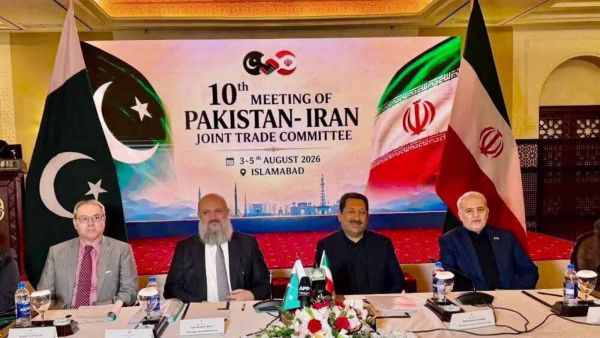
The understanding was reached at the conclusion of the 10th Pakistan-Iran Joint Trade Committee (JTC) meeting in Islamabad on Wednesday, August 5. The session was co-chaired by Pakistan’s Commerce Minister Jam Kamal Khan and Iran’s Minister of Industry, Mine and Trade Mohammad Atabak.
The MoU outlines measures to strengthen economic cooperation through expanded border trade, improved customs coordination, greater maritime connectivity, joint free trade zones and barter trade, while advancing work on the proposed FTA.

Atabak said both delegations had identified practical steps to remove obstacles affecting trade and agreed to fast-track the implementation of existing bilateral commitments. He also called for stronger participation from the private sector to unlock the full potential of commercial ties.
A separate cooperation agreement was signed between the Iran Chamber of Commerce, Industries, Mines and Agriculture and the Federation of Pakistan Chambers of Commerce and Industry to promote business partnerships.
Khan said both countries should move swiftly towards finalising the FTA, stressing that smoother border logistics, efficient cargo movement and modern customs procedures would help increase trade volumes.
He added that extending operating hours at border crossings, developing joint border markets and introducing electronic data interchange would improve cross-border commerce. The minister also said governments must create a stable and business-friendly environment to encourage private investment.
During his visit, Atabak met Prime Minister Shehbaz Sharif, who reiterated Pakistan’s support for expanding economic cooperation with Iran and achieving the USD 10 billion annual trade target.
The two sides agreed to extend operating hours at border crossings, improve logistics, streamline customs procedures and strengthen cooperation in the mining sector, including gemstone processing and value addition.
Sharif also highlighted agriculture and food products as sectors with strong potential for bilateral trade.
Despite sharing a 900-kilometre border, Pakistan and Iran have yet to realise the full potential of their commercial relationship due to sanctions on Iran, banking restrictions, security concerns and infrastructure constraints.
To address these challenges, both countries have expanded border markets, promoted barter trade, upgraded customs facilities and improved transport links through Karachi and Gwadar ports.
Officials said technical discussions on the proposed free trade agreement are continuing, expressing optimism that negotiations can be concluded in the near future.