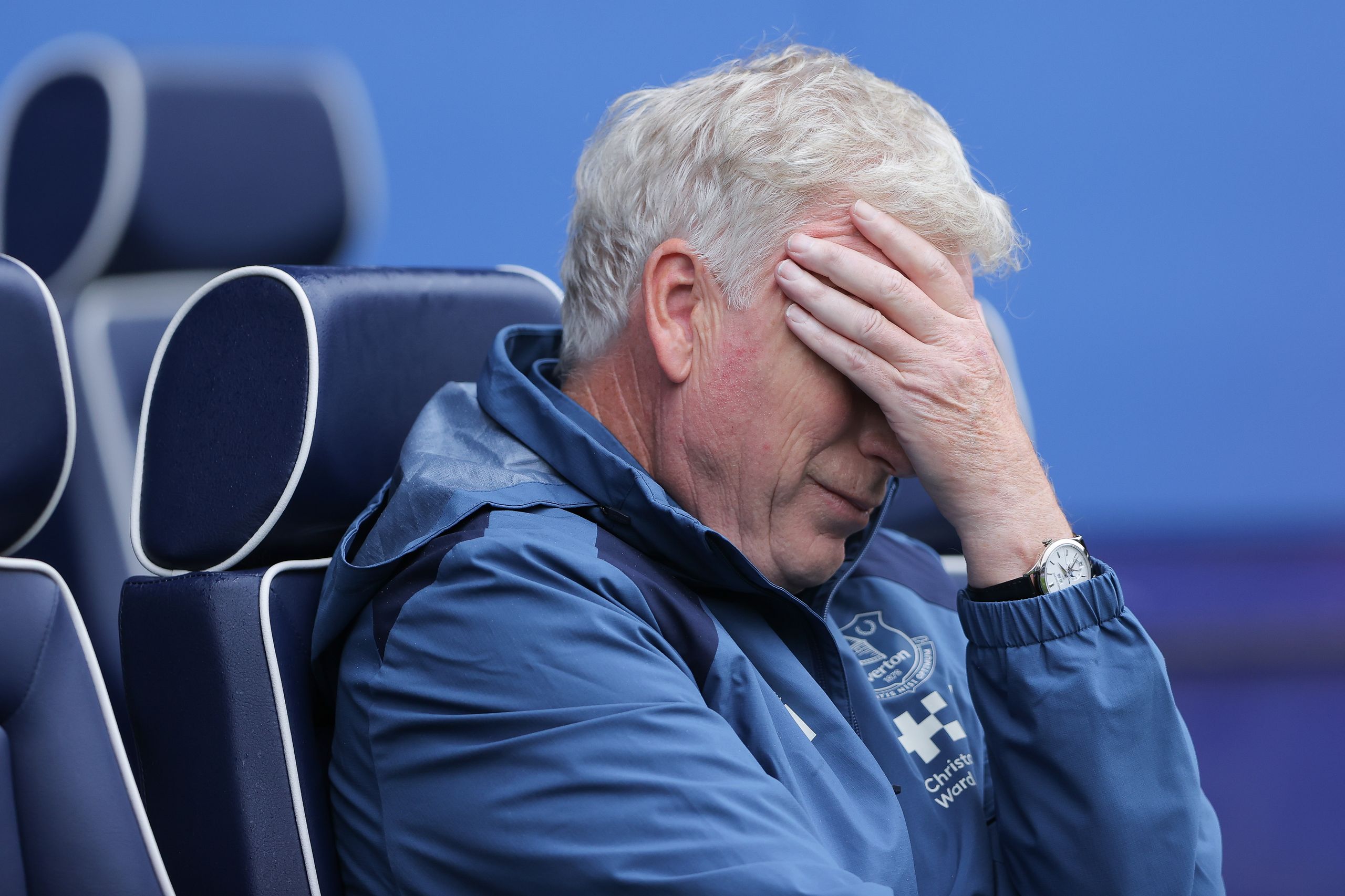
David Moyes’s return to Everton has already reached a stage where it feels like success or failure, with little room in between.
Everton supporters would be forgiven for feeling a sense of possible déjà vu this summer.
With the first anniversary of Everton’s official move to Hill Dickinson Stadium drawing ever closer, an increasingly uneasy atmosphere is building on the banks of the River Mersey.
The shift to Bramley-Moore Dock was meant to be the launchpad for the Toffees’ revival, bringing an end to decades of underachievement that have now included a 31-year wait for major silverware to return to a royal blue shirt. Instead, this famous old club is at risk of drifting into what feels like the Last Chance Saloon.
When David Moyes went back to Everton 19 months ago, the expectation was that he might complete the work begun during his respectable 11-and-a-half-year spell in charge. Securing Premier League survival, while also giving Goodison Park a more suitable farewell than had seemed likely under Sean Dyche, appeared to offer encouragement for what might follow.
The Scot’s first full campaign back in charge brought mixed results, although a strong run in the closing months gave Everton hope of an outside push for European qualification. For a brief period, they even entertained hopes of sneaking into the fifth Champions League spot. However, a last-gasp Merseyside derby loss to Liverpool ended those continental ambitions before Everton then collected only two points from a possible 18 in their final six matches, allowing a number of clubs with smaller profiles and fewer resources to move above them.
Preparations for a stronger season are already under pressure ahead of the opening Premier League clash with Crystal Palace, a club that has enjoyed visible success by embracing ambition rather than shrinking from it. It is hardly unfamiliar territory, particularly given Moyes’s long-standing nickname of ‘Dithering Dave’, yet the promise of a bright new chapter could be fading before it has properly started.
Almost a decade ago, Everton’s former owner Farhad Moshiri warned that the club had only a limited period in which to break up the Premier League’s top-six order, and told supporters he did not want Everton to become ‘a museum’ of English football. The British-Iranian billionaire succeeded in avoiding a house of memories, but what followed instead was a circus, with disorder taking hold both on and off the pitch throughout his tenure.
Moshiri’s scattergun recruitment strategy left Everton burdened with a badly unbalanced squad that looked more and more like Frankenstein’s Monster with each new managerial appointment. Everton’s transfer dealings were so chaotic that Dyche recently labelled his three full windows in charge as ‘a s*** show’. It is hard to avoid the sense that history may be about to repeat itself, with two of the club’s first three summer signings having already spent last season there on loan: Merlin Rohl and Tyrique George, brought in for a combined £36m.
The German midfielder’s return this summer saw him used at right-back in three pre-season friendlies, as Everton’s search for a long-term successor to Seamus Coleman remains unresolved. The poor way in which the club captain’s situation has been handled ought to have acted as a delayed warning after Everton failed to properly solve the gap created by his recurring injury troubles in recent years. Since coming back, Moyes has added a fresh variation to an old theme by deploying centre-back Jake O’Brien in that role, echoing his earlier use of Joleon Lescott in a similar fashion. Nathan Patterson, now the only recognised senior right-back at the club, has effectively been out in the cold ever since he was on the receiving end of a ‘playful slap’ from Dyche during a mid-season training camp more than two years ago.
Everton’s problems, though, go beyond a shortage in defence, as they also need to fill several other areas that remain understocked following Idrissa Gueye’s departure, four years after he returned as the answer to the holding midfield role he had originally left vacant in 2019. The Senegal international’s exit has been made more problematic by the likelihood that James Garner will miss the Palace match while recovering from surgery on a groin problem identified early in pre-season. Another option, Hayden Hackney, last season’s Championship Player of the Year, must meanwhile deal with adapting quickly to a new environment.
Uncertainty over Iliman Ndiaye’s future has intensified amid recent speculation linking him with a move to Al-Hilal. The man who scored the final goal in a men’s match at Goodison Park and the first at Hill Dickinson Stadium has already made it clear that he wants to test himself in the Champions League, something currently beyond Everton’s expected reach. Repeated failed efforts to secure Ndiaye on terms beyond the expiry of his present contract in summer 2029 have only increased concerns that he may not remain for the longer term. A possible £70m transfer fee would normally give Everton significant rebuilding money, but in an increasingly inflated market it would not go as far as the hierarchy, now led by The Friedkin Group, might hope. It would also mean losing their most dangerous attacking outlet.
The Americans, who also own AS Roma, have drawn criticism from sections of the fanbase because of their limited visibility and lack of direct involvement. Nearly two years after taking control, leading figure Dan Friedkin has still not attended an Everton match, home or away, instead leaving various family members to briefly monitor his investment. Some supporters believe their absent owner has little interest in micromanaging affairs on Merseyside in the same way that he and his son Ryan closely focus on developments among the seven hills of Rome. CEO Angus Kinnear’s clumsy end-of-season programme note, in which he said he was ‘happily dissatisfied’ with the club’s current position, did little to ease suspicion that the Friedkins are content with preserving the status quo of simply remaining in the English top flight.
There is also a reluctance to clarify Moyes’s long-term future, with the former West Ham manager now entering the final 12 months of the contract he originally signed in January 2025, and that too points to owners mainly interested in keeping matters stable. Talk of a possible extension, which surfaced during Everton’s late-season upturn, has now gone notably quiet at a time when supporters are desperate for some sign of a longer-term strategy. As the only Premier League club without a director of football, Everton’s recruitment drive is now being shaped by a collective approach in which the 63-year-old has major influence, despite there being no certainty that he will still be in charge over the medium term.
For Everton, breaking the damaging cycle of brushes with relegation was only part of the challenge. If the club fails to correct these basic issues this summer, what may be the last genuine opportunity to return one of English football’s sleeping giants to former heights could easily slip away.