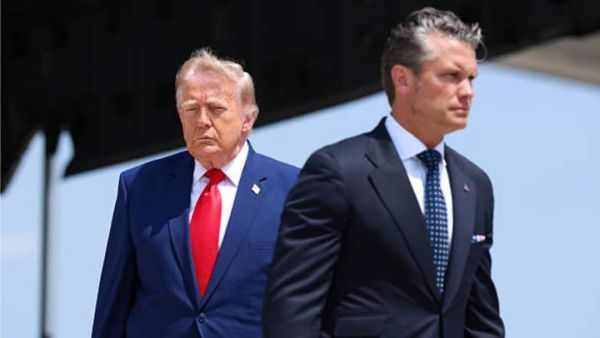
The White House and Pentagon have denied reports that US President Donald Trump clashed with Secretary of War Pete Hegseth over alleged shortages of critical weapons stockpiles during the ongoing conflict with Iran, dismissing the claims as "fake news" and insisting the administration remains united.
The denials came after reports claimed Trump confronted Hegseth during a Cabinet meeting at Camp David over dwindling inventories of key munitions, including long-range guided missiles and air defence interceptors.
White House Press Secretary Karoline Leavitt rejected the account, saying she was present during the meeting. "I was at Camp David with President Trump and Secretary Hegseth. This literally never happened," she said.
She also described the reports as "100 per cent fake news" and said Trump continued to have "the utmost confidence" in Hegseth.
Leavitt later added that "the President loves the Secretary and thinks he's doing a tremendous job."
Trump also publicly rejected reports suggesting the US military was running short of weapons needed for operations against Iran.
Posting on Truth Social, the President said the United States possessed "massive amounts" of ammunition and claimed defence manufacturers were rapidly increasing production.
"Defense companies are building the largest number of plants and factories in our country’s history," he said.
He also threatened legal action against officials accused of leaking information about US military stockpiles.
"The ‘leakers’ of these treasonous statements are being hunted down. Long term jail sentences will be sought!" the US President warned.
The Washington Post, citing two people familiar with the matter, reported that Trump questioned Hegseth after learning that shortages of critical munitions had not been resolved as he had believed.
According to the report, Trump expressed frustration over what was described as "extreme munitions shortages," while Hegseth reportedly defended his handling of the issue and shifted responsibility to Deputy Secretary Steve Feinberg.
CNN separately reported that the US military had "nearly exhausted 80%" of its stock of Terminal High Altitude Area Defense (THAAD) interceptors, with shortages of long-range guided missiles and air defence systems beginning to affect military planning.
The reports also suggested concerns over dwindling stockpiles influenced Trump's decision not to authorise additional large-scale strikes against Iran, even as he continued to warn Tehran of possible military action.
Pentagon spokesperson Sean Parnell rejected both the reported confrontation and claims that Hegseth had misled the President.
He described the allegations as entirely "fictional."
Parnell also said Hegseth would continue serving alongside Deputy Secretary Feinberg while working to strengthen America's defence industrial base and ensure US forces remained fully equipped.
Later on Thursday, Trump again backed Hegseth, writing on social media that "I am extremely happy with the job that Pete Hegseth is doing," while accusing media organisations of spreading "false and completely unfounded rumors."
The concerns over US weapons inventories existed before the current conflict but intensified following heavy use of cruise missiles and tactical ballistic missiles in West Asia. The reported shortages have also affected planning for future military assistance to allies, including Ukraine.
Hegseth had previously attributed existing stockpile deficits to policies under the Biden administration during a Senate hearing in July.
To replenish reserves, Hegseth, Feinberg and Joint Chiefs Chairman General Dan Caine are seeking USD 67 billion in emergency funding as part of a proposed USD 1.5 trillion defence budget currently awaiting congressional approval.