
If you’ve been waiting for AWS to fully open its AI coding tools, this release comes with an asterisk worth reading closely. AWS open-sourced Kiro Crew on August 4 under the Apache 2.0 license, confirmed on Kiro’s own product page and reported by Forbes, DevOps.com, and InfoWorld. Crew turns Kiro from an interactive coding assistant into a persistent agent platform capable of working across sessions, machines, and events, provided the underlying host stays available, but AWS drew a clear line around what actually got open-sourced.
Asked directly during a late-July briefing whether the agent harness itself would also go open source, Deepak Singh, AWS’s Vice President for Agentic AI, was unambiguous with Forbes: “We are not open sourcing the harness.” AWS’s stated strategy, he said, is to standardize on open protocols rather than open implementations.
Rather than treating every task as a single chat exchange, Crew introduces standalone applications built around specific workflows: DevFleets for managing git worktrees, Task Runner for long-running execution, and Issue Radar for repository triage. AWS also provides an SDK for teams building their own applications on top of the platform. Its LaunchDarkly integration illustrates the approach in practice, piping feature flags into the workspace through MCP so agents can discover flag usage and adjust configuration without leaving the development environment.
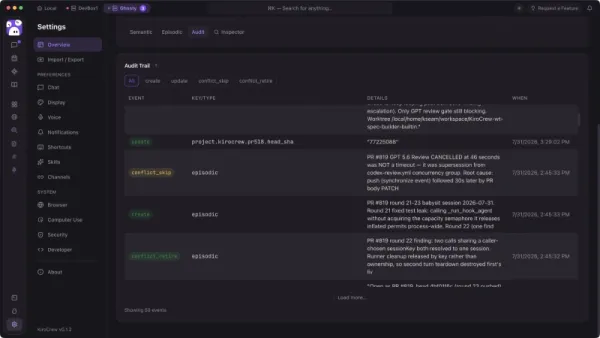
Security got equal billing in the release. Crew includes operating-system sandboxing, deny-by-default command execution, sensitive-path protection, credential redaction, and signed audit logs, with its management dashboard binding only to localhost by default unless a team explicitly configures otherwise.
This is the detail that matters most for anyone evaluating Crew. AWS released the orchestration layer around the agent while keeping the agent runtime itself proprietary, and Crew runs on the Kiro CLI at launch, which is both closed and metered by usage credits. That means the actual harness doing the work is the same proprietary, paid component Kiro has always used; Crew coordinates around it rather than replacing it.
AWS has said Crew supports the Agent Client Protocol specifically so other agents can theoretically be run underneath it, and coverage from SiliconANGLE noted Crew can incorporate skills and configurations from other open-standards harnesses like OpenClaw and Hermes. In practice, though, no one has yet demonstrated a different agent running fully under Crew in place of Kiro’s own CLI. Until that happens, the open part of this release stops at the orchestration layer, not the engine actually executing the work.
Kiro Crew didn’t start as a planned product. It began as an internal side project called MeshClaw, built by three Amazon engineers who wanted a way to kick off a task, walk away, and come back to something reviewable without babysitting prompts the whole time. Built on top of Kiro’s existing IDE harness and CLI, the project grew fast internally: within six months, it reached more than 39,000 Amazon builders, with nearly 500 contributors shipping 597 updates at an average pace of 143 commits a week. AWS CEO Matt Garman has credited that internal growth to builders extending it for their own needs, from on-call rotations to overnight migrations across multiple repositories.
The release lands amid broader enterprise concern over cost control in agentic coding workflows, where continuous, always-on agents can quietly drive up compute and API spend. AWS has reportedly pushed its own employees toward Kiro over third-party tools for exactly this reason, with internal guidance discouraging additional third-party AI development tools.
Making Crew free and open source, while existing customers pay only for the underlying agents and tools they connect to it, gives AWS a lower-friction path to widen Kiro’s footprint without giving away the metered component that actually generates revenue.
The clearest signal to watch for is whether a team outside AWS successfully runs a non-Kiro agent, something like Claude Code or Codex, fully under Crew’s orchestration layer using the Agent Client Protocol, since that would test whether the “open standards, not open implementation” strategy holds up in practice.
AWS has also said it will govern the project through a public steering committee with proposals submitted as pull requests, so how quickly outside contributors are able to meaningfully shape Crew’s direction is worth tracking as the project matures beyond its Amazon-internal roots.