A Deal with Iran over Strait of Hormuz May Require a Compromise from Trump/ TezzBuzz/ WASHINGTON/ J. Mansour/ President Donald Trump may need to accept some Iranian control over the Strait of Hormuz to secure an agreement reopening the critical energy route. Washington opposes Iranian shipping fees, while Tehran insists the strait cannot return to its prewar status as a fully open international waterway. Economic pressure, public opposition to the war and concerns about shrinking U.S. weapons stockpiles could push Trump toward a compromise.
WASHINGTON — President Donald Trump may need to accept a compromise with Iran to reopen the Strait of Hormuz, one of the world’s most important energy routes.
Both governments say an agreement is close, but they remain divided over who will control the waterway and whether Tehran can charge vessels for passage.
A concession could be politically difficult for Trump, who generally presents negotiations as contests with clear winners and losers.
Eliot Cohen, who served as a State Department counselor during President George W. Bush’s administration, said accepting Iranian demands could conflict with Trump’s political identity.
Trump has also denied unfavorable assessments of the economy, opinion polls and military weapons supplies following more than five months of war.
Approximately 20% of the world’s oil normally passes through the Strait of Hormuz.
The Trump administration has rejected any agreement that would formalize Iran’s control over the Persian Gulf waterway.
Washington is particularly opposed to allowing Tehran to charge tolls or service fees to commercial vessels.
Iran insists that it must retain some authority over shipping through the strait.
Tehran says the waterway will not return to its status before the war as an open international passage.
Despite thousands of U.S. strikes, Iran retains the ability to launch missiles and drones against ships, giving it substantial influence over whether commercial carriers consider the route safe.
Continuing restrictions in the strait have helped keep gasoline and other energy prices elevated.
Higher fuel costs create political problems for Republicans ahead of the November midterm elections.
Cohen said the pressure may not make it easy for Trump to publicly accept an Iranian advantage.
David Schenker, a State Department official during Trump’s first administration, said economic pressure could make compromise more likely.
Any agreement allowing greater Iranian control could have long-term consequences for global commerce and freedom of navigation.
Trump has publicly conceded little about the military and economic costs of the war.
He wrote Thursday that the United States still possesses “massive amounts” of weapons and is manufacturing more.
The president also threatened prison for alleged “leakers” who provided information about military stockpiles.
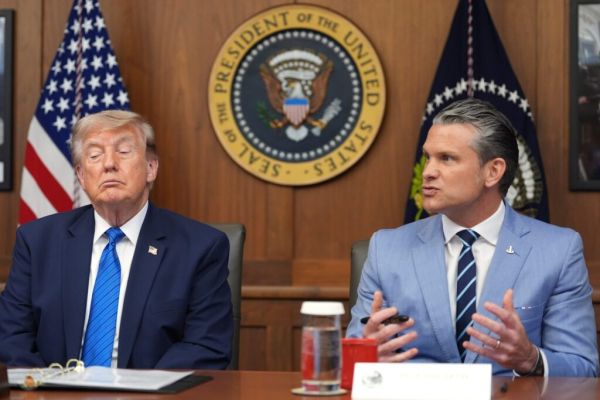
Trump was responding to a Washington Post report describing his frustration with Defense Secretary Pete Hegseth.
The report said advanced weapons inventories had declined significantly during the Iran war.
The issue reportedly arose during a Cabinet gathering at Camp David the previous week.
A senior administration official said Cabinet members had a “robust and healthy” discussion about Iran.
The official declined to provide further details but said there had not been a “knock-down, drag-out fight” over the issue.
The official spoke anonymously to discuss private administration deliberations.
Military specialists say the United States is running short of advanced missile interceptors used to protect American forces against Iranian attacks.
The Center for Strategic and International Studies has published analyses documenting inventory declines using federal budget records and other public information.
Such weapons can require years to manufacture and replace.
When reporters later asked Trump about U.S. weapons inventories, he said “we need more all the time.”
He acknowledged that other categories were “a little bit tighter.”
Trump did not identify which weapons were plentiful and which faced shortages.
Trump insisted that the military remained prepared.
The president said the Pentagon could draw on U.S. weapons stored elsewhere in the world if necessary.
Moving those supplies could reduce resources available for other regional commands and potential conflicts.
Hegseth met privately with Republican senators on Capitol Hill during the week.
He is seeking billions of dollars in additional military spending through a major GOP budget package.
The administration says the funds are needed to replenish stocks and maintain U.S. readiness.
Democratic Sen. Mark Kelly of Arizona, a former Navy pilot, said the weapons shortage resulted from a conflict without a clearly defined goal.
The United States has struck more than 14,000 targets during the Iran war.
He cited employment figures and the “Denuclearization of Iran” among his accomplishments.
Iran’s nuclear program has not been fully eliminated, and public polling presents a significantly less favorable picture of the war.
An AP-NORC poll conducted in late July found that about two-thirds of American adults believed the Iran war had not been worthwhile.
That view was held by overwhelming majorities of Democrats and independents.
Approximately 37% of Republicans also said the conflict had not been worth its costs.
The United States had nearly 159 million nonfarm jobs in June, the highest total on record.
However, hiring growth slowed considerably during Trump’s second term.
The labor market weakened further in July, adding to economic pressure created by high energy prices and the war.
Trump continues to claim that the Strait of Hormuz is open to commercial traffic.
The president pointed to the U.S. Navy’s blockade of Iranian ports and a shipping route monitored near Oman.
Trump acknowledged that Iran could continue attacking vessels or placing mines in the waterway.
Even a small number of attacks can deter shipping companies and insurers from using the route.
At least two vessels were hit in the Strait of Hormuz during the past week, according to Lloyd’s List Intelligence.
Other ships reported near misses or received warnings from entities claiming to represent Iran’s Revolutionary Guard.
Those incidents demonstrate that the waterway remains dangerous despite U.S. claims that it is open.
Vessel traffic increased to 84 transits last week from 45 the previous week.
However, more than 700 vessels typically passed through the strait during a prewar week.
The current volume therefore represents only a small fraction of normal commercial traffic.
The U.S. military maintains that an internationally accessible route remains available near Oman’s coast.
The low traffic volume and recent attacks show that many shipping operators remain unwilling to accept the risk.
The Associated Press reported Wednesday that negotiators were describing the potential agreement as a temporary solution.
Under the proposal, vessels would enter the Persian Gulf using a route controlled by Iran.
Ships leaving the Gulf would use a separate route controlled by Oman.
The arrangement could allow traffic to resume while negotiations continue over a permanent system.
The Trump administration repeatedly said it would not accept an agreement allowing Iran to charge shipping fees.
Tehran has argued for compensation tied to security and environmental services.
A U.S. official said temporary routes would not include tolls, charges or other obstacles.
The official was not authorized to speak publicly and discussed the negotiations on condition of anonymity.
The official said diplomacy remains Trump’s preferred method of resolving the Hormuz dispute.
The official also maintained that the president “holds all the cards” in dealing with Iran.
But Tehran’s ability to threaten commercial ships means that the practical balance may require concessions from both governments before normal traffic can resume.
More on US News