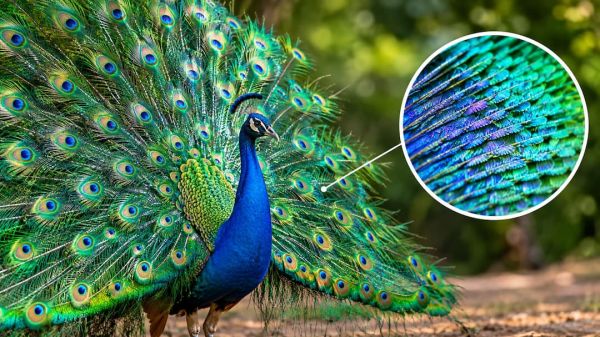
The peacock is often admired for its striking blue-green feathers and elaborate display, but there is much more happening than meets the eye. Its famous tail does not simply owe its appearance to ordinary colour pigments. The microscopic structure of the feathers interacts with light, producing the shimmering effect that can look different as the viewing angle changes. This phenomenon, known as structural coloration and iridescence, is also found in other birds and animals. From its elaborate courtship display to the unusual way its feathers reflect light, the peacock offers an interesting example of how biology and physics work together.
The striking colours of a male peacock's train are linked to the microscopic structure of its feathers. According to the Smithsonian, peacock feathers are iridescent, meaning their appearance can shift depending on the angle from which they are viewed. Instead of behaving like a simple painted surface, the tiny structures within the feathers interact with incoming light. The way these structures are arranged affects how different wavelengths are reflected towards our eyes.
This is why the same feather can appear to change as the bird moves, the light shifts, or the observer changes position. The effect is commonly described as structural coloration. So, calling the peacock a 'biological hologram' may be a dramatic description, but the comparison comes from a real optical effect: the colour we see is strongly influenced by the feather's physical structure.
Structural colour is produced by the physical arrangement of microscopic features rather than colour alone. The Smithsonian explains that iridescence occurs when the structures in feathers interact with light waves, creating different visible colours from different angles. This also explains why peacock feathers have such a distinctive metallic appearance. The male's elongated train contains numerous eyespots surrounded by blue, bronze and green shades, creating the shimmering effect associated with its courtship display.
View this post on Instagram
When a male peacock raises and vibrates its train while displaying to a peahen, the feathers produce a noticeable visual effect. The display is primarily associated with attracting females and showcasing the elaborate train.
Peacocks are not simply carrying around colourful feathers for decoration. Their elaborate train plays an important role in courtship. The male raises the long upper-tail feathers into a fan, displaying the numerous eyespots across the train. Some popular descriptions of peacocks claim that they are specialised snake killers, can digest cobra venom or communicate with females through sounds humans cannot hear. Such claims are often repeated online, but they should not be presented as established scientific facts without reliable evidence.
What science does clearly establish is already fascinating: the peacock's famous shimmer is closely tied to microscopic feather structures and the physics of light. Its appearance can change with viewing angle, giving the bird one of the most recognisable examples of iridescence in nature. The next time a peacock spreads its train, its colours are not simply a matter of paint-like pigments. The microscopic architecture of its feathers is doing much of the visual work.