VnExpress‘s article, “Inside the $8 banh mi at Ho Chi Minh City’s Michelin-starred restaurant,” sparked lively debate, with readers sending in comments expressing sharply different views on the premium version of the baguette.
The sandwich, created by chef Peter Cuong Franklin, owner of Michelin-starred restaurant Anan Saigon, does have premium ingredients such as wagyu beef and an intricately prepared filling served in a smaller loaf than usual.
One netizen commented: “Don’t turn an affordable dish into a luxury item. The art of banh mi lies in its low cost, while still delivering nutrition and great flavor.”
Another said a banh mi with shredded pork skin or sliced pork at small alleyway stalls offers the traditional taste at a price 10 times cheaper. “Working people don’t need banh mi loaded with pork, cold cuts and pate at sky-high prices.”
|
The $8 banh mi at Anan Saigon restaurant in Ho Chi Minh City. Photo by VnExpress/Cong Khanh |
Others, however, argue that the meticulous preparation and premium ingredients justify the price of $8, and that it is not unreasonable for middle- and higher-income customers.
Dr. Le Thi Thanh Thuy, vice rector of the Ho Chi Minh City University of Culture, says such debates over new twists to banh mi or its elevation to a luxury dish are inevitable in the evolution of cuisine.
Innovation is a natural response to the increasingly diverse demands of consumers and the market, she says.
Every new version is created to meet the actual needs of a particular group of consumers, and the market would embrace it if it meets those needs or else would phase it out.
But the banh mi is adaptable, and runs the gamut from cheap street food to versions served in upscale restaurants.
“A high-priced and reinvented banh mi doesn’t take anything away from the traditional version,” Thuy says, arguing there is no single definition of “traditional” in the case of this sandwich.
Cultural researchers think the banh mi evolved from the French baguette, which was introduced in the mid-19th century and gradually became more popular.
Over the following century, Vietnamese localized the baguette into the banh mi of today.
Cultural researcher Nham Hung says: “The vitality of Vietnamese banh mi lies in its cultural exchange and evolution. Its more than century-long transformation into a distinctly Vietnamese dish also reflects the Vietnamese people’s openness to new influences.”
|
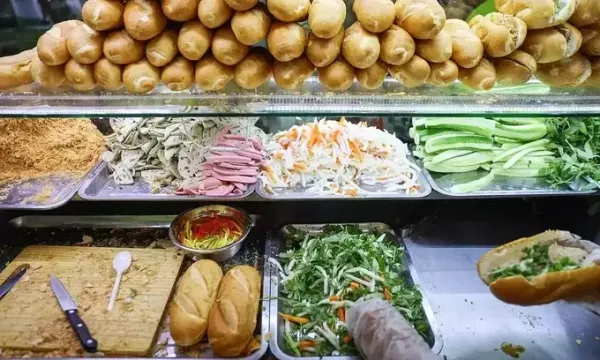
A cold-cut banh mi stall at the Ho Chi Minh City Banh Mi Festival in April 2026. Photo by VnExpress/Tran Quynh |
Franklin’s $8 banh mi is the result of nearly a decade of exploring the Vietnamese baguette from a new perspective.
He says he did not want to replace everyday banh mi, typically priced at $0.8-1.2, but only offer a higher-tier option.
He makes the point that if people are willing to pay $8-10 for a hamburger, banh mi can command a similar, or even higher, price.
“We’re not trying to replicate what’s already out there, but to create something different.”
The 2026 Future Menus report, released in July by Ipsos Vietnam and Unilever Food Solutions, said more restaurants are elevating street food by investing in higher-quality ingredients, refined cooking techniques, and the overall dining experience.
It claimed that 62% of diners are willing to pay more for familiar dishes when they are carefully prepared, meet food safety standards, and are served in a better environment.
Nguyen Ngoc Thach, owner of Nguyen Sinh Bistro – est. 1942 restaurant in Ho Chi Minh City, says an $8 banh mi is not unusual because it targets a different customer segment.
“There is no one-size-fits-all price for banh mi.”
His restaurant too offers a wide range of baguettes, with some priced at more than $10.
Its premium banh mi chao (banh mi with sizzling pan), claimed to be made with expensive ingredients, costs over $13.
Its cold-cut banh mi is presented differently from the traditional stuffed banh mi.
The cold cuts, pate, pickles and sauces are served separately on a plate alongside a baguette, and the dish is priced at $4.5.
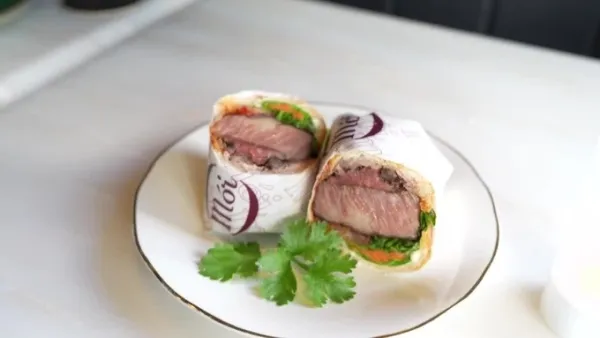
Inside HCMC’s $8 banh mi. Video by Bich Phuong, Cong Khang