Edited by: M Gagnon
The statement issued after this week's meeting in Jordan was blunt about what might happen next.
Israeli infringements on one of Islam's holiest sites, the Al-Aqsa Mosque in east Jerusalem, could lead to "a religious conflict with repercussions that will extend beyond the region and threaten regional and international peace and security," the foreign ministers of 10 countries belonging to the Arab League said after Wednesday's emergency meeting in Amman, Jordan. The statement was also signed by ministers from Indonesia, Pakistan, Turkey, and Malaysia.
Jordan's foreign minister called the meeting because of mounting evidence that the Israeli government is surreptitiously changing a decades-old agreement meant to ensure intercommunal peace at the Al-Aqsa Mosque compound, an area of great religious significance to Muslims, Jews, and Christians.
"We warn that tampering with the status quo … could trigger a religious conflict that will reverberate beyond Palestine and Jordan into the whole Muslim world," Foreign Minister Ayman Safadi told the UK newspaper the Guardian before the meeting.
Israel's Foreign Ministry issued a response, saying the statement was inaccurate and Jerusalem "has never been more open and accessible to worshippers of all faiths."
Al-Aqsa is considered the third-holiest site in Islam, after Mecca and Medina in Saudi Arabia. The compound, also known as the Temple Mount, is also Judaism's holiest site — two Jewish temples are thought to have stood there — and it is also of significance to Christians for its biblical connections to Jesus Christ's life.
Al-Aqsa also bears a lot of political weight because the mosque is seen by many as the embodiment of Palestinian identity, a flashpoint in a city sought as the capital of any eventual Palestinian state.
Because of the site's importance, when Israel first occupied East Jerusalem in 1967, it was deemed in the interests of Israeli national security to keep allowing Muslims to worship there. Jews could only visit and would not be allowed to pray there. Instead Jewish visitors perform religious rituals at the wall below the mosque, known as the Western or Wailing Wall.
Jordan was also allowed to continue its century-old custodianship of the site, and today the mosque is administered by a religious trust called the Islamic Waqf, paid for by Jordan at about $20 million (€17 million) annually. Israeli authorities still take care of security there.
This delicate compromise is known as the "status quo." But recent reports indicate that the situation has been changing.
Residents of Jerusalem say dozens of mosque officials employed by Jordan have been prevented from entering Al-Aqsa this year.
The number of Muslim worshipers halved during 2025, according to Jerusalem-based monitors. More Jewish worshipers are being allowed in and are increasingly overtly performing rituals, something forbidden for decades, including by Jewish religious authorities. The Times of Israel reported in January that police openly let Jewish visitors take printed prayer sheets onto the site for the first time.
In June, there were also reports of an Israeli-US plan to turn the mosque area into a "multifaith center," although US Secretary of State Marco Rubio later denied any knowledge of such a plan.
This is not the first time that the governments of Muslim-majority countries and activists in Jerusalem have issued such warnings.
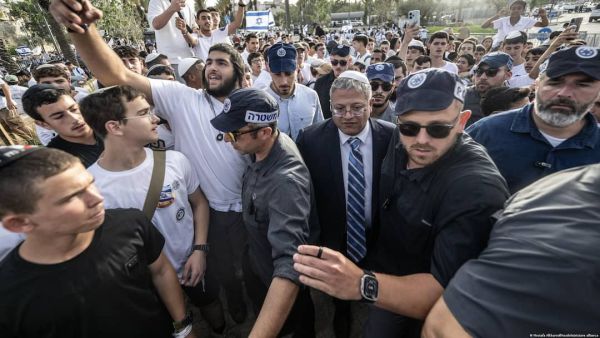
For decades, Jewish fringe groups, often referred to as the Temple Mount movement, have demanded that they be allowed to pray at the site. The most extremist of these groups say they want to demolish the mosque and construct a new Jewish temple.
At first they were mostly ignored, Jerusalem-based lawyer Daniel Seidemann wrote in 2025. Seidemann is the founder of Terrestrial Jerusalem, an organization that tracks such developments in the city. But, he said, that "radical fringe" has become more mainstream. "Over time, the Temple Mount movements, backed by more than 100 rabbis associated with the settler movement in the West Bank, became more visible, more vocal and more provocative," Seidemann said.
"This crisis has been decades in the making," said Omar Rahman, a fellow at the Middle East Council on Global Affairs. "There's been an effort from religious extremists to destroy the Al-Aqsa Mosque since at least the 1980s, when plots to do that were uncovered. But those groups and those ideologies have gained more representation within the Israeli [parliament] Knesset today."
An October 2025 report by the Ir Amim Association, which focuses on Israeli-Palestinian issues in Jerusalem, found that politicians, including from within Prime Minister Benjamin Netanyahu's national-conservative Likud party, frequently break rules around the Al-Aqsa status quo but never face consequences from authorities.
"In practice, Netanyahu allows and normalizes grave breaches of the status quo," the association reported. Yet Netanyahu "continues to declare that his government remains committed to the status quo and nothing has changed."
"It would be very unwise to make any sort of prediction," Joost Hiltermann, a special adviser for the Middle East and North Africa at the Crisis Group think tank, told DW.
But, Hiltermann said, it's essential to consider that "while the fate of Jerusalem as a city may be an overriding Palestinian concern, the fate of the holy sites of Islam in Jerusalem is an abiding global Muslim concern. Not just for the Arab world but also for the largest Muslim countries: Indonesia, Pakistan, Bangladesh. So any Israeli attempt to change the status quo would face a global backlash."
In the past, changes have led to violence. In 2000, Ariel Sharon, an Israeli right-wing opposition leader at the time, visited Al-Aqsa — an event that was seen as one reason for the Palestinian uprising known as the Second Intifada. In 2017, when Israeli authorities erected cameras and metal detectors at the site, it led to deadly protests.
One likely outcome of further infringements of the status quo would be major public protests in Muslim-majority countries. "While the Arab regimes would be reluctant to engage in any sort of confrontation with Israel, their publics will be outraged," Hiltermann said. "The regimes will have to manage that, and they will try to do so by launching vigorous criticism of Israel, not followed by any action — they've become very good at that. The same will be true for Indonesia and others. But all of them may have a hard time controlling domestic fury."
Rahman said the consequences of further Israeli infringement would depend on how radically things changed at Al-Aqsa. "It would trigger a fairly significant reaction, but the extent of it is hard to say," he said. "It could spark a catastrophic religious war or maybe just a diplomatic reaction, or maybe it simply adds to the well of grievance against Israel," he added.
Because Al Aqsa is so important in Islam, it could also make it hard for some countries to resist an upsurge in anti-Israel feeling, even if they might want to, he adds. For example, countries like Morocco and the United Arab Emirates that normalized relations with Israel might feel forced to reverse that.
Because of Al Aqsa's significance to Palestinian identity, the Gaza-based militant group Hamas often says it is defending the mosque. Extremist groups with an Islamist background have also used defense of Al Aqsa to recruit members.
Disclaimer: This report first appeared on Deutsche Welle, and has been republished on ABP Live as part of a special arrangement. Apart from the headline, no changes have been made in the report by ABP Live.