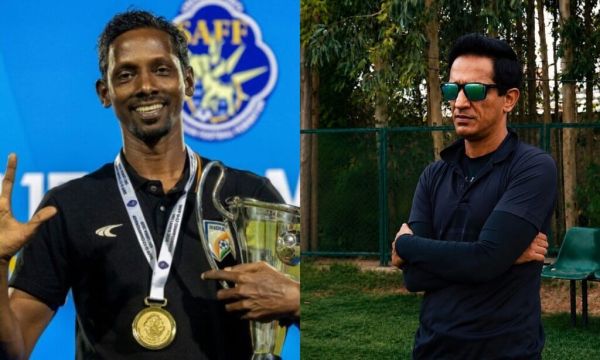
There is a question the All India Football Federation (AIFF) needs to answer before anyone starts debating whether Ranjit Bajaj should lead India’s U-15 team.
What, exactly, was the criteria?
There is something fundamentally strange about the Ranjit Bajaj-Bibiano Fernandes saga that goes beyond the AIFF’s decision making.
It is this: why is the team manager determining, or publicly challenging, the footballing philosophy of a national team in the first place?
That question has been lost amid the noise around Bajaj’s appointment, rejection and subsequent U-turn.
Coaching credentials
Let’s start with the obvious. Ranjit Bajaj is not a qualified national-team coach as per the requirements.
His contribution to Indian football is real. His work in grassroots football is significant. Minerva Academy has become one of the country’s most successful youth football setups, with national and international tournament successes and a long list of players who have progressed into the Indian system.
Bajaj deserves credit for building that ecosystem and for relentlessly pushing youth development into the conversation.
But building an academy is not the same thing as coaching a national team. And owning an academy is certainly not the same thing as being its head coach.
That distinction matters because Bajaj’s public expression of his appointment as Manager of India’s U-15 squad and that of Bibiano Fernandes’ as coach was not simply that the AIFF had failed to consult him. It was that the two men had fundamentally different footballing philosophies.
Bajaj described his preferred approach as aggressive, high-pressing and attacking. He characterised Fernandes’ approach as more pragmatic and counter-attacking, and argued that putting the two together would be a “preparation for disaster”.
But if Bajaj is the team manager, why take the full responsibility for determining how India U-15s should play?
is that not what the head coach is for?
A team manager in football is generally responsible for the operational side of the team: logistics, coordination, administration, player welfare and ensuring that the football staff can function effectively. The head coach, meanwhile, is the person responsible for the team’s footballing identity, tactical approach, training methodology, selection within the technical framework and match preparation.
The exact division of responsibilities can vary between federations and teams, but the fundamental principle should not be interchanged: The coach coaches.
So when a team manager expresses displeasure over an appointment because he does not agree with the head coach’s footballing philosophy, the obvious follow-up question is: what authority is a manager expected to have over playing philosophy?
And if Bajaj was expected to have none, why was this supposed incompatibility apparently such a deal-breaker?
That takes us to the much bigger issue with AIFF’s decision.
A manager’s qualifications
The federation would do a world of good by clarifying a manager’s credentials and role. Not with a statement about youth development. Not with a list of junior trophies won.
But with a response to this: What is the selection criterion for national junior squads?
Because when it comes to coaching credentials, the Bajaj’s comparison with Bibiano Fernandes is not an ideal one in keeping with the roles they have played through their careers.
Fernandes is an AFC Pro-licensed coach who has spent years working inside India’s youth national-team system. AIFF itself described him in 2025 as one of the most successful coaches in the history of Indian men’s youth teams.
He had already led India to three successive AFC U-16/U-17 Asian Cups between 2018 and 2023. He has won the SAFF U-15 title twice, in 2017 and 2019, the SAFF U-17 title in 2022, and the SAFF U-19 title in 2025. By October 2025, AIFF recorded five SAFF age-group titles under his leadership.
And this isn’t merely a coach with a collection of regional trophies.
In December 2025, Fernandes’ India U-17 side qualified for the 2026 AFC U-17 Asian Cup by beating Iran 2-1 in a result ESPN described as a major achievement given India’s historical difficulty against Iran.
Fernandes then took that team into the 2026 AFC U-17 Asian Cup, where India faced Australia and Uzbekistan, two countries with considerably deeper youth football ecosystems. His credentials therefore aren’t theoretical. They have been built through years of actual national-team coaching.
Now put Bajaj’s résumé alongside that.
The 47-year old has not coached a national-team just yet. And there is no public record of him having obtained an AFC coaching license.
That does not mean Bajaj knows nothing about football.
It only means that knowledge of football and qualifications to coach a national team are not the same thing.
But did Bajaj not coach Minerva?
This is another important distinction that tends to disappear in the mythology around the Minerva Academy.
Bajaj founded and runs the successful academy. He is the face of the project. His vision, money, recruitment and organisational leadership have clearly played an enormous role in its development.
That said, he does not run the academy all by himself, but does so by working with a team of professional coaches.
Minerva’s own website specifically highlights Technical Director Surinder Singh and Pradhyum Reddy as Pro-licensed coaches and credits their methods and footballing philosophy for the academy’s development.
Minerva even recommended the pair to help coach the Philippines U-17 women’s team because they were Pro-licensed and aligned with the academy’s playing philosophy.
Transfermarkt’s current staff listing similarly identifies Bajaj as the owner, while Surinder Singh is listed as technical director. That distinction is important.
Bajaj can absolutely say: “This is the footballing philosophy I built at Minerva.”
He can say: “This is how I believe young Indian footballers should be developed.”
He can point to Minerva’s results as evidence that his model deserves attention.
But that still does not automatically make him the person who should be drawing up India’s tactical plan. Not unless the AIFF says so.
And if the argument is that Bajaj has been deeply involved in Minerva’s coaching decisions despite not being the licensed coach, then that raises an even more important question: Why have coaches at Minerva needed professional licenses if those licenses suddenly don’t matter when the same football philosophy is transferred to a national team?
The manager-coach problem
This is where the AIFF’s original appointment needs examining.
The federation selected an experienced, pro-licensed national-team coach as head coach. Then it selected a successful academy owner as team manager.
Then the manager rejected the arrangement because he disagreed with the head coach’s footballing philosophy.
Then, after reports that Fernandes had declined, Bajaj said he was ready to take charge himself.
At that point, the job titles start becoming meaningless. If Bajaj’s role is purely managerial, he would not need to approve the coach’s tactics.
If a manager seeks a say in the tactics, then he or she is effectively functioning as a technical authority.
If he is the technical authority, why was he appointed manager and not the head coach?
And if the AIFF now believes he should actually coach the team, what changed about his qualifications between August 6 and August 8?
India has spent years complaining about the lack of qualified coaches.
The answer cannot simultaneously be that coaching qualifications matter enormously and that, when a sufficiently prominent personality comes along, they suddenly become optional.
Bajaj has something that most Indian football coaches do not: an enormous direct-to-fan communication platform.
He can put out a video, mobilise supporters and get an institutional to act within minutes. That is powerful.
And social media is very good at rewarding certainty. Coaching is very good at exposing it.
You can be a brilliant football administrator, academy builder, talent identifier, communicator or visionary without being the best coach in the room.
And there is nothing diminishing about that. In fact, Indian football needs people like Bajaj.
But Indian football also needs coaches. Qualified coaches.
Coaches who have spent years learning how to structure sessions, develop players, analyse opponents, manage different stages of development and translate a philosophy into an actual training environment.
Where does the problem lie?
This is ultimately not about Bajaj’s philosophy or Minerva, or whether Bibiano’s football is aesthetically pleasing.
It is about whether the AIFF intends to streamline each position in a junior national-team setup with definitive roles.
If Fernandes is the head coach, let Fernandes coach. If Bajaj is the manager, let him manage.
If the federation wants Bajaj’s grassroots expertise, use it. Make him part of the development structure.
Let him advise on talent pathways. Let him contribute to the broader youth programme. There is plenty he could bring to Indian football without pretending that every valuable football personality needs to become a national-team coach.
And if the AIFF genuinely believes Bajaj should be the head coach, then it should explain why. What technical criteria did they used? Who else was considered?
Why did the federation advertise for a head coach and then end up in a situation where the internet is divided about whether the team manager should take over?
The irony is that Bajaj has spent years demanding exactly this kind of accountability from the AIFF. Now, the federation will do well to clarify the same to the fraternity at large.
Because if it does not, this staff selection isn’t a bold new model for Indian youth football. It is simply another AIFF appointment where the designations were decided before the responsibilities were.
(The opinions expressed in this article are solely those of the author and do not necessarily reflect the views or positions of publication)