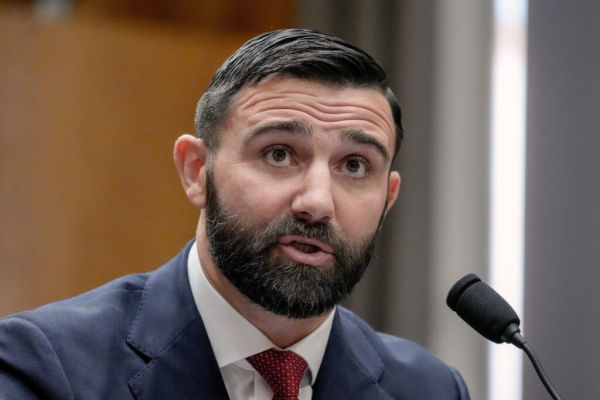
Senate Confirms Cameron Hamilton to Lead FEMA Alongside 73 Trump Nominees/ TezzBuzz/ WASHINGTON/ J. Mansour/ The Senate confirmed Cameron Hamilton as FEMA administrator after he was fired last year for opposing the agency’s elimination. Hamilton will oversee a depleted workforce and the Trump administration’s effort to shift more disaster responsibility to states. The Senate also approved 73 other nominees, including new leaders for the TSA and the U.S. Embassy in Brazil.
The Senate confirmed Cameron Hamilton as administrator of the Federal Emergency Management Agency on Friday, returning the former Navy SEAL to an agency he briefly led before being fired for publicly opposing its elimination.
Hamilton was one of 74 nominees approved by the Senate. The group also included President Donald Trump’s selection to lead the Transportation Security Administration, David Cummins, and his nominee for ambassador to Brazil, Daniel Perez.
Once sworn in, Hamilton will become FEMA’s first permanent administrator during Trump’s second term.
He will take charge of an agency confronting severe workforce losses, more than 1,000 open disaster declarations and continuing uncertainty about how extensively the federal government will participate in future disaster response.
Trump threatened to abolish FEMA shortly after beginning his second term, arguing that states should bear greater responsibility for responding to natural disasters.
Hamilton’s nomination suggests the president may have moved away from eliminating the agency entirely. However, the administration continues to advocate significant changes that could reduce FEMA’s role and shift more financial and operational responsibility to state governments.
Hamilton told senators during his June confirmation hearing that FEMA could not be expected to respond to every emergency and needed to reconsider its role.
The administration argues that federal disaster programs have become overly bureaucratic and that states should handle more routine events, leaving FEMA to respond primarily to the most catastrophic emergencies.
Hamilton will also face questions about whether FEMA applies disaster-relief standards consistently across Republican- and Democratic-led states.
Democrats have accused the Trump administration of politicizing federal disaster assistance.
An Associated Press analysis published in July found that Trump had approved approximately 80% of disaster requests submitted by Republican governors, compared with about 60% of requests from Democratic governors.
During his confirmation hearing, Hamilton promised to support FEMA employees and ensure that disaster decisions were based on neutral standards.
He pledged to make certain that FEMA “objective, is fair and reasonable, follows the law, and is consistent in the approach to how we adjudicate and process claims and requests for disasters.”
Hamilton will be expected to demonstrate that commitment while implementing an administration agenda intended to narrow the federal government’s disaster-response responsibilities.
Hamilton had little professional emergency-management experience when Trump appointed him as FEMA’s temporary leader in January 2025.
He had previously criticized the agency but later said his time inside FEMA gave him a greater appreciation for its mission and workforce.
His tenure ended after he publicly disagreed with then-Homeland Security Secretary Kristi Noem and other department officials who supported eliminating FEMA.
He was dismissed the following day.
That decision to challenge the administration publicly won praise from some emergency-management professionals.
The National Emergency Management Association also welcomed Hamilton’s appointment.
Some FEMA employees remain cautious, however, because Hamilton participated in controversial decisions during his temporary tenure, including the cancellation of a multibillion-dollar grant program intended to improve disaster resilience.
Hamilton takes over during a summer already marked by destructive wildfires and dangerous flooding.
FEMA is currently managing more than 1,000 active disaster declarations, increasing the pressure on an agency that has lost thousands of experienced workers.
More than 4,300 employees separated from FEMA during the 2025 budget year, according to a Government Accountability Office report. More than 1,500 departed through voluntary workforce reductions.
The agency’s instability intensified during Noem’s tenure as Homeland Security secretary. FEMA experienced mass departures, disruptions to grant programs and delays in providing disaster assistance.
Former Oklahoma Sen. Markwayne Mullin, who replaced Noem in March, has reversed some of those policies.
He rehired employees for some positions that had been eliminated and rescinded a requirement that the DHS secretary’s office approve every expense exceeding $100,000.
That rule had contributed to a backlog involving billions of dollars in disaster assistance.
Although Mullin has reversed some of the previous disruption, the Department of Homeland Security continues to introduce policies that have generated controversy.
Twenty-five states and the District of Columbia sued the Trump administration in July over new election-security requirements connected to FEMA counterterrorism grants.
The dispute illustrates the broader political and legal challenges Hamilton will inherit as he takes control of the agency.
At a meeting with governors last weekend, Mullin described FEMA as “bloated” and outlined the administration’s intended shift toward state-led disaster response.
A FEMA Review Council appointed by Trump recommended major changes in May to the way the federal government assists states, territories and tribal governments after disasters.
Some recommendations could accelerate the distribution of aid and simplify complicated federal processes.
Other proposals could reduce how frequently FEMA intervenes and limit the amount of assistance available after certain disasters.
Many of the council’s recommendations would require congressional approval. Hamilton could nevertheless make some administrative changes using the authority already available to the FEMA administrator.
Gaynor said he expected Hamilton to move quickly where possible.
The Senate also confirmed David Cummins to lead the Transportation Security Administration.
Cummins previously served as a senior vice president at government contractor Serco, which operates air traffic control towers at 60 U.S. airports.
He will take over a security agency facing persistent staffing and operational challenges.
A record partial government shutdown earlier this year required TSA employees to continue working for weeks without receiving pay. Thousands of officers called out of work during the funding lapse, while approximately 1,100 employees quit.
Cummins assumes leadership as the Trump administration seeks to cut thousands of TSA positions and expand the use of privately operated airport-security screening.
Daniel Perez, a former speaker of the Florida House of Representatives and a close friend of Secretary of State Marco Rubio, was confirmed as the next U.S. ambassador to Brazil.
His appointment is already at the center of a diplomatic dispute between the Trump administration and Brazilian President Luiz Inácio Lula da Silva’s government.
The State Department said earlier in the week that Brazil’s refusal to accept Perez was a principal reason the United States revoked the visa of Brazil’s ambassador in Washington.
Under international diplomatic protocols, host governments must approve foreign ambassadors before they can formally take up their posts.
Perez’s Senate confirmation therefore does not, by itself, resolve whether Brazil will permit him to serve in Brasilia.
More on US News