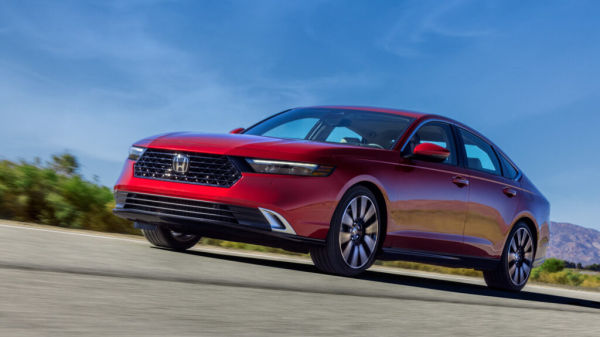
When it comes to America’s best-selling passenger vehicles, the Toyota RAV4 and Honda CR-V have firmly replaced the Toyota Camry and Honda Accord as each brand’s top seller, but that does not mean that the market for those sedans has disappeared. Combined, the two automakers sold well over 450,000 Camrys and Accords in 2025, showing that many buyers are still drawn to these spacious, fuel-efficient, and relatively affordable four-door sedans.
Given their long history, it’s not surprising that both the Accord and Camry are ranked among the best family sedans on the market. Compared head-to-head, there are many reasons one might choose one over the other, including differences in MSRP, powertrain options, and fuel economy ratings. Resale value, however, is not one criterion that should sway a buyer either way.
Both models generally hold their value well; in fact, neither the Accord nor the Camry has a substantial advantage when judged by the common five-year deprecation metric. Per one source, the Accord has a very slight edge in average deprecation, but likely not enough to outweigh other specs.
Evenly matched in all ways
Let’s start with CarEdge’s five-year resale numbers for both sedans. It’s a dead heat here, as the Camry and Accord both have the same 36% depreciation figure after five years. Another trusted source for depreciation numbers is iSeeCars, and it shows the Accord with a slight advantage at 30.3% depreciation after five years, compared to 34.3% for the Camry.
However, iSeeCars also maintains separate data for the Accord Hybrid, with that version showing a higher depreciation figure of 36.5%. If you were to average those two different Accord numbers, the depreciation would be very close to that of the Camry. On that same note, Kelley Blue Book’s data shows that five-year-old examples of the Accord and Camry both rank within the top 10% of all 2021 sedans in terms of resale value.
When comparing the current versions of both sedans, it’s important to consider that while the Camry has a slightly higher base price than the Accord, the Camry now has a standard hybrid powertrain on all trims. Honda still offers the Accord with both hybrid and non-hybrid engines and charges a several-thousand-dollar premium for the former. Also of note is that the Camry can be optioned with all-wheel drive, while the Accord cannot. This isn’t to say that one powertrain or trim level is necessarily better, but these options are sure to influence real-world resale values between the two models in a way that overall averages might not show.
No wrong choice?
Exact resale differences will, of course, vary greatly based on a specific car’s options and the regional and national market conditions at the time. Still, based on the overall numbers, it’s difficult to declare one of these models a clear winner in terms of projected resale value.
Used-car retail listings are another way to compare to the real-world values of comparable models — but these don’t really change the picture either. Looking at CarMax listings for similar base trims of both cars, a 2021 Accord Hybrid with 65,000 miles has an asking price of $26,000, while a comparable 2021 Camry Hybrid LE with 58,000 miles has the same $26,000 asking price. Obviously, specific used prices will vary from dealer to dealer and car to car, but these listings show you shouldn’t expect comparable examples of either car to differ significantly in price.
The current Honda Accord impressed us with its smooth and efficient powertrain, while Toyota has done a great job refining the Camry and its standard hybrid setup. These two Japanese mid-size sedans have always competed extremely well against each other, and it’s not a big shock to find that they are evenly matched in resale value too.