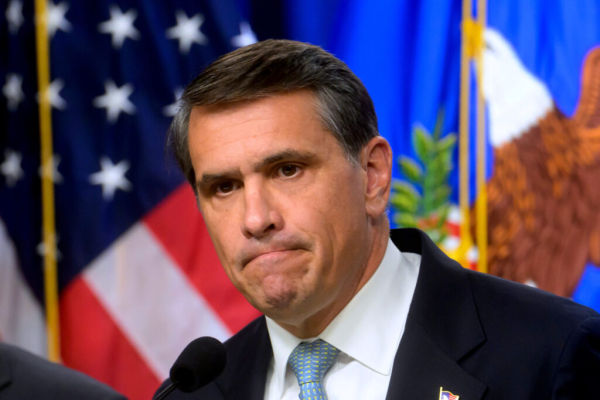
Senate Confirms Todd Blanche as Attorney General in Narrow 50-49 Vote/ TezzBuzz/ WASHINGTON/ J. Mansour/ She Senate narrowly confirmed Todd Blanche as attorney general in a 50-49 overnight vote, placing Trump’s former criminal defense lawyer permanently in charge of the Justice Department. Two Republicans joined every Democrat in opposition amid concerns about Blanche’s loyalty to Trump, investigations of political opponents and a controversial IRS settlement. Blanche secured the decisive vote after promising to abandon a $1.8 billion compensation fund and narrow tax audit protections for Trump and his family.
WASHINGTON — The Senate narrowly confirmed Todd Blanche as attorney general early Saturday, placing President Donald Trump’s former personal lawyer permanently in charge of the Justice Department.
The Republican-controlled Senate approved the nomination 50-49.
Blanche becomes Trump’s second Senate-confirmed attorney general since the president returned to office in 2025.
Blanche had already been running the department as acting attorney general.
Senate confirmation removes the temporary nature of his position and could give him greater authority to implement Trump’s law enforcement agenda.
Trump returned to the White House openly promising to use the Justice Department to investigate people he considers political enemies.
After the vote, Blanche thanked the president and lawmakers in a social media post.
Blanche also said he was “grateful” to senators who remained at the Capitol late to complete his confirmation.
Blanche was confirmed by the narrowest possible margin.
Republican Sens. Susan Collins of Maine and Lisa Murkowski of Alaska joined all Senate Democrats in voting against him.
Their opposition reflected concerns about Blanche’s independence, his relationship with Trump and controversial decisions he made while serving as acting attorney general.
The bruising confirmation battle revealed deep anxiety about placing one of Trump’s closest legal allies at the head of the country’s chief federal law enforcement agency.
The Justice Department has traditionally sought to maintain independence from direct political control by the White House.
Critics fear Blanche will prioritize Trump’s personal and political interests over the department’s institutional responsibilities.
Blanche’s path to confirmation became especially difficult because of the Justice Department’s settlement of Trump’s lawsuit against the Internal Revenue Service.
The agreement included a proposed $1.8 billion fund to compensate Trump allies who claimed they were mistreated by the criminal justice system.
Potential beneficiaries included people involved in the Jan. 6, 2021, attack on the U.S. Capitol.
The IRS agreement also offered Trump and members of his family protection from some tax audits.
Republicans and Democrats questioned the legality and scope of those protections.
The settlement raised concerns that the president was using control of the executive branch to secure favorable treatment from a federal agency he oversees.
Under pressure from Republican senators, Blanche formally promised in writing to abandon the $1.8 billion “Anti-Weaponization Fund.”
The Justice Department also clarified that the tax audit agreement applied only to claims open when the settlement was reached.
It does not prevent the IRS from examining Trump’s future tax filings.
Republican Sen. Bill Cassidy of Louisiana announced Friday morning that he would support Blanche.
His decision supplied the crucial vote needed for confirmation.
Cassidy said another nominee might not be able to manage the Justice Department more effectively under Trump.
Cassidy argued that Blanche’s previous work as Trump’s criminal defense lawyer could make him better able to push back against legally improper presidential demands.
Because Trump trusts Blanche, Cassidy suggested the new attorney general might have more influence when explaining the limits of federal law.
“This is not a referendum on President Trump. It is a decision regarding Mr. Blanche in very specific circumstances,” said Cassidy, who lost his primary this year to a Trump-backed challenger.
Democratic Sen. Dick Durbin of Illinois, the highest-ranking Democrat on the Senate Judiciary Committee, urged lawmakers to reject Blanche.
He called the confirmation a “serious mistake” and asked senators not to place themselves on the “wrong side” of history.
Questions about Blanche’s loyalty to Trump remained central throughout the confirmation fight.
Trump elevated Blanche to acting attorney general after firing Pam Bondi in April.
Once in control, Blanche accelerated investigations involving Trump’s perceived opponents and advanced other White House priorities.
Trump dismissed Bondi after she failed to produce successful criminal cases against people the president considers political enemies.
Her removal reinforced concerns that Trump expects the attorney general to deliver personal retribution.
Blanche’s confirmation now tests whether he can meet Trump’s demands while operating within legal and constitutional limits.
The controversial IRS settlement nearly ended Blanche’s nomination.
Republican Sens. John Cornyn of Texas and Thom Tillis of North Carolina threatened to withhold their support.
They demanded written assurances that the compensation fund would not proceed and that the tax protections would be narrowed.
Blanche formally rescinded the fund as part of an agreement with Cornyn and Tillis.
The compromise allowed the Senate Judiciary Committee to advance his nomination earlier in the week.
Without those concessions, Blanche might not have secured enough Republican votes to reach the Senate floor.
The written agreement did not persuade every Republican.
Murkowski announced Friday that she would join Collins in opposing the nomination.
Murkowski expressed doubt that Blanche would provide that independent restraint.
Before representing Trump, Blanche worked as a federal prosecutor in New York.
He later became nationally prominent as a leading member of Trump’s criminal defense team.
Blanche represented Trump during his New York hush money trial and in two federal criminal cases brought by the Biden administration’s Justice Department.
Blanche has said his experience defending Trump gave him a direct view of what he considers the weaponization of the criminal justice system.
That perspective has shaped his approach to the Justice Department.
Supporters say it motivates him to correct political abuses, while critics say it encourages him to use federal power against Trump’s adversaries.
Blanche joined the Justice Department in 2025 as deputy attorney general under Bondi.
He supervised the department’s daily operations and became its public face during several high-profile controversies.
Those matters included the release of millions of investigative records involving disgraced financier Jeffrey Epstein.
Democrats accuse Blanche of placing allegiance to Trump above the Justice Department’s independence.
They cite investigations targeting former FBI Director James Comey and other perceived presidential opponents.
They also object to the broader restructuring of a department that historically tried to maintain distance from White House political pressure.
Thousands of Justice Department employees have departed under Bondi and Blanche.
The losses occurred through dismissals, resignations and voluntary separation programs.
Critics say the departures have damaged morale, reduced institutional knowledge and weakened resistance to political pressure.
Blanche’s allies say his prosecutorial background and personal relationship with Trump make him more qualified than Bondi.
They argue that his credibility with the president could help him explain why certain demands cannot legally be carried out.
Supporters also say his courtroom experience gives him a realistic understanding of what prosecutors can prove.
Republicans have highlighted Blanche’s efforts to reduce violent crime and increase immigration enforcement.
They also praise his work targeting drug trafficking and violent cartels.
Those priorities closely match the law enforcement agenda Trump promoted during his campaign and second term.
Senate Judiciary Committee Chairman Chuck Grassley strongly supported the nomination.
He said Blanche had led the department effectively while serving in an acting capacity.
It remains unclear whether Blanche can deliver the prosecutions Trump wants.
Bondi encountered resistance from judges, grand juries, prosecutors and other Justice Department employees.
Establishing criminal conduct against one Trump opponent after another proved more difficult than the president’s public demands suggested.
Shortly after Blanche took control, the Justice Department moved to indict Comey.
The charges accused the former FBI director of threatening the 47th president by posting a social media photograph showing seashells arranged as “86 47.”
Comey’s attorneys are asking a court to dismiss the case.
Comey’s defense team accuses the Justice Department of misleading judges and submitting documents containing false statements.
The lawyers also allege that prosecutors withheld important facts while seeking the indictment.
The outcome could become an early test of the credibility and legality of Blanche’s approach.
Blanche also appointed Joseph diGenova, a former Reagan-era Justice Department prosecutor, to oversee an investigation based in Florida.
The inquiry is examining whether former intelligence and law enforcement officials conspired during the past decade to undermine Trump.
It remains uncertain whether investigators will uncover evidence supporting criminal charges.
More on US News