For many companies, duplicating a microSD card sounds like a straightforward process: create a master card, copy the contents to multiple cards and ship them with the product.
That is still how plenty of microSD duplication jobs work. But embedded systems, navigation products, industrial equipment and other specialized applications are creating a different requirement. Manufacturers increasingly need to do more than place identical files onto a stack of memory cards. They may need to identify individual cards, generate unique data for each card, lock content against modification or associate protected data with a specific piece of media.
This is where a professional microSD duplicator starts looking less like a copying machine and more like a provisioning system.
Every microSD card contains a Card Identification register, usually referred to simply as the CID. The CID contains information used to identify the card at the hardware level.
For ordinary file duplication, the CID isn’t particularly important. Copy a folder containing images, firmware or configuration files to 500 cards and the files can be identical.
Things become more interesting when an application uses the identity of the card itself.
Navigation and mapping systems are a good example. A manufacturer can distribute map content on microSD media while using information associated with the individual card as part of its content-protection scheme. Rather than treating every microSD card as interchangeable storage, the application can associate encrypted or protected content with the identity of a particular card.
That makes duplicating the files only one part of the production process.
A production system may need to read the CID, record it, generate information based upon it and then stream unique data to that particular card. The next card receives its own data, and the process continues across an entire production run.
This type of workflow is considerably different from making 16 identical copies of a master card.
There is an important distinction here because the two capabilities are sometimes confused.
A system designed for CID-aware production can read the CID value from a standard microSD card. That can be useful for logging, validation, serialization or applications in which software needs to know the identity of the media.
Changing the CID is another matter.
The CID register on normal retail microSD cards is programmed by the card manufacturer and is not generally rewritable. CID programming therefore requires microSD media specifically designed to support that capability.
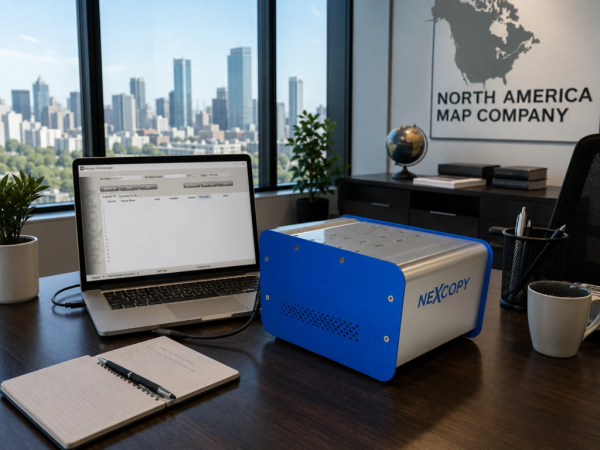
Nexcopy’s PC-based mSD160PC microSD card duplicator takes an unusually deep approach to this problem. The system can read CID values from standard microSD cards, while CID programming is available when used with Nexcopy-qualified programmable media.
That combination makes the system useful for applications where the memory card is part of the security or authentication architecture rather than simply a place to store files.
Perhaps the more interesting capability is unique data streaming.
Traditional duplication starts with one master and produces many identical targets. Unique data streaming allows the production process to modify what is written to each individual card.
Imagine producing microSD cards for a navigation system. Every card might contain the same underlying map database, but a portion of the information written to each card can be generated specifically for that card. The production software can read the card’s CID, use that value as part of the provisioning process and stream the appropriate unique data to the media.
The result is a production line capable of creating individually provisioned cards without abandoning the efficiency of multi-target duplication.
Similar techniques can be useful for embedded products, industrial equipment, software distribution, device configuration and other applications where manufacturers need to know exactly which card went into which product.
Logging also becomes considerably more valuable in this environment. Instead of simply knowing that a batch of cards was copied successfully, a manufacturer can maintain production information associated with individual pieces of media.
None of this means every duplication job needs a computer-controlled provisioning system.
Companies producing identical microSD cards may be better served by a standalone duplicator. These systems operate without a PC and are designed around the traditional master-to-target workflow. Insert the master, insert the blank cards and run the duplication job.
For larger production runs, Nexcopy offers standalone configurations with as many as 31 target slots. These standalone systems are designed for high-volume duplication rather than CID reading, CID programming or unique-data provisioning.
For applications requiring those more advanced functions, the PC-based mSD160PC provides 16 target positions along with software-controlled capabilities for CID operations, unique data streaming and production logging.
This distinction is useful because the best microSD duplicator isn’t necessarily the machine with the largest number of sockets. It is the one that matches what needs to happen to each card.
There are plenty of inexpensive devices capable of copying one microSD card to another, and for simple jobs that may be all that is required.
The situation changes quickly once microSD cards become part of a manufactured product.
Production quantities, verification, traceability, unique data, CID handling and hardware-level data protection introduce requirements that aren’t addressed by ordinary card readers or basic cloning equipment.
Nexcopy’s microSD duplicator platform stands out as one of the most feature-rich solutions in this specialized category because it covers both sides of the problem. Standalone systems handle straightforward high-volume duplication, while the PC-based mSD160PC addresses considerably more sophisticated provisioning workflows.
For companies distributing maps, embedded software, configuration data or other protected content, that distinction can be significant. The objective isn’t always to make hundreds of identical microSD cards.
Sometimes the objective is to make hundreds of cards that are almost identical, while giving each one its own identity.