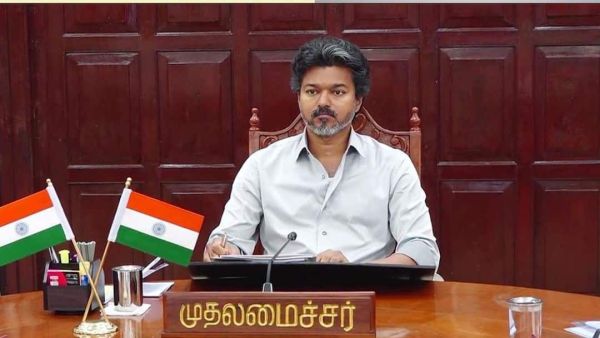
Tamil Nadu's Legislative Assembly has passed another resolution challenging the Centre's proposed delimitation exercise, with Chief Minister C Joseph Vijay arguing that changes to parliamentary constituencies must not reduce the political representation of states that have successfully controlled population growth.
The resolution, moved by Vijay on Wednesday, also called for the immediate implementation of the 33% reservation for women. The latest move adds to the Tamil Nadu government's earlier opposition to issues including NEET and the FCRA Bill.
Speaking in the Assembly, Vijay said the women's quota should come into force in the 2029 Lok Sabha election itself, rather than being postponed until after a fresh delimitation exercise.
Vijay said: "The 33% reservation for women should be implemented in the 2029 Lok Sabha elections itself, based on the existing 543 constituencies. The 33% reservation for women should not be delayed any further. In Tamil Nadu, more women have voted than men. Providing reservation for women is not a concession; it is a matter of social justice. The 33% reservation for women must be implemented without any further delay."
The Chief Minister's argument places women's representation and the delimitation debate side by side, with the state seeking to ensure that the two issues do not become linked in a way that delays the quota.
A key concern raised by Tamil Nadu is that using population figures to redraw constituencies could alter the balance of parliamentary representation between the northern and southern parts of the country.
The resolution argued that states such as Tamil Nadu should not be penalised for implementing population-control measures successfully over several decades.
"All the states including Tamil Nadu and the people / elected representatives of the union territories have not had their population counted for more than 50 years. The next census to count the population was supposed to be held in 2026. Therefore, since the delimitation of constituencies has not been carried out for the last 50 years, based on the 2011 population census, the constituencies should be delimited and the number of Lok Sabha and Assembly members should be increased from 550 to 850 by bringing in a constitutional amendment Bill," he said, as per ANI.
The resolution further raised concerns about the basis that could ultimately be used for determining representation.
"It has been understood that the above-mentioned constitutional amendment Bill has been brought in the Indian Parliament on the basis that the 1971 population census will continue to be the basis for any population count thereafter. Even though Tamil Nadu has built a strong Tamil Nadu by effectively implementing population control measures on the basis of the 1971 population census, the representation of the southern states including Tamil Nadu in Parliament will be permanently affected," he added.
The latest resolution comes against the backdrop of an ongoing political dispute over the proposed expansion and redistribution of parliamentary seats.
The Constitution (131st Amendment) Bill, which sought to remove the existing freeze on increasing Lok Sabha seats, was defeated in April following opposition from multiple parties. The proposed legislation had envisaged using the 2011 Census as the basis for a future delimitation exercise.
Southern states have repeatedly objected to a system in which population growth becomes the primary factor in deciding parliamentary representation. Their argument is that states that invested in population stabilisation could lose political weight relative to states where population growth has been considerably higher.
The issue has gained renewed attention with the Centre reportedly working to build political support for a constitutional amendment connected to delimitation and women's reservation. There has also been speculation that the government could bring the legislation before Parliament during the concluding days of the Monsoon Session.
The resolution sets out three major positions for the state.
First, Tamil Nadu has demanded that the existing 543 Lok Sabha constituencies be retained permanently. Second, it wants the current allocation of parliamentary seats among states to remain protected. Third, the state has called for a 33% quota for women in state legislative assemblies.
Taken together, the demands seek to separate women's reservation from any immediate redistribution of parliamentary seats while protecting the political representation of states such as Tamil Nadu.