Hyderabad: Thirty-six years may not be a very long period in the life of an institution. But it is certainly long enough to show whether a dream has acquired direction, whether an experiment has survived the test of time and whether an institution has remained true to the vision with which it began.
By that yardstick, the journey of the MS Education Academy is a story of sweat, grit and persistence. What began as a modest two-room coaching centre in 1991 has grown into a sprawling educational network with 163 institutions, 33,000 students and a growing presence across Telangana, Maharashtra, Delhi and Uttar Pradesh.
The journey has been neither accidental nor effortless. Its success has been built brick by brick through determination, discipline and, at times, the courage to confront criticism.

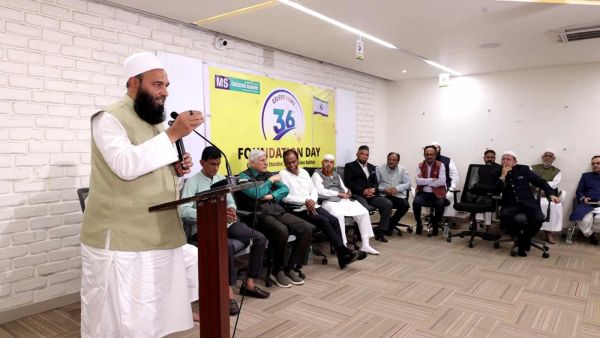
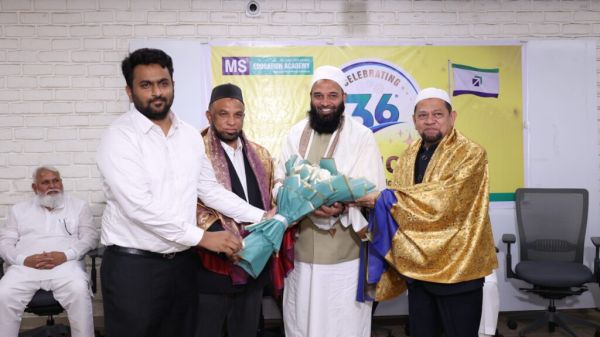
As the MS Education Academy celebrated its 36th Foundation Day recently, its founders, teachers, students, well-wishers and distinguished guests took a walk down memory lane. The gathering included Indian Administrative Service (IAS) and Indian Police Service (IPS) officers, doctors, entrepreneurs, academicians, NRIs, journalists and social workers — people from diverse walks of life who have witnessed the institution’s evolution.
When Mohammad Lateef Khan, MS founder-chairman, and a group of like-minded people embarked on their educational journey on August 10, 1991, their objective was both simple and challenging: to provide quality and affordable modern education to the community without compromising on Islamic values.
It was a proposition that resonated with parents.
Over the years, MS came to be seen as an institution that attempted to bridge two worlds — modern education and religious values. In an environment where parents often worry about the influence of external factors on their children’s faith and identity, this became one of the academy’s biggest strengths.
The confidence it enjoys among parents was reflected in an anecdote shared by MA Majeed, proprietor of Pista House. “I faced no difficulty in getting a good alliance for my daughter. The moment it was told that she had studied at MS, the marriage was fixed,” he said.
The remark elicited laughter and applause.
But amid the applause came a reminder that no institution should become complacent. Mustafa Ali Sarvari, a faculty member of Maulana Azad National Urdu University (MANUU), struck a discordant note when he raised questions about the academic standards of the institution and the wider social challenges facing the community.
He wondered why hundreds of highly educated girls continued to struggle to find suitable marriage alliances. While acknowledging that MS had done well, he felt the institution had considerable ground to cover in improving its academic standards.
“Most parents, including myself, sent their wards to this institution because it took care of their Islamic beliefs,” he observed.
The criticism, however, was not seen as an affront. Rajen Habib Khwaja, retired IAS officer, put it in perspective. “Self-criticism is essential for the development of any institution.” He summed up MS management’s determination with this couplet:
Hum ne ek shaam charagon se saja rakhi hai
Shart logon ne hawaon se laga rakhi hai
That perhaps was one of the most important lessons from the Foundation Day celebrations. Institutions grow not merely through praise but also through the willingness to listen, introspect and improve.
There is little doubt that MS has come a long way since 1991. The numbers are impressive, both in terms of students and institutions. But it is the achievements behind those numbers that have given MS its reputation.
The story of Ayesha Fatima remains etched in the institution’s history. In 2005, she secured 985 marks in Intermediate, an achievement that became a benchmark for MS students. This year, Hafsa Begum raised the bar even higher, scoring an extraordinary 997 out of 1,000.
For an institution that began with modest resources, such academic accomplishments are significant. The record of professional achievements is equally noteworthy.
According to the institution, 2,116 MS students have secured merit-based MBBS seats. Another 211 have gained admission to IITs, NITs and other premier institutions. The MS Academy has also produced 154 chartered accountants, four Union Public Service Commission (UPSC) civil servants and more than 50 Group I and other senior government officers.
And there is another number that reflects the other half of the MS philosophy: 481 Huffaz, or students who have memorised the Quran.
For MS, these figures are not merely statistics. They represent an attempt to combine academic achievement with moral and spiritual grounding. The true success of education lies not merely in producing professionals but in producing responsible human beings.
Lateef Khan, the man who spearheaded the MS initiative, has never claimed sole credit for its success. At the Foundation Day celebrations, he recalled the contribution of several individuals who encouraged and supported the institution during its early years.
He specifically remembered Siasat newspaper and its late Managing Editor Zaheeruddin Ali Khan. “The Siasat newspaper was a launching pad for us. Particularly, Zaheer sahib encouraged me a lot.”
He also acknowledged the contribution of KM Arifuddin of Madina Education Centre and his own teacher, Fareed sahab. Such acknowledgements are significant because institutions are rarely built by one person. Behind every successful organisation are teachers, administrators, parents, supporters and well-wishers who invest their time, trust and energy in its growth.
Yet, the MS story is not about looking back alone. The academy has set itself an audacious target — to establish 2,036 institutions by 2036. It sounds very ambitious. But Lateef Khan does not appear intimidated by the scale of the challenge.
“A tall order but not impossible,” he says.
Former police commissioner AK Khan suggested another direction for the institution: introducing professional courses in law and chartered accountancy. Both, he felt, had immense employment potential. The management took the suggestion in right earnest as it prepares for its next phase.
Expansion brings its own challenges. The bigger an institution becomes, the greater the responsibility to maintain academic quality, professional standards and individual attention. Growth in numbers must not come at the cost of quality.
That may well be the central challenge before MS in the years ahead.
Looking back, the MS journey is a story of dreams, milestones, values and perseverance. But perhaps the most significant achievement is the confidence that MS has managed to build among a section of the community — confidence that modern education and religious values need not necessarily be mutually exclusive.
The target of 2,036 institutions by 2036 is ambitious. So is the task of ensuring that every new institution matches the standards and vision of those that came before it.
That will require the same qualities that sustained MS through its first 36 years: hard work, discipline, innovation, self-criticism and an unwavering belief in the dream.
As Anwar Ahmed, Managing Director of MS Education Academy, aptly summed up the institution’s philosophy: We don’t FEAR. “We Face Everything and Rise.”
It is more than a slogan. It is, in many ways, the story of MS itself.