There was a time when the car market worked on a simple principle: pay more and you got more. Costlier variants in a model line usually came with bigger engines, often with more cylinders as well. In today’s downsizing era, that logic no longer always applies. The standard Hyundai Palisade uses a naturally aspirated 3.5-litre V-6, but the higher-ranking Palisade Hybrid gets a turbocharged 2.5-litre inline-four working alongside two electric motors. The hybrid is both more powerful and more efficient, and it is also the best choice in the range.
The Lowdown
Hyundai clearly does not want prospective buyers to feel short of options. Shoppers looking for a three-row SUV can choose from several alternatives, including the more affordable Santa Fe and the all-electric Ioniq 9 EV, alongside the more premium Palisade. In the Palisade Hybrid, the turbocharged four-cylinder produces 258 hp and 260 lb-ft on its own and teams up with a high-voltage hybrid system featuring two electric motors. The stronger of the two, rated at 72 hp and 199 lb-ft of torque, drives through the six-speed automatic transmission, while the second serves as a starter-generator.
The Palisade Hybrid is not a plug-in hybrid, so its 1.65-kWh battery cannot be charged from an external socket. Even so, the electric side of the powertrain is strong enough to lift total system output to 329 hp and 339 lb-ft. Buyers can choose between front-wheel drive and all-wheel drive, with the latter—tested here—bringing a small penalty in both price and fuel economy.
Vehicle Tested: Hyundai Palisade Hybrid Calligraphy
Base Price: $59,880
Price as Tested: $60,625
Location: Los Angeles and Ojai, California
More Specs
Powertrain: 2497-cc turbocharged inline-four engine + 2 electric motors
Power: 329 hp (system peak)
Torque: 339 lb-ft (system peak)
0–60 mph: 6.4 sec (Hearst Autos)
Transmission: six-speed automatic, all-wheel drive
EPA Fuel Economy (City/Highway/Combined): 29/30/29 mpg
How Does It Drive?
No one shopping for a family-oriented 5030-pound three-row SUV is likely to expect a truly athletic driving experience. Hyundai has tuned the Palisade primarily for comfort and refinement, but it still offers brisk enough acceleration and respectable handling precision within its modest dynamic limits. It is not an enthusiast’s machine by any means, yet there is still a fair bit here that keen drivers can appreciate.
The chassis tuning is extremely relaxed, with the Palisade Hybrid using soft springs and damping to prioritise ride comfort over tightly controlled body movements. The result was progress smooth enough for a passenger to wonder whether Southern California’s uneven, broken freeways had somehow been improved since our last visit. They had not. Double-pane glass and effective sound insulation also helped create a notably quiet cabin even at high cruising speeds. Even before considering its upscale interior, the Palisade delivers a genuinely luxurious experience from behind the wheel.
That cushy suspension setup does come with trade-offs. It rides on steel springs and passive dampers, while pricier rivals often use air suspension and adaptive dampers, so there is no way to firm things up when the road gets twisty. On canyon roads and mountain routes, that translated into plenty of body roll in corners, even at ordinary speeds—enough for rear-seat passengers to start complaining about motion sickness early and repeatedly.
Pirelli Scorpion all-season tyres offered decent grip, and for something this large and heavy, the Palisade changes direction with reasonable precision until the tyres begin to protest and the nose starts to push wide. But the numb steering, the soft-feeling brake pedal, and the often slow-witted shift logic of the automatic gearbox did little to encourage enthusiastic driving on winding roads.
You can take manual control of the six-speed gearbox using the paddles behind the steering wheel, but apart from proving that the engine really will rev to an indicated 5800 rpm—which it never does in Drive—there seemed little reason to bother, except perhaps to hold a lower gear on a long downhill stretch. There is also a Sport mode that adds steering weight and sharpens throttle response, but not to a degree that makes the Palisade feel genuinely eager for faster progress.
The powertrain’s focus on refinement and efficiency is completely understandable, and in Drive the transmission moves through its ratios quickly. Although the Palisade Hybrid is not a plug-in, it has enough electric assistance to run in EV mode at low speeds and occasionally during steady-speed cruising as well. The starter-generator also brought the engine back in seamlessly and swiftly whenever needed.
Press the accelerator harder and the Palisade responds with strong punch for something so big—Hearst Autos recorded a 6.4-second 0–60-mph run in testing—although the engine takes on a coarse, gravelly note when pushed. Steep inclines also exposed some low-speed confusion, where the electric motor did not always seem to have enough torque to avoid a downshift into first gear and a flare of revs. And despite the Htrac all-wheel-drive system, my test vehicle was also prone to spinning its front tyres on the few loose surfaces I came across; clearly, it takes a moment for torque to be sent rearwards.
What’s It Like to Live With?
There are not many genuine bargains in today’s car market, but the Palisade Hybrid really does feel like exceptional value for what it delivers. Yes, this is a near-$60,000 Hyundai, which would have sounded absurd not all that long ago. But it is also a vehicle that feels noticeably more expensive than it actually is, even in fully loaded Calligraphy trim. Many three-row rivals from prestige brands costing six figures feel less special, and almost all of them will be less generously equipped.
The cabin combines generous space in the first two rows with high-quality materials such as napa leather and a smart, carefully thought-out design. At the centre of the dashboard sits a 12.3-inch touchscreen—fairly restrained by current standards—but there are also physical climate controls and a row of shortcut buttons. Hyundai’s twist-and-go gear selector, effectively an extra stalk on the right side of the steering column, takes some getting used to. I adapted to it after a few days. The fact that it also incorporates both the engine start/stop button and the park selector is a clever piece of packaging.
The 12.3-inch digital instrument cluster follows another recent trend by trying to look more like something from an EV than from a vehicle with a combustion engine. The rev counter is merely an ungraduated rendered circle, with engine speed shown as a number that has to be multiplied by 1000. It would be better if Sport mode changed this into something more like a proper tachometer.
The Palisade is clearly designed for family duties, and the Calligraphy’s standard second-row captain’s chairs were every bit as comfortable as the front seats, offering full power adjustment along with heating and ventilation in both rows. The third-row bench is tighter and plainly better suited to children than adults. One irritation was the slow speed of the power-folding second row when trying to access the rearmost seats. I suspect most children will do exactly what mine did and simply squeeze through the narrow gap between the second-row chairs instead. This is not the most spacious three-row SUV for luggage, but with the third row in place it still offers a competitive 19 cubic feet, rising to 46 cubic feet when those seats are folded.
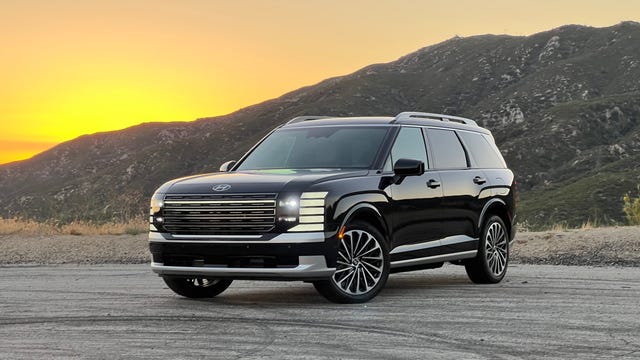
And, unusually for something I am writing about a Hyundai SUV, the Palisade is really very handsome. It has clearly been styled by people who understand proportions and visual mass. From the rear and rear three-quarter angles there are definite Range Rover cues, and I even found myself warming to the front lighting signature—compared to Star Wars’ Boba Fett by Road & Track’s John Pearley Huffman when he drove the non-hybrid version. The way the DRLs switch to flashing amber to act as oversized turn indicators is a clever touch that other road users are unlikely to miss.
The Robust Emerald Pearl paint on my test car, a fairly modest $500 option, was especially impressive. In some lighting and from certain angles it appears black, but it is actually a very dark green.
Should I Buy One?
The Palisade Hybrid is likely to be chosen on rational grounds, but it also scores strongly on desirability. In terms of price versus perceived quality, its closest rival is the closely related Kia Telluride, which offers a similar blend of space, equipment, and value, albeit with boxier styling.
But if you have already decided on a Palisade, then choosing the Hybrid over the standard V-6 should be an easy call. The Hybrid Calligraphy costs $2220 more, and that premium is justified by the added performance and better efficiency. Over 750 miles of mixed driving, I averaged 23 mpg, but with gentler use it was easy to get the trip computer beyond the 29-mpg combined rating.
At $59,800 including destination, the Calligraphy sits at the top of the Palisade Hybrid line-up, but buyers willing to live with fewer features can start with the front-wheel-drive SEL at just over $45,000.
Highlights and Lowlights
We Love:
The spacious and genuinely luxurious interior.
The outstanding refinement.
The fact that the SUV handles well for what it is.
We Don’t:
The engine gets loud when worked hard.
The slow-witted transmission.
The second row folds too slowly.
Favourite Detail:
The full ADAS suite includes a warning on the rear doors if an occupant tries to open them when traffic is approaching from behind, a clever feature that adds reassurance when children are getting out of the vehicle.