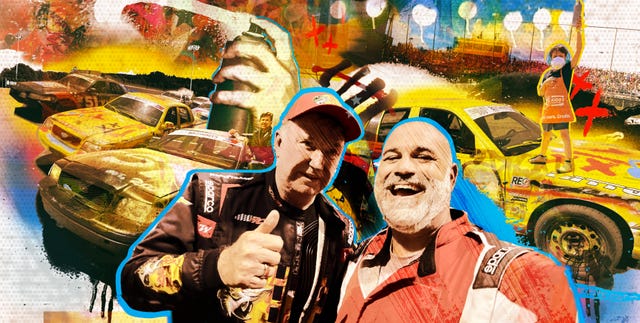
Stafford Motor Speedway, located in Connecticut just south of the Massachusetts border, is not exactly near my home in Los Angeles. But when Cleetus McFarland asks you to come and race in one of his now-legendary “Freedom” events, you make it happen. And it was absolutely worth the journey. Between the carnage of the “Van Prix”, a fireworks show of the sort usually associated with the budget and permissions of a mid-sized city, and a fired-up sellout crowd, some of whom had stood in the sun for hours to cheer on their scruffy underdog heroes, I got to see what feels like the future of grassroots motorsport. It was a mix of racing, spectacle and content creation, viewed from the best seat possible: the driver’s seat.
To be clear, this is one seriously daring business model. McFarland, whose real name is Garrett Mitchell, began as a YouTuber and has since evolved into something like a Don King-style promoter of live, over-the-top Southern-flavoured motorsport excess. What began with buying and reviving a struggling racetrack has turned into a full touring production that sells tens of thousands of tickets, along with many thousands more pay-per-view subscriptions for the races. In fact, four of those subscriptions were bought by my immediate family. McFarland wears multiple hats in this operation: promoter, host, producer and the creative spark behind the madness. Supporting him is a quietly efficient team of dedicated motorsport professionals, with partner Alan Chervitz effectively steering the logistics side of the whole enterprise.
I reached the gate at 11 a.m. and found a queue already several hundred people long. The doors were not due to open for another two hours, and it was a hot day, so the commitment from the crowd was very real. As it turned out, so was mine. The racing itself did not begin until six in the evening, and by then my bald head had turned beet red. The regulars, clearly knowing the drill, sauntered in with helmets in hand at around three.
The organisers supply the cars for this Olympic-style spec race: identical post-2003 Ford Crown Victorias. Each one is fitted with a roll cage, a racing seat, a dry 50-shot of Nitrous Oxide, and a 10-pound bottle good for roughly 60 seconds of spray. They also run steel wheels and Nitto tyres. They do not have mufflers. Cleetus’ crew works to make the cars as equal as possible, and no setup work or adjustments are allowed before the race; competitors are not even permitted to check tyre pressure or lift the bonnet for a quick look around.
Decoration, however, is allowed. As with the 24 Hours of Lemons, that means some cars end up with bizarre add-ons stuck to them, though most are simply covered in spray paint and silly slogans. I recruited my 5- and 6-year-old nephews to help decorate my car, and the result certainly stood out against the dark tarmac and white walls, thanks to its yellow base coat and distinctly avant-kindergarten theme.
I do not think I had ever heard the phrase “blast radius” used during a drivers’ meeting before. Nor had I ever heard a race promoter say, while pointing at Ryan Preece, the NASCAR driver who won at this track last year, that “there’s people you can hit”, followed by “there’s people you can’t hit” while gesturing towards the 80-year-old Richard Childress. Childress, founder of Richard Childress Racing, runs one of the most successful teams in oval racing and was winning NASCAR races long before I was born. Also in the field was Childress’s grandson, NASCAR Cup Series driver Ty Dillon. There were Late Model drivers and Formula Drift champions as well, but the grid was rounded out by motorsport-adjacent influencers such as myself, Zack Klapman, BoostedBoiKyle and others.
I have never before been in a spec-racing field of any kind where half the entrants were actual professional drivers and the other half were, broadly speaking, novices. Perhaps I am just naive and this all seems perfectly normal to the rest of you. I was not personally singled out as someone people were allowed to hit. Even so, I still felt very much as though I was about to be planted into the wall by a group of people who knew exactly what they were doing, and did it much better than I did.
Forget practice; the very first time you slot that Crown Vic into Drive, you are only a hundred yards away from the start line for qualifying. You get five laps in total: an out lap, three flying laps, and a cool-down lap. In that short time, you are expected to learn the car, understand the line and put in a decent time. One driver ahead of me got a bit too ambitious and hit the wall, so avoiding that quickly became priority number one, well ahead of actually going fast. Out of twenty-four cars on the grid, I qualified P18. That is not exactly a standout result, but it also placed me exactly where I wanted to be: around the middle-to-back of the field for what I expected would be a completely mad start.
I then had to wait, as the support races came first. One of them was a 40-plus-car Nissan Altima race which, although officially billed as a 40-lap contest around the one-eighth-mile infield course, might just as well have been called “last car running”. Of the 40 cars that started, perhaps only a third made it to the finish, and even those that did were barely holding together. It was an astonishing spectacle, surpassed only by the Van Prix. That was a similarly chaotic short race on the one-eighth-mile oval, only this time using minivans. Uncaged, road-legal minivans. Straight off the street, complete with standard seats, seatbelts, windows and no roll cages. The same was true of those Altimas as well.
“What’s wild is the optimism of some of these folks racing Altimas,” Cleetus told me. “They buy a car on Marketplace, register it and insure it, and bring it here to race, fully expecting to drive it home. Delusional, but you’ve got to love it. They’re always going home in a rental.”
To distinguish the Van Prix from a normal Altima race, the Freedom Factory crew brought in a portable jump which, despite looking small, is capable of launching a minivan eight feet into the air before it nose-dives into a completely flat landing. Having seen it in person, I will forever sing the praises of the durability of a minivan’s front suspension.
“This particular sport has a hard out at about 24 years old,” Cleetus laughed from the sidelines as yet another minivan dropped from the sky, smashed its nose into the tarmac at 50 mph, and simply carried on like a Ferrari in a Michael Bay film.
I asked one of the competitors, as he took off his helmet while wearing jeans and a hoodie, what it feels like to flat-land a dozen jumps in a stock van. “Best day of my life, bro!” he replied. He was 20.
The main event consisted of 90 green-flag laps, and that detail becomes important later. The spread in qualifying time between first and twentieth place was under one second. “The Crown Vic is the great equaliser,” Cleetus told me before the race. “It’s very hard to pass when the difference between you and a NASCAR pro is like, a few tenths of a second a lap. That’s when the racing gets… a little aggressive. We don’t hit, but we will move you out of the way.”
Over the next two and a half hours, 14 cars completed ninety laps, while ten met noble ends in the attempt. In all my previous racing experience, contact with another car would at minimum earn you a black flag and a stern talking-to, and possibly a penalty as well. Here, however, I learned that there is in fact a “correct” amount of crashing. Obviously, you want your car to remain on track and keep racing. But you also need to move people aside, and they will do the same to you. Sometimes you need to lean on someone else’s car to make the corner. It happens. And sometimes another driver may use your car to stop themselves from hitting the wall. They may, in effect, use your car as the wall.
My background in endurance racing turned out to be a genuine advantage here. My stints regularly last more than two hours in an eight-hour race, and if you want any chance of winning, the car has to survive to the end. For 75 laps, I did my best to keep the nose of car 419 clean, weaving through spinning cars, sliding cars and cars eliminating one another in battles for sixth place with dozens of laps still to run. My only real objective was to stay on the lead lap, avoid destroying my right-front tyre because that would cost me positions in the pits, and remain within sight of the pack. The nearly dozen full-course yellows, which added almost an hour to the race duration, gave me chances to reset and close back up to the leaders.
In one particularly wild moment, I zig-zagged past a spinning car only to find myself 50 metres from the driver’s door of a sideways, sliding Richard Childress. My yellow nose was pointed directly at the casually flexed, unretired “Earnhardt” No. 3. Fortunately, he locked the brakes and came to a halt, while I managed to weave clear and avoid hitting the one man I had explicitly been told not to hit. It was a one-way rule, though, because Mr. Childress apparently had permission to hit everyone else. He tried to P.I.T. manoeuvre me at least twice, and on two more restarts he used nitrous to shove past me. Once a racer, as they say.
On the advice of practically everyone, I saved all of my nitrous for the final 15 laps. I later discovered that this was slightly misleading, as many of the professional drivers begin using it much earlier. You can see that on the video feed because a light on the rear deck lid illuminates whenever the nitrous is being used. I also began driving far more recklessly, rubbing panels and banging fenders in what felt like a fight for last place. The aggression at the front was even more intense: three restart crashes in succession prompted race control to issue a lecture over the radio. Thankfully, it had the desired effect, and we made it to the chequered flag with the yellow flags staying in their holders.
In the end, I did The Smoking Tire and Road & Track proud, charging through to finish seventh, with my car still in reasonably decent condition. I crossed the line directly behind Bobby Earnhardt, nephew of Dale Jr., and David Arute, the general manager of the speedway and a Late Model driver. Just behind me was the aforementioned Mr. Childress, who made sure to put on his Bass Pro Shops gear before posing for a photograph. A truly professional move.
The crowd of more than 7000 erupted as we climbed out of our cars on the finish line. Not because of what had happened on track, but because Cleetus brings his own fireworks crew from Florida. They had set up the sort of fireworks display normally reserved for Jacksonville on the Fourth of July. The shells were exploding high overhead and raining debris down over the entire venue.
McFarland then shifted seamlessly from driver to post-race commentator, just as impressively as he had done after the Altima race, interviewing the top three finishers for the live stream, working the crowd and keeping the energy alive for another half hour.
Tickets for this all-day automotive circus started at just $40. Watching the stream cost $20, or $20 per month for access to all the streams, and the production quality is comparable to any IMSA race broadcast on television. Members of my immediate family bought streams from all over the country, and every one of them insisted they got their money’s worth. “That Van race was CRAZY,” my mother texted me. This may well have been the first time she had ever watched even a single frame of motorsport on television.
“You really want to put on a show for people who want to see excitement out on the track but don’t care about the intricacies of racing,” Cleetus says. “That’s how you get the masses into it.”
It is not a demolition derby. Destruction is not the objective. But when the cars die noble deaths in pursuit of victory, or carry on far beyond reason like Monty Python’s black knight, armless and still shouting about flesh wounds, you do not need to know who is leading to enjoy watching it. Top Gear brought car culture to people who did not care about cars, and this ridiculous, chaos-filled form of motorsport may be exactly how to get my boomer parents, my toddler nephews, my Gen X friends, and really just about anyone, to watch racing.
They were not joking about the “blast radius.”