The Lamborghini Urus has always had one standout strength: it works brilliantly as an everyday car. Lamborghini’s supercars usually ask owners to give up practicality and comfort in exchange for performance and theatre. But beneath the cartoonishly aggressive, attention-grabbing styling, this super-SUV offers space for four occupants and, in its softest Strada drive mode, a supple ride that makes it a genuinely capable long-distance machine.
That is why the 2023 Urus Performante stood out as an unusual misjudgement from a brand that typically understands its customers extremely well. This sharpened, even more performance-focused version of the Urus did bring a slight rise in power and a modest drop in weight, giving it the bragging rights of the stronger numbers. But the Performante also replaced the standard Urus air suspension with lower and stiffer steel springs, a change that removed much of the regular car’s plush ride quality. The Performante could attack a race circuit better than any 4800-pound SUV had any real business doing, something Lamborghini underlined by launching it at the Vallelunga circuit near Rome. Yet it was also compromised in a way that made little sense for the road-only use most owners would give it.
It is therefore no surprise that the 2027 Urus SE Performante returns to air suspension, although it uses a different dual-chamber setup from the one fitted to the regular Urus SE. As with the previous Performante, the new version gets a modest bump in output, with its plug-in hybrid powertrain now producing a quoted peak of 801 hp when the twin-turbo V-8 and electric motor are working at full force. That is an increase of 12 hp over the standard SE. Torque also rises, climbing from 700 to 738 lb-ft.
The SE Performante is also said to be 70 pounds lighter than the SE, with the biggest contribution to that saving coming from a part-titanium exhaust system supplied by Akrapovič. But that figure needs to be seen in the context of the vehicle’s total mass, which Lamborghini quotes at 5450 pounds. That makes it 650 pounds heavier than the non-hybrid Performante, with much of the difference coming from the weight of the sizeable 5.9-kWh hybrid battery.
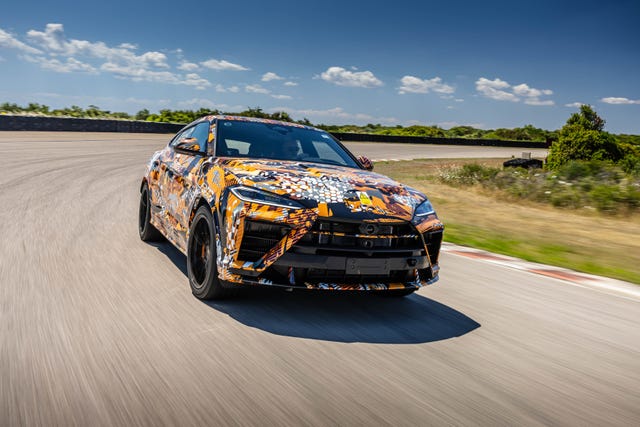
Road & Track’s first drive of the SE Performante, still in prototype form, took place at Porsche’s Nardò proving ground in Italy across several types of surface, including a skidpad, a gravel course designed to mimic a rally stage, and the demanding 3.8-mile handling circuit. The drive confirmed that this remains an SUV capable of delivering a level of performance far beyond what future buyers are ever likely to demand from it.
The air suspension is the key change here. Lamborghini’s engineers had plenty of figures to share—apparently, in its firmest setting, the SE Performante has a 55 percent lower roll gradient than its predecessor—but the clearest difference is how much its character can be altered through the selectable dynamic modes. In the most aggressive setting, Corsa, it offered flat cornering and a strong feeling of connection between the front tyres and the steering wheel, especially in the quicker bends on the handling track, while still leaving enough wheel travel to soak up the bigger kerbs when hit at speed.
By comparison, Strada mode was clearly softer, although the smooth surfaces around the Nardò facility mean it will take more time to judge how well it handles the rougher realities of public roads. Even so, the first impression was that, under gentle loads, its compliance felt broadly similar to the standard Urus SE and significantly better than the old steel-sprung Performante.
The prototype I drove on Nardò’s handling circuit was fitted with 22-inch Bridgestone Potenza Race semi-slick tyres, an upgrade over the regular Pirelli P Zero rubber. While very few owners are expected to choose that option—Lamborghini executives believe the overwhelming majority will go for the 23-inch wheels fitted with sport tyres—the more aggressive Bridgestones do allow the SE Performante to fully exploit its ability to generate both lateral and longitudinal grip.
The result felt almost unreal for something of this size and weight, with the Urus circulating the handling track quickly enough to keep a Huracán pace car working hard. But although the new Performante felt planted and secure in the faster corners, there was no disguising the effort involved in making so much vehicle turn into slower bends. It definitely felt less agile than the lighter, non-hybrid version I remembered.
The prototype’s many active systems worked together to suppress the understeer that ought to be unavoidable in something this tall and heavy, guided by a “6D” sensor that combines a three-axis accelerometer with measurements of roll, pitch and yaw. Even so, it also felt like the car would benefit from a final round of refinement before the production version is signed off.
On the handling track, I found that the actions of the active rear steering, torque-vectoring differentials and stability control occasionally seemed to be working against one another, making it difficult to maintain a chosen line through longer corners even with steady throttle and steering inputs. The Performante is immensely fast, but in dynamic terms it felt more like a hammer than a scalpel.
Of course, a certain brutality suits an 800-plus-hp Lamborghini perfectly well, and Nardò also gave me the opportunity to verify the extra punch the new SE Performante has over the old model. As with other applications of this powertrain—with less powerful versions used in the Porsche Cayenne Turbo E-Hybrid, the Audi RS Q8 and the regular Urus SE—the electric assistance removes any trace of turbo lag, delivering immediate response regardless of what the tachometer is showing.
Accelerating hard from very low revs made the Urus feel as though it had a 16-litre engine rather than a four-litre one. And a session on Nardò’s skidpad showed that the prototype has more than enough torque for full-power, tyre-smoking drifts. Like the previous Performante, the new car also gets a Rally mode, which permits substantial yaw angles on loose surfaces before stepping in to stop a spin.
Lamborghini quotes the same 3.3-second 0-to-62-mph time for the SE Performante as for the previous version, showing that both are already accelerating close to the limit of tyre traction. But the new model’s 10.8-second 0-to-124-mph time is 0.7 second quicker. Subjectively, the improvement felt even bigger than that. Launching the prototype on Nardò’s main straight using launch control, it felt relentless through the first three gears of its eight-speed automatic transmission, with the rate of acceleration only beginning to ease deep into fourth gear as physics finally started to push back hard.
Lamborghini claims a top speed of 194 mph, although even Nardò did not provide enough room to verify that. The exhaust note, routed through the Akrapovič silencer, has also been tuned to sound more aggressive than that of the Urus SE.
The purpose of the SE Performante is to be the ultimate Urus—the version intended to make owners of the regular model feel envious and somehow short-changed—but without the harshness that undermined its predecessor. Based on this first drive in a car that is not yet fully finished, that objective appears to have been achieved.
We all know that very few buyers, if any, will ever take it to a race circuit—not least because the prototype’s Bridgestone tyres were being changed after just two sessions on Nardò’s handling track, and replacing them would cost more than $2000 at retail. Even so, I suspect at least some future owners will choose it precisely because of the improbable things the SE Performante is capable of doing.