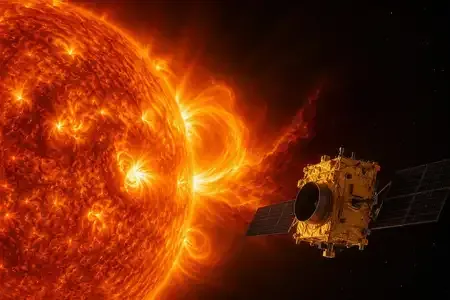
New Delhi, August 14 (IANS). Observations from India's Aditya-L1 solar mission have provided important information towards understanding one of the biggest mysteries of the Sun. According to Indian scientists, these data could help find out how the Sun's outer atmospheric layer, the corona, remains millions of degrees hotter than its surface and maintains its heat despite constantly losing huge amounts of energy.
Scientists studying data from India's first dedicated solar observing mission Aditya-L1 have obtained important clues to understanding the long-standing puzzle of why the Sun's corona remains extremely hot.
These findings have been published in Astrophysical Journal Letters. The study is led by Indian Institute of Astrophysics (IIA) professor R. Ramesh has done it.
The study sheds new light on the processes that heat the Sun's outermost atmospheric layer and the mechanisms involved in compensating for energy loss during powerful solar eruptions.
The temperature structure of the Sun has remained a puzzle for scientists for decades. The temperature at the Sun's core reaches about 15 million degrees Celsius, while its visible surface, called the photosphere, is about 5,500 degrees Celsius.
The surprising thing is that the temperature of the corona, located far away from the center of the Sun, can reach about 20 lakh degrees Celsius and in some circumstances it even increases up to 40 million degrees Celsius.
This increase of temperature despite moving away from the source of energy is contrary to general scientific expectations. This is why the extreme heat of the corona is included in the oldest unsolved puzzles of solar science.
It is in the corona that extremely powerful solar weather phenomena, such as solar flares and coronal mass ejections, originate. During these explosions the Sun releases huge amounts of energy and charged particles into space.
These events can cause beautiful auroras to appear on Earth, but they can also cause geomagnetic storms that can affect power grids, communications networks, navigation systems and satellites.
According to Professor Ramesh, two to three coronal mass ejections usually occur every day during times of low sun activity. At the same time, during the peak phase of the Sun's 11-year solar cycle, their number can increase to 10 or more per day.
Scientists have long been trying to understand how the Sun's corona maintains its extreme temperature despite constantly losing such large amounts of energy. If this energy is not replenished, the Sun will gradually cool down, which can affect the entire solar system.
–IANS
dsc