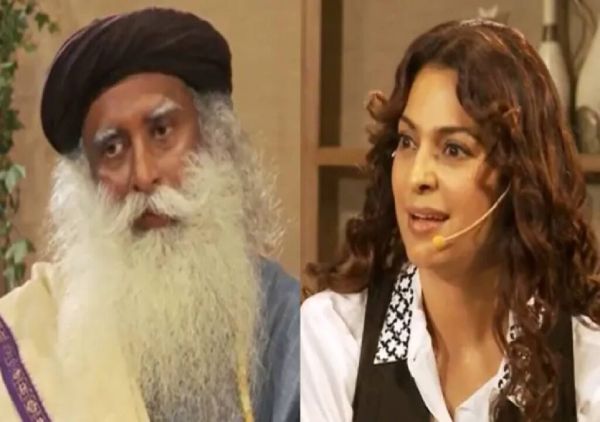
Mumbai: Actress Juhi Chawla once asked spiritual leader Sadhguru a question that continues to resonate with working women: Can motherhood and a career truly coexist? In an old conversation that has resurfaced, Chawla spoke about the challenge of balancing professional ambitions with the responsibilities of raising children.
The discussion, which took place years ago, focused on a dilemma faced by many women — whether pursuing a demanding career means compromising on family life. Sadhguru’s response centred on personal choice, balance and the importance of not measuring a woman’s worth solely through professional or financial success.
Chawla, who has enjoyed a long career in Hindi cinema, brought up the question from the perspective of a woman trying to manage both professional commitments and motherhood.
The actress asked whether a woman could genuinely pursue a career while also giving sufficient time and attention to her children.
The question reflected a broader social expectation that women often face — the idea that they must choose between professional ambitions and family responsibilities.
Rather than presenting the issue as a simple choice between the two, Sadhguru’s response focused on how women should decide what they want from their lives.
According to Sadhguru, women should have the freedom to pursue whatever they want, including careers and professional ambitions.
However, he argued that a woman’s value should not become dependent on how much money she earns or the position she holds professionally.
His broader point was that a career should not become a compulsive measure of success.
For him, the important question is not whether a woman works or stays at home, but whether the decision is made consciously rather than because of social pressure.
One of the key ideas in Sadhguru’s response was that professional achievement and financial independence should not become the sole measures of a person’s value.
He told Chawla that women are free to choose their path, but they should not associate their entire identity with their earnings.
This perspective shifts the conversation away from the question of whether women should work and towards whether they have the freedom to decide what works for their circumstances.
The discussion also challenges the assumption that every woman must follow the same definition of success.
Motherhood, Sadhguru suggested, involves responsibilities that cannot simply be measured in financial terms.
He spoke about the significance of a mother’s presence in a child’s life and reflected on his own experience of motherhood’s importance.
The conversation therefore did not dismiss professional ambitions. Instead, it placed motherhood and career in the context of different kinds of contribution.
For many parents, the challenge lies in determining how much time and energy can realistically be devoted to each area of life.
Chawla’s question was particularly relevant because she had continued to remain associated with the film industry after becoming a mother.
She married businessman Jay Mehta in 1995, and the couple has two children. Chawla has continued to take on acting and other professional projects while maintaining a relatively private family life.
Her career itself has evolved considerably over the years.
After becoming one of Hindi cinema’s leading actresses during the late 1980s and 1990s, she gradually moved towards character-driven and independent projects while also taking breaks from acting.
Chawla became one of Bollywood’s most popular actresses through films such as Qayamat Se Qayamat Tak, Darr, Hum Hain Rahi Pyar Ke, Yes Boss and Ishq.
Her career later moved in a different direction, with performances in films including 3 Deewarein, My Brother Nikhil and I Am.
This transition demonstrated that professional life does not necessarily have to follow one fixed trajectory.
Chawla was able to change the nature of her work while continuing her association with cinema.
The question Chawla raised remains relevant even years after the original conversation.
Working mothers frequently face expectations to excel simultaneously in their careers and personal lives.
A successful career can sometimes be accompanied by guilt over spending less time with children, while choosing to prioritise family can lead to questions about professional ambition.
This pressure can make the idea of “balance” seem like a constant obligation rather than an individual choice.
The conversation between Chawla and Sadhguru also highlights that balance may look different for different women.
For one person, continuing a full-time career may be the right choice.
For another, reducing professional commitments during certain stages of motherhood may make more sense.
Some may choose to work from home, pursue flexible careers or take breaks before returning to professional life.
The important factor is that the decision should reflect an individual’s circumstances rather than an imposed definition of what a successful woman should be.
Sadhguru’s response also touched upon the relationship between money and identity.
Professional success is often measured through salary, business growth, promotions or public recognition.
But these measures do not necessarily determine personal fulfilment.
His argument was that women should not feel compelled to prove their worth through financial achievement alone.
At the same time, this does not mean that financial independence is unimportant. For many women, earning their own income provides autonomy and security.
The larger point is that income should be one part of a person’s life rather than the sole measure of personal value.
The original discussion took place years ago, but its central question continues to appear in conversations around working mothers.
Today, women in entertainment, business, technology, politics and other professions regularly discuss how they manage demanding careers alongside parenthood.
The rise of flexible work has changed some aspects of the equation, but the emotional and practical challenges remain.
Questions about childcare, time, travel, work schedules and societal expectations continue to influence the choices working mothers make.
The resurfacing of Chawla’s conversation comes at a time when discussions about motherhood and professional identity are increasingly visible in popular culture.
Several actresses have spoken publicly about continuing their careers after becoming mothers, while others have discussed taking breaks or changing their work schedules.
The debate has gradually shifted from asking whether mothers should work to asking how workplaces and society can make it easier for women to make their own choices.
Although the conversation involved a film actress, the issue is not limited to the entertainment industry.
Women in corporate jobs, entrepreneurship, education, medicine, government and other professions face similar questions.
The film industry can involve particularly demanding schedules, including long shooting hours, travel and unpredictable commitments.
For an actress, balancing those demands with family responsibilities can therefore require considerable planning.
Ultimately, there is no universal formula for combining motherhood and a career.
Some women may find fulfilment in pursuing ambitious professional goals while raising children.
Others may prioritise motherhood during particular stages and return to their careers later.
Some may want both but require greater support from partners, family members, employers and society.
The conversation between Chawla and Sadhguru reinforces the idea that these decisions should be personal rather than dictated by social expectations.
Juhi Chawla’s old conversation with Sadhguru continues to resonate because it addresses a question many women still face: Can motherhood and a career coexist without one having to completely replace the other?
Sadhguru’s response emphasised freedom of choice and cautioned against measuring a woman’s value purely through her earnings or career achievements.
Chawla’s own journey demonstrates that a professional life can evolve alongside motherhood. Her career has moved through different phases, from leading roles in major Bollywood films to character-driven projects and other ventures.
Ultimately, the discussion suggests that there is no single definition of a successful working mother. The right balance depends on individual priorities, circumstances and choices — and those choices can change over time.