Iran War Pulls US Last Carrier From Asia, Giving China A Pacific Opening
Sneha August 16, 2026 01:41 AM
President Donald Trump’s war against Iran is placing growing pressure on the US Navy’s aircraft carrier fleet, with one of the service’s key warships leaving the western Pacific at a time when China is showing increasing assertiveness in the region.
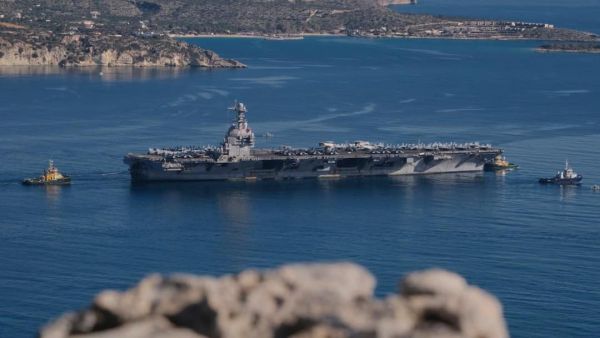
The USS George Washington is set to leave the Pacific and replace the USS Abraham Lincoln in the Middle East, where the Lincoln’s deployment has been extended well beyond its original May return date to support US operations against Iran, AP news agency reported.
The move could temporarily leave the Pacific without a US aircraft carrier. While the gap may be brief if another carrier deploys in the coming months, analysts say the development highlights the strain caused by prolonged operations in the Middle East.
US Focus Shifts From Pacific To Middle East
The carrier deployment comes as the Trump administration increasingly focuses on the Middle East and the Western Hemisphere, despite previously identifying the Pacific as a key strategic priority.
“The administration says that the Pacific is supposed to be the most important behind the Western Hemisphere,” said Greg Poling, director of the Southeast Asia Program at the Center for Strategic and International Studies.
Instead, he said, Washington was “doing the exact opposite” of its earlier goal of reducing its military involvement in the Middle East.
The shift is unsettling US allies in the Pacific, Poling said, while Beijing is benefiting from what he described as American distraction and frustration among Washington’s regional partners.
China Could Use Carrier Absence To Project Power
China regards the US military presence in the Indo-Pacific as a challenge to its rise and its ambitions regarding Taiwan, the self-governing island Beijing claims as its territory.
Analysts do not expect China to invade Taiwan simply because a US aircraft carrier has left the region. However, the absence could provide Beijing with an opportunity to demonstrate its military strength.
Bryan Clark, a former Navy submariner and defence analyst at the Hudson Institute, said China could use the situation to reinforce a narrative among countries such as the Philippines, Japan and Indonesia that Washington can no longer guarantee regional security.
China has recently conducted naval exercises with Indonesia and increased military activity involving Japan and the Philippines.
Beijing also held military drills near the Scarborough Shoal in the South China Sea this month. Last month, a Chinese guided-missile destroyer conducted a live-fire exercise near Japan’s southernmost island of Okinotori.
US Seeks To Reassure Pacific Allies
Washington is seeking to reassure its regional partners despite the carrier gap.
Adm Frank Bradley, head of the US Special Operations Command, visited Manila on Thursday and told Philippine officials that US special operations forces were prepared to expand joint exercises to strengthen the alliance. He is also expected to visit Japan.
Evan Sankey, a policy analyst at the Cato Institute who focuses on US policy towards China, said aircraft carriers offered psychological reassurance to American allies.
Their absence, he said, adds to the perception that the US is distracted by events in the Middle East.
The USS Abraham Lincoln has now spent more than 240 consecutive days at sea, a record deployment that has raised concerns over the physical and mental strain on its crew.
Democratic lawmakers have called for greater scrutiny of conditions aboard the carrier.
The Navy has already faced difficulties with other long deployments. The USS Gerald R. Ford returned home in May after an 11-month deployment, the longest since the Vietnam War. During that deployment, it supported US operations against Iran and the capture of Venezuela’s then-leader, Nicolás Maduro.
The Ford also suffered a fire in a laundry area that forced it to return to the Mediterranean for repairs and left hundreds of sailors without sleeping quarters.
Robert Farley, who teaches national security and diplomacy at the University of Kentucky, said prolonged deployments could take a significant psychological and operational toll on crews.
“People don’t get enough rest. It’s psychologically exhausting,” Farley said, warning that crews cannot maintain peak efficiency indefinitely without adequate rest and recovery.
Carrier Fleet Faces Maintenance Crunch
The pressure on the carrier fleet also reflects questions over US planning for a prolonged conflict with Iran.
Clark said the Navy could potentially deploy four carriers if the USS Theodore Roosevelt moves from San Diego towards the Middle East, allowing the George Washington to eventually return to the Pacific.
The US Navy has 11 aircraft carriers and typically deploys two or three at a time.
However, prolonged deployments could create another problem: maintenance.
The Navy’s carriers will eventually require extensive repairs and upkeep, potentially creating bottlenecks at the country’s two carrier shipyards.
Clark warned that the Navy could accumulate a “maintenance debt” lasting several years, reducing the number of carriers available for operations in the future.