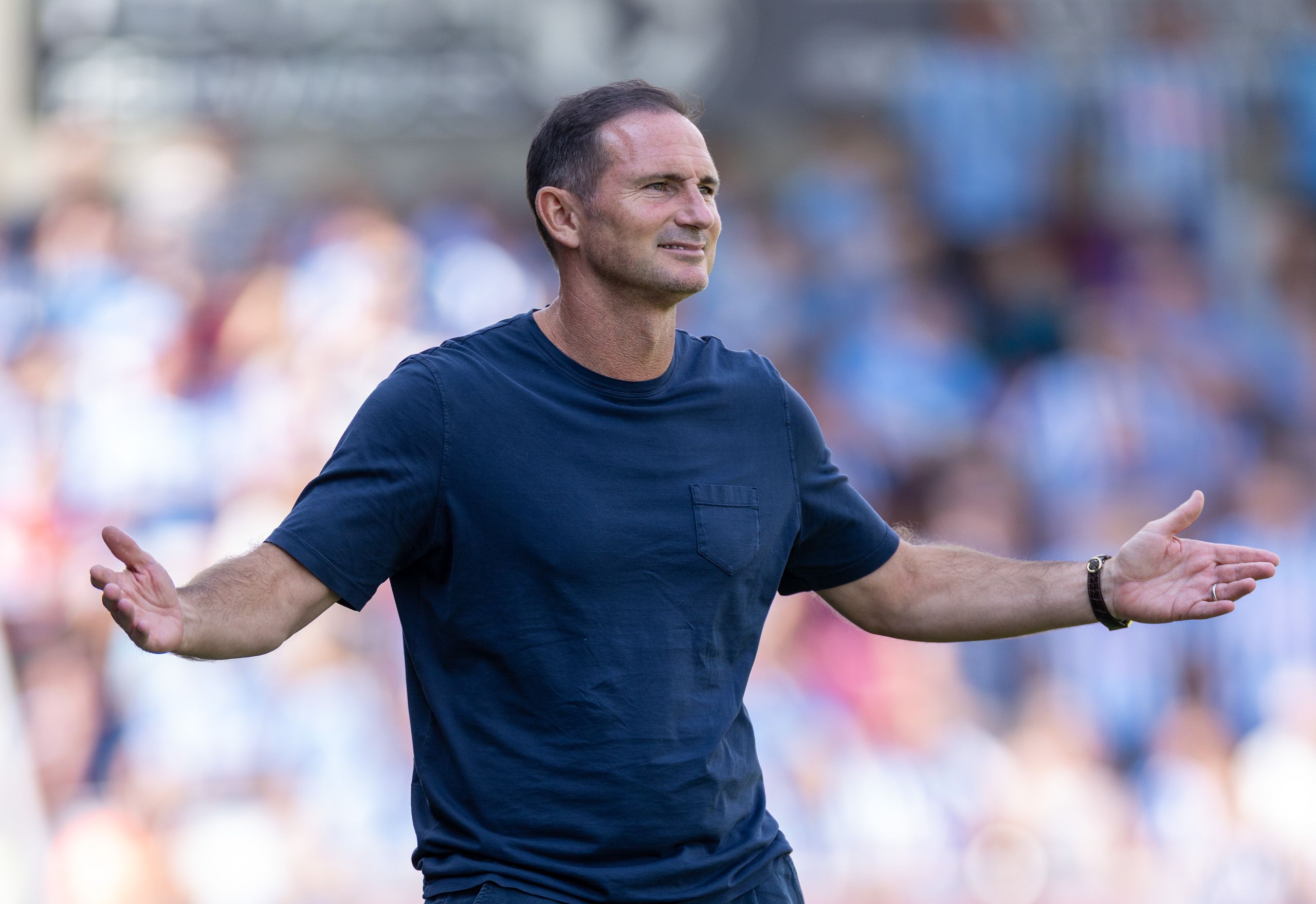
Frank Lampard has been in this position before. The Premier League was his stage for almost 20 years, and by the time he stepped away from it as a player, he had firmly established himself as one of the competition’s finest ever footballers.
He has also experienced it as a manager, with both Everton and his former club Chelsea. The Coventry City head coach is far from a newcomer to the Premier League, but this return feels different. His spells at Goodison Park and Stamford Bridge had their positives, yet the three years since his third departure from Chelsea appear to have shaped him most.
Guiding the Sky Blues to promotion as Championship winners in his first full campaign in charge was a major accomplishment. Owner Doug King gave no sign in the autumn of 2024 that he believed appointing Lampard was a gamble, and Lampard has rewarded that faith many times over.
Not everyone was persuaded. There are still sceptics even now, especially among those whose focus starts and finishes with the Premier League. They have seen Lampard produce the headline outcome of promotion, but the deeper story — the real development of Lampard the manager in the West Midlands — has largely gone unnoticed.
Anyone expecting exactly the same Lampard is making a mistake. In three years, all of us learn plenty about ourselves, our lives and our priorities, as well as our strengths, weaknesses, methods and motivations.
Lampard is no exception, though it also has to be said that the immediate challenge in front of him is a tough one.
There is a great deal of transfer business to be done, both in terms of numbers and quality, and yet no recruitment drive is ever truly complete.
City share that reality with most promoted sides, but they have spent heavily to bring in players they believe — with good reason — can turn out to be smart signings.
Carl Rushworth was always their first-choice goalkeeper. Frank Onyeka was a straightforward decision in midfield after an encouraging loan spell. Gustavo Hamer is the returning favourite, looking once again for the creative freedom that feels like home.
Loum Tchaouna and Aurele Amenda represent expensive, high-upside gambles, while Caleb Yirenki is the young superstar who arrived as the club’s record signing.
King, Lampard and Dean Austin have already got plenty done in the transfer window, and further additions are expected, but Coventry will begin the season with the natural disadvantage of a club reaching the Premier League for the first time in the modern era. There is a huge amount of work ahead of them, and none of it will be straightforward.
Lampard is back in the Premier League as a more accomplished and more seasoned manager, but the sharpness and flexibility he now possesses were honed away from the intense spotlight of the top flight.
It is possible to frame Lampard’s managerial career as a succession of very specific assignments. His two spells at Chelsea were jobs born partly of hopeful convenience, Derby County was a shared expression of ambition, and Everton was effectively a rescue operation.
Whether it is too generous or not to argue that he performed better in those positions than he is usually credited for is not really the point. Lampard went through all of that as a young manager, at a stage when many coaches are allowed to learn, fail and grow away from the scrutiny in which he was working.
At 48, Lampard fits a different managerial mould — thoughtful and even academic in his approach, but without becoming another stereotype from the one-note high-performance production line. He is committed, but perhaps flourishing precisely because he values balance in life.
When guidance comes from people who succeeded in management before him, Lampard is capable of absorbing it without losing faith in his own perspective and methods. Over time, he has become a more complete manager than he was the last time he oversaw a Premier League match.
Like every manager, Lampard has tactical concepts and plans, but he does not let them box him in. In a Championship title race that at times threatened to become genuinely tense, he succeeded not as an ideologue but as a manager who discovered how to build a team that always finds a solution.
The defining point of Coventry’s season, and perhaps of Lampard’s coaching career, arrived in February, when an injury-hit Sky Blues side found themselves looking up at Middlesbrough from second place after the Teesside club recorded a sixth straight win.
Coventry, without a win in three games and with only two victories from their previous eight Championship matches, defeated Boro fairly comfortably in the very next fixture, then won six in a row and never looked back.
The connection between Lampard and Coventry is genuine, and this new journey belongs to both, but every outcome remains possible amid the difficulties and uncertainty that come with being a promoted side. Even strong managers need things to go their way in that unforgiving first season.
Coventry may survive, or they may be relegated. Lampard may stay for the whole season whatever happens, or he may receive an offer from elsewhere that is impossible to turn down. King may ultimately be the one to make that call, unlikely though that seems right now.
In FourFourTwo’s view, the only thing that can be said with any real confidence is that Lampard, in one way or another, will be among the Premier League managers again next season.