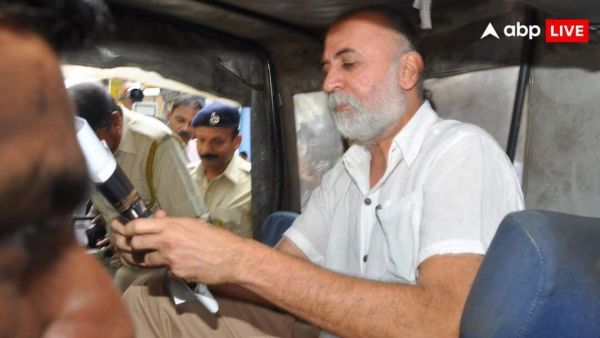
New Delhi: The Goa government on Tuesday moved the Supreme Court seeking enhanced sentence for journalist Tarun Tejpal in the 2013 sexual assault case, contending the case warrants imprisonment for life.
On August 6, the Bombay High Court convicted Tejpal of rape and sentenced him to rigorous imprisonment for 10 years, overturning the acquittal of the former editor of Tehelka by the trial court five years ago.
In a petition filed in the apex court, the Goa government said that the sentence imposed by the high court was "grossly disproportionate to the nature and gravity of the offences" committed by Tejpal.
"The present case warrants enhancement of sentence to imprisonment for life, or such enhanced sentence as this court may deem appropriate, and the sentences ought not to have been directed to run concurrently,” the plea said.
The challenge is confined to the quantum of sentence and the direction for concurrent operation of sentences, it said, adding the sentence does not adequately reflect the gravity of the offences or the aggravating circumstances found proved by the High Court.
In its verdict, the high court had termed the trial court’s 2021 order as "perverse", noting that it fell for the notion that a sexual assault complainant must be a "perfect victim" and conduct herself in a certain way so as to appear credible.
Tejpal was convicted of raping a junior colleague inside a hotel elevator in 2013 during an event organised by the magazine in Goa. The 62-year-old journalist claimed that he was a political victim and would approach the Supreme Court to challenge his conviction.
The Goa government, in its plea filed in the top court, said the high court “imposed only the minimum sentence of 10 years’ rigorous imprisonment for each of the two aggravated rape convictions, with the sentences directed to run concurrently”.
It said Tejpal was the employer of the victim and was also a friend of her father.
“The high court, inter alia, relied upon the fact that 13 years had elapsed since the commission of the offences and that both the victim and the respondent had moved on with their lives, while imposing the minimum sentence and directing the sentences to run concurrently. Such reasoning is untenable,” it said.
The plea said the passage of time cannot operate to the benefit of the offender or become a premium for the delay in the administration of justice, particularly at the cost of the victim.
It said the sentence imposed was further disproportionate in view of the high court’s own finding that the victim was subjected to nearly 1,000 pages of invasive cross-examination, during which the defence sought to “harass and humiliate her and portray her as a woman of loose morals”.
“The petitioner State does not, in the present petition, seek to reopen or challenge the findings of conviction recorded by the High Court. The challenge is confined to the quantum of sentence and the direction for concurrent operation of sentences,” the plea said.
It said the sentence imposed does not adequately reflect the gravity of the offences or the aggravating circumstances found proved by the High Court.
The plea said the delay taken for the victim to get justice cannot become a mitigating circumstance in favour of an offender so as to dilute the sentence for a grave sexual offence, particularly where the delay has not been shown to be attributable to the victim.
“The direction that the sentences should run concurrently further substantially reduces the effective punishment for two distinct aggravated sexual assaults committed on two successive days. Each incident constituted separate criminality and deserves to be reflected in the sentence,” it said.
The plea said the sentence imposed by the high court was inadequate and disproportionate to the gravity of the offences and the aggravating circumstances established on record.
The high court had asked Tejpal to surrender within two weeks but later extended the period to four weeks on a request from his lawyers.
In its 81-page judgment, the high court had expressed strong disapproval about the way the defence put the victim in the dock and focused on her personal life, and said it found it surprising that the trial court "remained silent and allowed the defence to harass and humiliate her during the cross-examination".
Tejpal was convicted under several sections of the Indian Penal Code (IPC), including 376(2)(f) (rape committed by a person in a position of trust or authority), 354(a) (sexual harassment), and 354(b) (assault or use of criminal force with intent to disrobe). Under Section 376(2)(f), the maximum punishment is life imprisonment.
While Tejpal had pleaded for leniency, claiming he was a "political victim" and the father of two daughters, Solicitor General Tushar Mehta, appearing for the Goa government, had demanded the maximum punishment to send a strong message that "no means no".
Speaking to reporters after the verdict, Tejpal had said he would challenge the judgment in the Supreme Court, and also expressed confidence that the truth would eventually come out.
(This report has been published as part of the auto-generated syndicate wire feed. Apart from the headline, no editing has been done in the copy by ABP Live.)