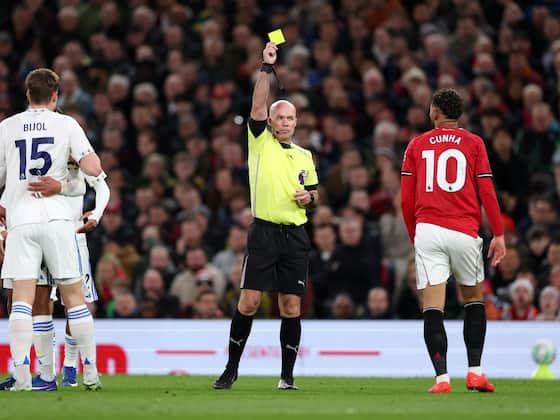
Premier League referees chief Howard Webb has said the Folarin Balogun controversy has made officiating harder because it “opens up space” for conspiracy allegations and could have a “snowball” effect.
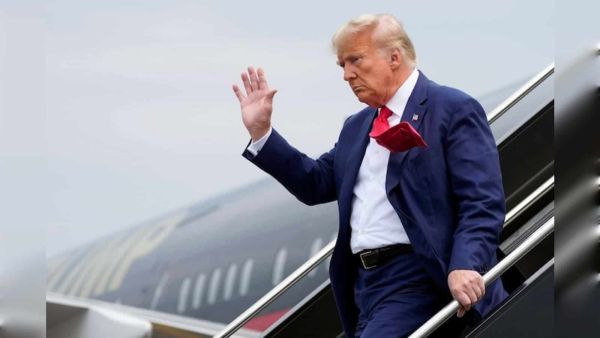
The controversy erupted when USA striker Balogun was sent off after a VAR review in the World Cup last-32 tie against Bosnia and Herzegovina, only for FIFA to delay the suspension after Donald Trump admitted he had made calls to the governing body’s leadership.
Folarin Balogun’s suspension was delayed after a political intervention.
FIFA president Gianni Infantino maintained that it was an independent process, but it later emerged that the panel consisted of only one official.
Premier League chief executive Richard Masters called it a “self-inflicted moment” that “stands alone” from the World Cup, while Webb, who oversaw 296 top-flight matches, said he was “really troubled by it”.
“We live in a world now which is different to the one that I occupied as a ref, in that decisions that are taken previously were viewed as correct or incorrect based on your judgement,” Webb said. “Far too often now, decisions are viewed as correct or corrupt by people who want to type all over social media.
“They try to draw inferences around decisions, around a decision that they don't agree with and what's the motivation behind that decision, which is born out of no facts, no evidence.
Howard Webb fears for officials in the Premier League.
“But when you get that type of situation, it opens up space for people to think, ‘ah ha, you see, this sort of thing's happening all the time behind the scenes’.
“And it's really not, in my experience, in my professional experience. But you worry, as we're about to kick off the season, that we're going to see that snowball now where people say, ‘oh, it happened there, but what happened in this decision that the Premier League gave?’
“You're going to get more of that as a consequence. It doesn't help, does it?”
“I don't want to talk about FIFA, but of all the things that people talk about, that's the thing that troubles me the most. That's the thing that affects the 90 minutes and the game.”
Masters said it was “a huge shame” that such controversies had overshadowed the football.
Donald Trump (right) called FIFA president Gianni Infantino about Balogun’s red card.
“The Balogun issue stands alone, really, in that isolated incident of something which is very difficult to comprehend, really, when you look at it,” the Premier League CEO said. “Again, I think it’s another sort of self-inflicted moment.”
The Premier League will, meanwhile, largely move away from FIFA’s World Cup officiating approach, even amid a wider effort to reduce “grappling” at set-pieces.
Unlike at the tournament in the summer, VAR will not be used to overturn corners, on the principle of minimising interventions, and there will be no red cards for players covering their mouths.
Yellow cards for diving will not be overturned in mistaken-identity cases, meaning there will be no repeat of Breel Embolo’s dismissal for Switzerland against Argentina. Cooling breaks, meanwhile, will only be used when temperatures go above 30 degrees.
One of the main aims for the new season, however, is to bring more nuance to officiating so that behaviour changes and there is less grappling.
Premier League referees will try to crack down on grappling at set-pieces.
Referees will issue fewer warnings in order to avoid lengthy delays, and as a result more situations will be penalised.
Reviews from last season surprisingly showed that it was unsporting actions regularly used by defenders that most often went undetected, despite perceptions that new attacking methods were changing set-pieces.
The priority, however, is to punish the sort of wrestling that has “no business being in our sport”, while also accepting that any infractions need to be clearer the further they are from the ball, so there is no constant intervention.
Webb accepted that if tactics continue to evolve in this direction, IFAB may have to consider a “fundamental law change”.
He also pointed to a mass grapple during Manchester United’s 1-0 win away to Everton in February as a particularly striking example of the issue the Premier League is trying to tackle.
“There was so much happening at both penalty areas, really difficult to officiate, really difficult to see the wood for the trees when there's so much happening,” he admitted.
“If you've got teams that have got set-piece routines and they're well drilled on that, they obviously get an advantage because the opponents don't know what's going to happen. But we as officials can try to identify what's happening, try to get ahead of it, use analysis, etc.m so we know where to look to try to identify actions that are not fair – but sometimes we're not able to see that either.
“We'll see how this kind of approach works. We're trying to get the officials to be as competent as they can be to penalise what they see, not to warn too much. But there has been talk on the edges around different approaches that might need to be taken, ultimately, if tactics continue to develop in a way that makes the game so difficult to officiate.”