
Rocket Lab (RKLB) CEO Peter Beck said that the company does not intend to compete directly with SpaceX CEO Elon Musk’s Starlink following its proposed $8 billion acquisition of Iridium, instead targeting emergency, defense and other critical satellite services.
RKLB stock fell 4% on Wednesday and is down 6% this week, putting it on track for its worst weekly performance in over a month.
When asked in an interview whether Iridium’s 66-satellite constellation could compete with Starlink’s nearly 11,000 satellites and Jeff Bezos’ upcoming network of over 5,000, Beck said Rocket Lab is pursuing a different strategy. “Our intention is actually not to compete directly with internet from space,” Beck said, calling that segment a “very well-served market.”
Instead, Rocket Lab plans to expand the emergency and defense services Iridium has provided for decades. The deal would also give Rocket Lab access to Iridium’s valuable L-band spectrum, which can penetrate poor weather and buildings more effectively than conventional broadband frequencies. “You can have as much aspiration as you want, but if you don’t have spectrum, you can’t really provide those services,” Beck said.
He called the addressable market “really substantial.” By combining Iridium’s spectrum with Rocket Lab’s spacecraft manufacturing and launch capabilities, Beck said the company could offer “something new and unique that hasn’t been seen before.” The acquisition would expand Rocket Lab’s end-to-end model beyond launch vehicles and spacecraft manufacturing into recurring satellite communications services.
Government customers have historically accounted for about 50% of Rocket Lab’s business, while commercial customers make up the other half, Beck said. However, he noted that governments frequently purchase services through commercial providers as well.
Rocket Lab has won several national-security programs, including a $397 million U.S. Space Force contract involving missile and threat-tracking satellites. Beck said government procurement is increasingly moving away from arrangements that reimburse contractors for their costs and toward programs that emphasize fixed prices and demonstrated delivery. “The age of cost-plus contracts is fast evaporating in favor of firm fixed-price contracts and proven execution,” he said.
Separately, Rocket Lab said on X that its robotics division will support EMILIA-3D, a University of Arizona-led lunar instrument selected for NASA’s Artemis program. The instrument will generate three-dimensional thermal models of the Moon’s surface, helping researchers study lunar soil and improve navigation for future missions.
Rocket Lab Robotics developed a single-axis gimbal that will allow a camera supplied by Northern Arizona University to scan the terrain accurately. The system is designed to withstand lunar dust, radiation and temperature swings of about 450 degrees Fahrenheit. Rocket Lab acquired the division, previously called Motiv Space Systems, in May, adding 50 engineers and technology with experience on NASA’s Perseverance Mars rover and other planetary missions.
The company also said Electron’s next flight will be another dedicated mission for Japan’s Institute for Q-shu Pioneers of Space. Dubbed “The Lightning God Defends,” the mission will deploy the latest QPS-SAR Earth-imaging satellite into low Earth orbit. Its launch window opens at 9 a.m. ET on Thursday.
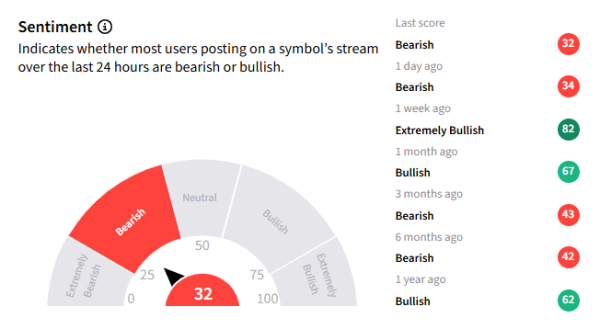
On Stocktwits, retail sentiment for RKLB was ‘bearish’ amid a 22% rise in 24-hour message volumes.
One user said, “$RKLB Why would a person buy RKLB when you can buy SPACEX? When will they get Neutron rocket flying?”
View this Stocktwits post
Another user said, “$RKLB Im long this stock, up pretty bug already but man its been exhausting waiting for any catalysts since we had that run earlier in the year. Time to log off and check back in 6 months from now.”
View this Stocktwits post
RKLB stock has jumped 85% over the past year.
For updates and corrections, email newsroom[at]stocktwits[dot]com.<