|
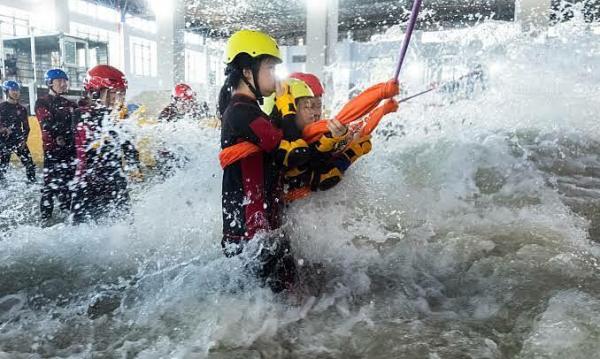
Participants during a typhoon survival training session at the Lvxing Disaster Simulation Training Center in Hangzhou, Zhejiang province, China, July 15, 2026. Photo by Reuters |
Dark tourism usually refers to visiting places connected to death, disaster, and history to see sites and artifacts of tragic events.
In China, places like the 2008 Wenchuan earthquake memorial and the Nanking Massacre museum are traditional dark tourism sites. They are free to the public and focus on history and memory.
This new form of tourism allows visitors to step inside simulated typhoons and floods for an intense, realistic experience while learning practical survival skills.
At the forefront of this trend is Lvxing Base in Hangzhou, a major city in the country’s east.
It opened in September 2024 and claimed to be the country’s first immersive natural disaster simulation center.
As reported by the South China Morning Post (SCMP)the venue has quickly become a sensation on social media.
Reports show it has attracted over 160,000 visitors since opening.
 |
|
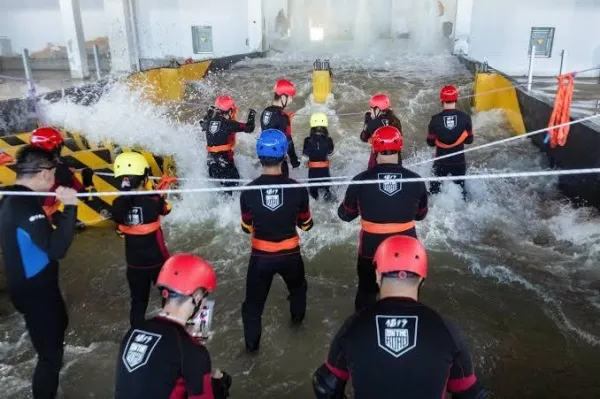
Participants during a typhoon survival training session at the Lvxing Disaster Simulation Training Center in Hangzhou, Zhejiang Province, China, July 15, 2026. Photo by Reuters |
It offers various packages for visitors.
Adults pay 899 yuan (US$135) to experience simulated typhoons, heavy rain, and flash floods.
Family packages cost nearly 5,000 yuan, adding wilderness survival and water rescue training for adults and children aged 6 to 14.
According to Reuters news agency, the facility uses serious equipment that can create winds of up to 165 km/h and release hundreds of tons of water.
Participants wear thermal suits and helmets before experiencing the simulated disasters.
Trained instructors and safety staff stay on-site to guide sessions and assist anyone who feels distressed.
The experience creates strong emotional and physical reactions among visitors.
In an interview with Vista Hydrogen Business, a participant shared her experience during an underground parking flood drill.
As water rose to her neck, the sudden fear made her temporarily forget it was only simulated.
The concept behind Lvxing Base was created by Zhang Xinyu and Liang Hong, a famous Chinese adventure couple known for visiting challenging places like volcanoes, war zones, and Chernobyl.
They wanted to turn their extreme travel experiences into a structured program that teaches practical survival skills while building respect for nature.
Experts say the attraction appeals to young people dealing with modern stress.
SCMP quoted Zhang Yong, a social work professor at Wuhan University of Science and Technology, as explaining that overcoming a controlled threat gives young people a clear sense of confidence and control over their lives.
Similar disaster safety centers exist in other East Asian countries that frequently face extreme weather. In Japan, the Honjo Life Safety Learning Center allows visitors to experience simulated earthquakes, fires, and heavy rain.
In South Korea, the Gwangnaru Safety Experience Center educates the public on disaster response through interactive training.
However, the Chinese facility sets itself apart by operating as a commercial attraction.
It claims to be the first in the world to offer high-volume typhoon and flash flood simulations to paying tourists.
Speaking to ReutersWang Kuanghan, the centre’s chief instructor, said there are plans to open five more centres in China within the next three years