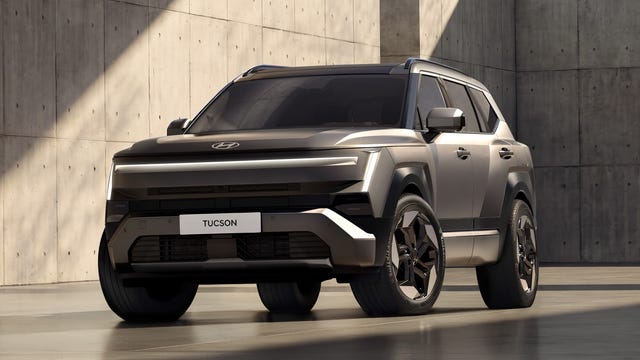
Now that this year’s Monterey Car Week celebrations are over, you could be forgiven for expecting a brief pause in fresh automotive unveilings. Even so, Hyundai has now taken the wraps off the next-generation Tucson’s design for the South Korean market, and the styling of this upcoming SUV represents a noticeable shift away from the version that has been a familiar face in NFL commercials over roughly the past five years.
Hyundai is currently in the middle of an extensive product refresh, partly driven by the carmaker’s plan to introduce 36 new or updated models in North America by 2030. Much like the Santa Fe, the new Tucson moves away from the softer design language traditionally associated with compact crossovers and instead adopts a look that is closer to the full-size SUVs popular in the United States. The overall form is quite upright, with considerable emphasis on visual width. That impression is strengthened further by squared-off wheel-arch cladding and full-width lighting signatures at both the front and rear. The headlamps in particular appear quite striking, successfully combining a conventional shape with more contemporary detailing, while the sculpting along the doors also looks appealing.
On the inside, the new Tucson seems to take a few cues from Hyundai’s full-size electric SUV, the Ioniq 9. As is common with many boxy sport utility vehicles in this segment, the cabin design leans heavily on horizontal themes. Based on these first images, the textures and materials used on the harder surfaces and door trims appear premium. A large infotainment display dominates the forward view, and there is a clear absence of physical buttons around it. That said, the squared two-spoke steering wheel did not particularly impress in the Ioniq 9, and it does not do much more here either.
Hyundai is not yet prepared to reveal details about the new Tucson beyond its design direction, but considering that the Tucson is currently the brand’s best-selling model in the U.S. by a huge margin, it would be surprising if much changes in principle beneath the bodywork. Expect both front-wheel-drive and all-wheel-drive versions, along with petrol, hybrid, and plug-in hybrid powertrain choices. A more off-road-oriented XRT variant also seems likely, while an N-Line version aimed at enthusiasts could also be possible, even if a full-fledged Tucson N still appears unlikely.
We will share more information as soon as Hyundai is ready to disclose it. In the meantime, tell us what you think of the all-new Hyundai Tucson.