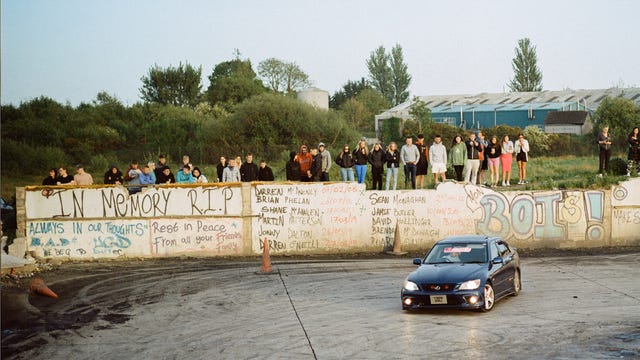
Drifting has surged in popularity in the United States since Formula Drift began in 2003. Over the past decade in particular, the fan base has grown enough to pack stadiums, with spectators turning up to watch drifting stars such as Chelsea DeNofa, Fredric Aasbø, and James Deane at speedways across the country. But long before ticketed events and big-name sponsorship deals, grassroots drifting culture took shape in quiet car parks and deserted developments—and that same culture is still alive in Northern Ireland today.
Belfast-born director Ruairí Bradley’s short film, “We Beg to Differ”, documents exactly that world.
After a successful two-year run on the film festival circuit, the 12-minute documentary was made available to stream free on Vimeo earlier this summer. The film focuses on grassroots drifting culture in Northern Ireland, drawing attention to the improvised spaces and the social dynamics that define it. While it is filled with rural backdrops and the sound of 2JZ engines bouncing off the rev limiter, the documentary ultimately speaks to the deeper emotional reasons drifting matters so much to this group of people in the North.
“Most of the film was shot in Belfast, and it was all shot in the north of Ireland. It's going to be almost 30 years since the Good Friday Agreement, when a civil war basically stopped here. There were 30 years of violence, and another 800 years before that which weren't great either,” Bradley said in an interview. “People aren't killing each other on the streets anymore, but it leaves a vacuum where there's so much inherent trauma in people because working-class communities were involved in warfare. They were involved in grassroots, guerrilla warfare. People were shooting each other and bombing each other, and what that just ends up creating is a culture of people who are really hardened.”
“I think that what [the drifting] community is so great for is it doesn't matter if you see yourself as Irish or if you see yourself as British. It's not a place for politics. It's a place for people to come together over cars and over something that they enjoy, and it can give them a buzz; it can give them a high; it can be a place where they can get all their social interaction. It's a place that can fill up that cup. A lot of people here struggle with their mental health. There is a big mental health epidemic in the North of Ireland—and it's not that drifting your car is gonna necessarily solve that, but it's a release.”
The film begins with a Vauxhall hearse turning off a country road, followed by 2-stroke dirt bikes and a convoy of drifters close behind. It then moves to a memorial for a drifter who had died, where the driver of a Lexus IS300 performs figure eights in tribute to their lost friend. Later, a wall behind a local drift spot is shown painted with the names of fellow enthusiasts, many of whom died by suicide while dealing with mental health struggles. Bradley said that two of the drifters he met during the 16-day filming process had taken their own lives less than six months later.
“Some of these people don't want to talk about how they feel. They don't want to go to their friends and tell them how they feel. That's also why the car is a really nice space, because they get to be with all these people, but they get to be with all these people inside their own car, in their own space,” Bradley said.
The drifting community shown in the film was brought together partly by the routine built around one particular drift location. After securing permission from a local landowner, drifters in Belfast started gathering at a fenced-off site outside the city to practise donuts and, over time, create a memorial wall for loved ones they had lost. In the summer, a burger van and an ice cream truck would set up there to serve drivers and spectators alike. However, after repeated complaints from neighbouring landowners, Bradley said that this centralised legal drifting venue was recently shut down.
Even so, that has not stopped drifters in Northern Ireland from pursuing what they love. Legal or otherwise, Bradley said street drifting remains just as popular as drifting in the limited approved locations that are available. Naturally, the police are often involved, and one scene in the film shows a driver being arrested. Those caught drifting on the street rarely end up in prison or face major legal consequences, but Bradley said the authorities have recently been monitoring things more closely using helicopters fitted with infrared cameras.
“There is a bit of a cat-and-mouse to it—where whenever they are drifting out in the street, some people enjoy the cat-and-mouse of it. There's nothing really that's going to bring you closer together than being all together in this thing, that none of us can get caught,” Bradley said. “What they used to do was block around the police car. They would let all the drivers escape, and then they would pull out again, so the police wouldn't know where to go because all the cars would be gone. Now, they have these helicopters that, wherever the cars go, they know which cars were drifting [because of] the heat.”
For viewers from a country where drifting has largely become part of the mainstream, “We Beg to Differ” feels like a surviving piece of an earlier era, right down to its outlaw spirit. Even if drifting is not your preferred motorsport, the camerawork, the craftsmanship, the care shown by the filmmaker, and the raw humanity captured on screen make this documentary well worth watching.