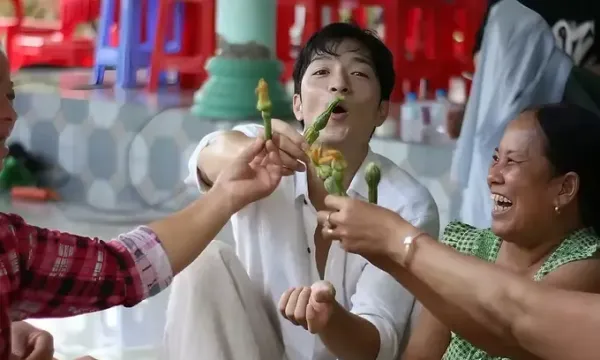
Japanese traveler Naoki Okamura, 31, was visiting Tien Giang Province in June when he stopped to watch locals setting up a canopy in a courtyard.
To his surprise, several people approached, took him by the hand and invited him inside. He was seated at a table filled with food, given a comfortable place to sit and repeatedly encouraged to eat.
“They pulled me right up to a table piled with delicious dishes, gave me the coolest spot in the house, and kept filling my plate,” Okamura says about his trip in June to Tien Giang Province.
Curious, he asked and discovered the family was organizing a dam gio, an ancestral death anniversary feast. It was in stark contrast to his home country, where such commemorations are quiet, private family affairs.
“Their hospitality was overwhelming,” he says. “They made me feel like there was zero distance between a total foreign stranger and their own family.”
|
Naoki Okamura (in white) attends an ancestral death anniversary feast in Tien Giang Province in June 2026. Photo courtesy of Okamura |
For Dutchman Marcel Lennartz, 55, who has called Vietnam home for over three decades, the delta’s generosity is “something you won’t find anywhere else on earth.”
Even after 30 years, traveling through the southern countryside brings delightful surprises.
Passing through rural hamlets in Ben Tre Province, adults and children routinely grabbed his hand and invited him inside, offering their hammocks for a midday nap, fruits, and local wine. “Many local farmers don’t speak a word of English, but the way they pull out a chair and pour you a cup of tea is more than enough to dissolve any language barrier,” he says.
These unscripted encounters are blowing up across social media. Videos and posts detailing western travelers being whisked away to local weddings, feast days, boat rides, and karaoke singing in the delta are drawing millions of views.
For many travelers, while the lush waterway scenery is a major draw, it is the genuine warmth of the locals that makes them want to return.
 |
|
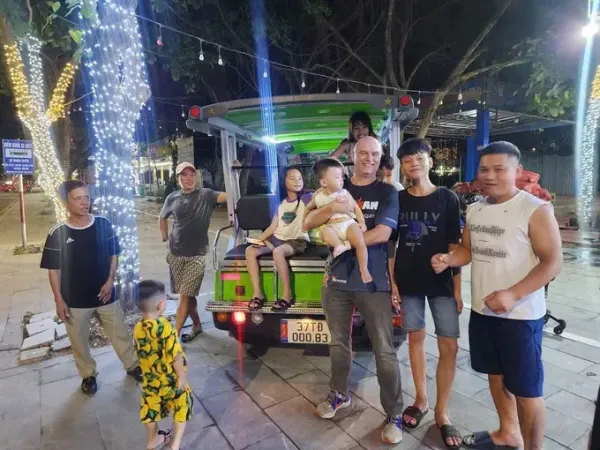
Marcel Lennartz, 55, holds a local child during a visit to the Mekong Delta in 2022. Photo courtesy of Lennartz |
This trend is providing a direct boost to regional tourism. Thuy Linh, head of international markets at a Ho Chi Minh City travel agency, says bookings for immersive, lifestyle-focused tours in the delta have doubled or tripled since the start of the year.
“Travelers from Europe and parts of Asia are moving away from passive boat sightseeing. Instead, they are booking experiences that take them deep into river islets to drain irrigation ditches for fish, make traditional cakes, and share homestay meals with local families.
“The authenticity and effortless hospitality of the locals are precisely why visitors rate this region so highly.”
That open-door ethos routinely turns private residences into spontaneous shelters for stranded travelers. Earlier this year, Bich Lieu, 35, a resident of An Giang Province, spotted a Hungarian backpacker preparing to pitch a tent inside a riverside shack near her house. Worried about the overnight weather, her family stepped in, inviting him to share their family dinner and offering him a free bed for the night.
“We even took him along to a neighborhood wedding so he could experience local life,” Lieu says. “Growing up here, we’ve always lived in a tight-knit community where neighbors lean on one another. That communal bond makes people naturally welcoming and far less wary of strangers.”
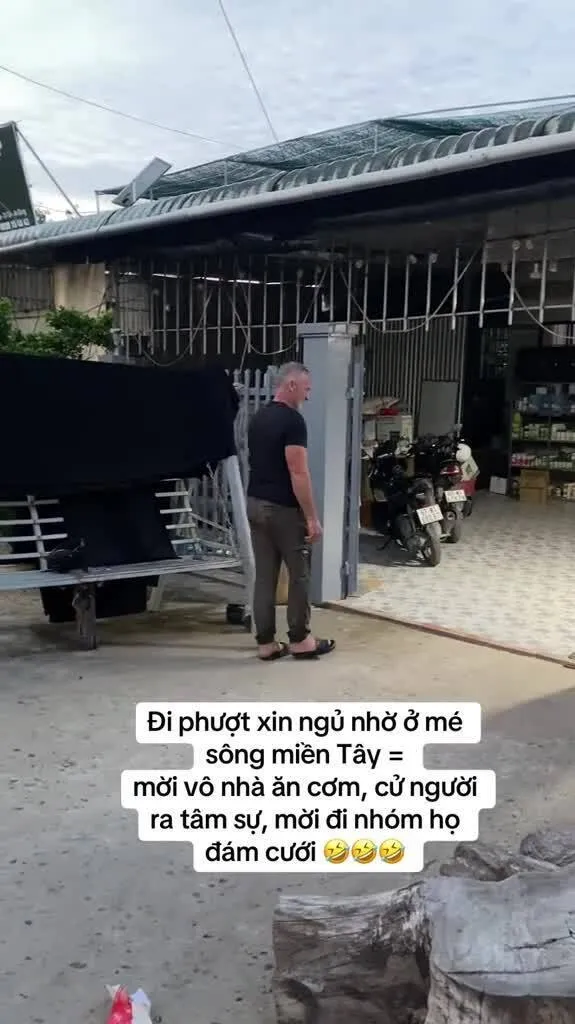
Bich Lieu’s family in An Giang Province hosts a foreign traveler for dinner and an overnight stay in February 2026. Video courtesy of Lieu
According to cultural researcher Dr. Pham Ngoc Trung, settlers who moved south from central and northern Vietnam more than 300 years ago faced harsh wilderness and constant dangers, forcing communities to depend heavily on one another regardless of social status or regional background.
Early pioneers guided newcomers, and whenever a family hosted an event or faced a crisis, the entire village rallied to assist.
Furthermore, the region’s intricate network of waterways nurtured a vibrant riverine trading culture, exposing communities to regular contact with newcomers, fostering an adaptable, open mindset unburdened by the rigid conventions of traditional agrarian villages.
It was this spirit that convinced Kyril Whittaker, a 29-year-old British native, to make the Mekong Delta his permanent home.
He talks about being stranded in Ca Mau Province and having an elderly shopkeeper cook him a bowl of noodles and refuse any payment, and having a bout of high fever at a Can Tho guesthouse when staff bought him rice porridge and nursed him like family.
“The greatest gift I’ve found here is peace of mind,” he says. “No matter where you wander, if you get into trouble, someone will always step up to help.”

Naoki Okamura, 31, attends a death anniversary feast in Tien Giang Province in June 2026. Video from TikTok/@naokiokramura.official