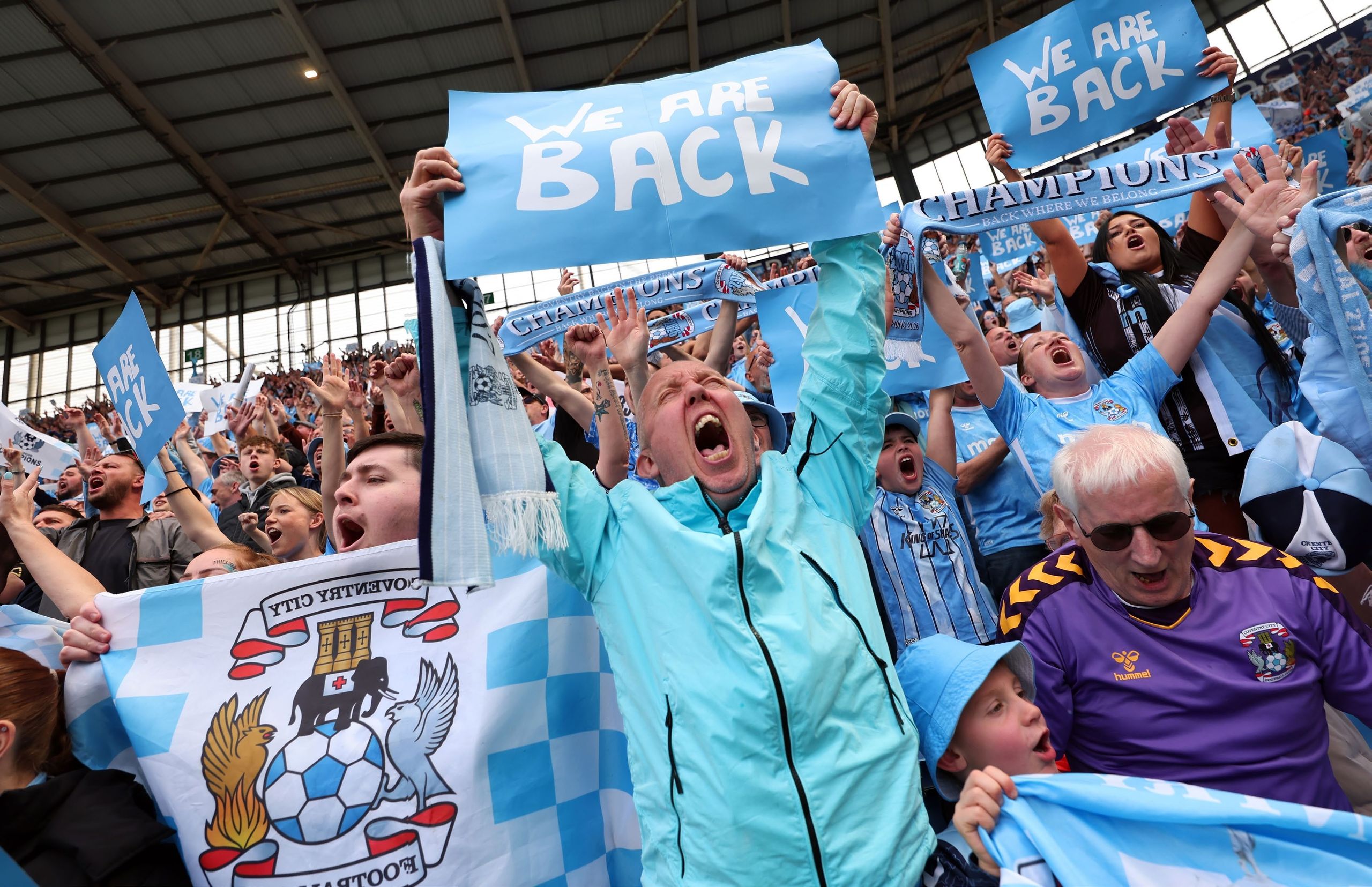
After 25 years away, the Sky Blues are back in the top flight under Frank Lampard. Captain Matt Grimes and the club’s last Premier League manager, Gordon Strachan, have spoken of their delight.
“It never happens for people like us, you know.”
That is the third line of We’ll Live And Die In These Towns by The Enemy. The Coventry band’s 2007 single has, for several years, served as the unofficial anthem of the city’s football club.
After a quarter of a century outside the top division, Coventry City supporters could hardly be blamed for feeling that particular lyric summed up the club’s suffering over recent decades. This season, though, they will sing it to a global Premier League audience for the first time.
Coventry stormed to the Championship title with 95 points and fully merited their return to the top tier under Frank Lampard. After spells with Chelsea, Manchester City and Everton, blue proved to be his colour once more.
The Sky Blues finished 11 points ahead of second-placed Ipswich and scored 97 goals. They occupied the automatic promotion spots for 40 of the 46 matchweeks and, apart from a brief wobble in mid-season, spent most of that time in first place. To keep the rest of the division at arm’s length without parachute payments was no small achievement.
It has been a long and difficult road. The club of today bears little resemblance to the one that was relegated from the Premier League in 2001. Back then, Coventry were playing at Highfield Road and had completed 34 straight seasons in the top flight – at the time, one of the longest runs in the division, behind only Arsenal, Everton and Liverpool.
Even the current version of Coventry City is very different from the side that was still in League One as recently as 2020. This is a team that has developed, reinvented itself and finally shaken off the financial burden that, at one point, had dragged the club down into the fourth tier.
In recent years, the direction of travel has been upwards, but making the climb back from League Two is rare – almost impossible, in truth. Coventry have managed it in eight years, even if there were a few false dawns along the way.
The club came painfully close to returning to the Premier League in 2023, only to lose on penalties to Luton in the play-off final. Then, in 2025, their hopes of redemption were crushed by a last-minute extra-time goal in the second leg of the semi-final at Sunderland. Between those two campaigns, Coventry also came within touching distance of an FA Cup final, only for a tight VAR decision to deny them after they had seemingly fought back from 3-0 down to lead Manchester United 4-3.
Given that the club had also spent the closing years of their previous top-flight spell flirting with relegation season after season, supporting Coventry has not been easy.
“There are signs up – even on the road signs – saying, ‘We’re back’,” Gordon Strachan says. The last man to manage Coventry in the Premier League was in the city this summer and saw first-hand what the club’s return to the big stage meant to people. He adds: “The community, football-wise, took a battering for 25 years. It’s a different world now in Coventry.”
He is absolutely right. The Scot understands better than most what the club has endured over the last 25 years. He also knows what came before that. Strachan arrived in 1995 under his former Manchester United manager Ron Atkinson, then became player-manager a year later. He retired from playing in 1997 but remained in charge for another four years, leaving four months after Coventry’s relegation from the top division.
Strachan’s family still hold season tickets at the club. Football may have taken him elsewhere, but Coventry remains a place he visits regularly.
“The eyes of the world are now on Coventry, which is great, and they’re actually talking about the football,” he says. “For 20 years, it was, ‘Who owns the stadium? Who’s got the shares in it? Where are we playing? Are we at Northampton or Birmingham? Who is the owner?’”
There were periods when supporters genuinely wondered whether the decline would ever stop. Rent disputes, administration, points deductions, Sisu, League Two, Mike Ashley, Frasers Group, Sixfields, St Andrew’s… but now, at last, the Premier League awaits.
We’ll Live And Die In These Towns is a song about post-industrial Britain, urban unemployment and surviving in spite of the weight of those realities.
Before the turn of the 21st century, Coventry was a centre of the automotive industry and home to many leading car manufacturers. The city’s industrial importance was such that it was targeted in a Luftwaffe bombing raid during the Second World War. It is no longer an industrial giant, but reminders of that past remain.
For much of the last 25 years, Coventry City have done exactly that – survived. While the club’s former owners kept a loss-making operation going, supporters did all they could to preserve the spirit of a well-backed football club.
“It’s been painful for these people, absolutely painful,” Strachan says. “But the younger ones, who are 12, 13 – that’s the catchment area. Coventry have captured another group of kids now, which they couldn’t do for years. The three main people in this have been Mark Robins, Doug King and Frank Lampard. Frank’s had to take them over the line, but between the three of them, that’s some group. I think Mark Robins is up there with Jimmy Hill, Noel Cantwell and people like that for the club.” It was Hill who led Coventry to their last promotion to the top flight in 1967. Cantwell followed him and, three years later, guided the club to sixth place in the First Division – still their highest-ever finish.
Any account of Coventry’s return to the top would do Robins a serious injustice if it failed to treat him with proper respect. Lampard will now take the team into the Premier League, but he may never have had that opportunity had Robins not laid the foundations through his promotion achievements.
The former Manchester United striker hauled Coventry back from the edge. He returned for a second spell as manager in March 2017, when the club were 10 points from safety in League One and seemingly destined for the fourth tier.
Yet they spent only one season in the basement division. Robins’ side sealed a play-off place with a 0-0 home draw against Morecambe on the final day of the 2017-18 season, then beat Notts County and Exeter to win promotion. Going up alongside Coventry that season were Luton, who would then defeat them at Wembley five years later to reach the Premier League.
The Sky Blues won the League One title in the Covid-affected 2019-20 campaign, despite being forced to play home fixtures at St Andrew’s in Birmingham. They were seven points clear of third place with 12 games remaining, having lost only three matches, when the season was halted and decided on points per game.
Robins came close to taking the club all the way back to the Premier League, but for that penalty shootout defeat in 2023. So when the decision was taken 18 months later to replace him with a high-profile, big-name appointment, there was uproar among supporters and pundits. Robins was EFL royalty and had transformed a troubled club. Lampard, by contrast, had underwhelmed in his second spell at Chelsea and only just kept Everton out of trouble.
It was a brave decision – but one that brought rewards worth hundreds of millions.
Not long after Lampard arrived, Coventry signed Matt Grimes from Swansea City in the middle of the season. Now 31, he has made 485 appearances across the EFL’s three divisions, but only four in the Premier League, all of them as a young Swansea player more than 10 years ago.
With 383 of the midfielder’s EFL appearances coming in the Championship – including three unsuccessful play-off campaigns – the phrase ‘glass ceiling’ felt fitting. Grimes admits openly that, after two or three years without any serious transfer interest, along with Swansea’s promotion hopes fading during his decade at the club, he had started to feel the Premier League chance had gone.
“I’m getting older,” Grimes says. “I gave a lot of years to Swansea and I’m very thankful for what they gave me in return, but I felt it was the right time to have a crack somewhere else. And it’s turned out as well as it could have done. I thought to myself, ‘If I don’t go and Coventry get promoted, I’d be gutted’. But then I thought, on the flip side, ‘If I go to Coventry and Swansea get promoted, I’d be just as devastated’.”
“I remember my agent saying, ‘Just have a chat with Frank Lampard.’ I was very settled at Swansea – I was very happy. We were like, ‘Let’s just have a conversation and see how it goes.’ As a midfielder, I don’t think there’s anyone you would rather play for than one of the greatest English midfielders of all time, if not the greatest. That was huge. It was a massive compliment that he wanted to sign me.”
“I’m not sure exactly how many seasons I’ve played in the Championship – seven or eight, I think – but I’ve had three play-off campaigns and eventually won the league. The painful moments make the good ones even sweeter.”
After last year’s play-off semi-final loss to Sunderland, the squad regrouped and used that disappointment as fuel to make a fast start in 2025-26. “The message from the gaffer was, ‘We need to start quick,’” Grimes explains. “In my past experiences, when Swansea made it to the play-offs under Steve Cooper, I think we won five of the first six matches. Our form for the rest of the season wasn’t great, but you’re always just a couple of wins away from where you want to be – top two, top six.”
Coventry then went 12 league matches unbeaten, and when their first loss arrived at Wrexham at the end of October, they were top of the table with a goal difference of +25 – a full 16 goals better than anyone else. Across those opening dozen games, they had won 4-0 away at Millwall, 5-0 at Sheffield Wednesday and 5-3 at Derby, while also beating Birmingham 3-0 at home and thrashing QPR 7-1.
Forward Brandon Thomas-Asante says: “The QPR and Sheffield Wednesday matches were pivotal points when we sent out a message and made people respect us more, as well as beating Middlesbrough at home in February.”
“Then when things weren’t going so great, like in the winter when people were asking, ‘Is this when the wheels fall off?’, we had the quiet confidence and humility to grind out a result or turn things around when the hype wasn’t there. That was important. Over the past 18 months, we gained those minerals.”
They needed those minerals, too, as Coventry managed only two wins in eight matches during the middle part of the season. By mid-February, the Sky Blues had also suffered back-to-back away defeats at Norwich and QPR, before being held 0-0 at home by struggling Oxford.
“If we’re having a stinker and I come in screaming and shouting at half-time,” says club captain Grimes, “then the lads aren’t going to take me seriously, because they know that’s not the type of person I am. I think the days where you need to be the loudest, and scream and shout, are gone.”
That approach proved effective. Coventry responded by securing a crucial 3-1 home win over Middlesbrough in the next game, taking top spot back from them and regaining momentum in the process. After spending four months at the summit, they had been displaced for just seven days.
“We dominated at the start, had a wobble, then recovered and won again,” Grimes says. “We won eight out of nine to cement our place at the top. Seasons like that don’t happen often. Even now, I don’t think it’s fully sunk in.”
Coventry sealed their long-awaited return to the Premier League with a 1-1 draw at Blackburn, thanks to Bobby Thomas’s 84th-minute header. Promotion was secured with three matches still to play.
“It was funny after Bobby scored,” Grimes recalls. “That was probably one of the strangest feelings on the pitch. I was going to the gaffer, ‘Should we go and win it? Should we not? Do we want to go for the title tonight?’ There were 7,000 fans there, something daft, which was a testament to them. It was more relief than anything at that point, because we knew it was going to happen. We were glad to get it done.”
“The club have been down to League Two, had to groundshare and all of that, so I feel like an imposter talking about it because I haven’t endured it the same way the fans have. But to give that back on that night, when we got the club promoted in front of 7,000 away fans, who travelled all the way to Blackburn on a Friday night, was very, very fitting.”
Coventry completed their title-winning season in style by scoring 12 goals against Portsmouth, Wrexham and Watford across their final three league matches. After that, the squad headed to Las Vegas to celebrate.
“When teams come down from the Premier League, it’s normal that all of the bookmakers have them to be in the top two or top six,” Grimes says. “So to win the league like we did, 11 points ahead of second – I don’t think people will realise the magnitude of it until maybe a couple of years down the line.”
“It was a season where most of what we touched turned to gold.”
Clearly, Lampard knows how to win football matches. “You can’t have too big a long-term plan at a club, because in football, the only thing that really matters is winning,” Strachan says. “Frank’s picked it up and added to it. It’s nothing cosmic – it’s good players, with a good understanding of what they’re doing, doing what they’re best at.”
The 69-year-old’s view may sound like a simplified explanation of management, but it worked well for him during much of his time at Highfield Road.
“Five years before relegation, we beat everyone – Liverpool away, Manchester United, Arsenal a couple of times, Chelsea three or four times, Aston Villa – so there were a lot of great moments,” he recalls with a smile. “I spent most of my life laughing. I had a great time.”
Lampard may well say something similar when the time eventually comes for him to put away his, well, notepad – but that moment is some way off. His uncle Harry Redknapp managed until the age of 70, which suggests that Lampard, now 48, could have another two decades in the dugout.
“He has surprised me – I didn’t see them going up at the start of the year,” Redknapp says. “I didn’t see Coventry in it at all. I thought if they could finish sixth, maybe make the play-offs, it’d be a great season for him.”
“He’s got to make sure he goes into the Premier League prepared. Are they going to be good enough to stay up? That’s the problem. We’ve seen it so many times: good young managers, who have done an excellent job and know the game, quickly watch all their hard work unravel.”
“When results aren’t going your way, you have people calling up the radio,” Redknapp continues. “Idiots who don’t know what they’re talking about come on and say, ‘Well, yeah, we’re losing because he’s a Championship manager.’ What a load of rubbish.”
This season will test the resolve of both Lampard and Coventry. Before Sunderland and Leeds produced fine campaigns in 2025-26, each of the previous six newly promoted teams had gone straight back down. For ambitious Championship clubs, harsh reality often arrives quickly once they reach the promised land.
Redknapp believes the Sky Blues need six quality additions to survive. Grimes, however, is not giving much away. “For any promoted team, the first goal is to stay up,” he says. “If you stay up, maybe then you can start to think about other things. We don’t want to get carried away.”
When asked which ground he is most looking forward to playing at, Grimes gives a straightforward answer. “It’s a cliche answer, but the big stadiums: Liverpool, Chelsea, Arsenal, Man United,” he says, having grown up in a Liverpool-supporting family. One of those away days comes first. Coventry will begin the 2026-27 Premier League season away to reigning champions Arsenal on Friday, August 21.
Having climbed from League Two to the top flight in only eight years, it will be some baptism of fire, before a first home match against fellow promoted side Hull at the Coventry Building Society Arena a week later. The Premier League will demand agility, adaptability, cunning and intelligence from both clubs. Do they have those qualities? We will find out soon enough. For 25 years, it did not happen for clubs like Coventry City. At last, after a quarter of a century, it has. The Sky Blues are back – and now the challenge is to stay there.