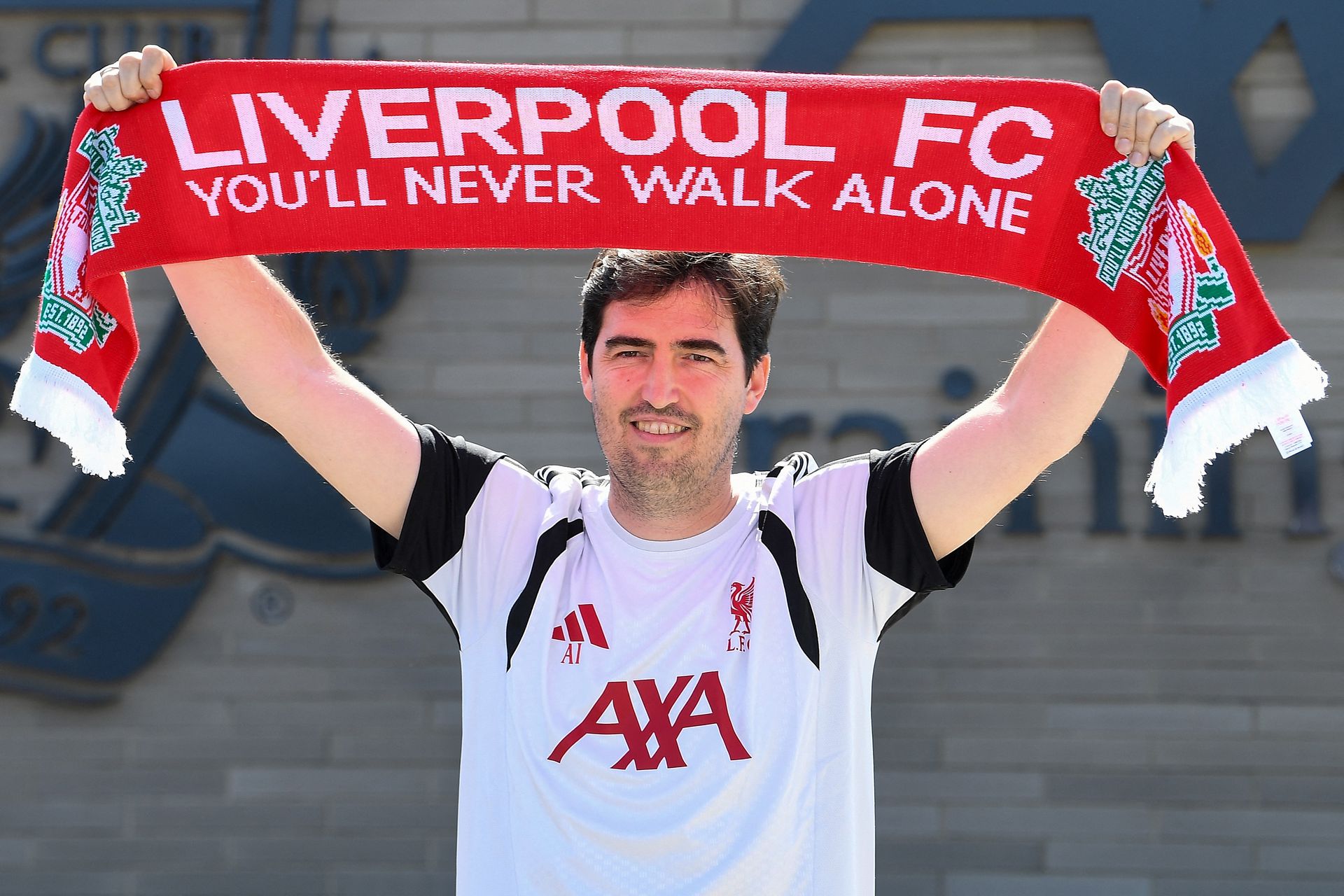
Liverpool appointed Andoni Iraola earlier this summer — and for FourFourTwo, it did not come as a surprise.
Liverpool bringing in Andoni Iraola felt like an unexpected move to some, especially as Xabi Alonso had been available for quite some time.
That had seemed the obvious route as well. The former Liverpool midfielder had been strongly linked with succeeding Jurgen Klopp, even before Arne Slot had entered the discussion for the role. So when the rumours of Alonso heading to Anfield did not become reality at the end of last season, the assumption was that the Reds would continue with Slot. Alonso even went to Chelsea.
That is what made Iraola such an intriguing appointment. On the pitch, certainly, he is ideally matched to the high-pressing style that has defined the red half of Merseyside over roughly the last decade. Away from the pitch, though, not many had yet joined the dots.
The Basque spent almost all of his playing career with Athletic Club, before enjoying a season in the Big Apple with New York City FC and then moving into coaching.
In 2024, FourFourTwo sat down with Iraola to discuss his journey from Bilbao to Bournemouth, and how he developed into one of the most exciting young coaches in world football through a very specific pathway.
Athletic, of course, have a famously clear identity: their ‘cantera’ policy is focused entirely on producing players of Basque origin or from the region. The supporters at San Mames, meanwhile, are openly politically engaged, showing solidarity with international social and political causes. Broadly speaking, whether you are on the left or the right in Bilbao, you are still part of something bigger.
Rayo Vallecano — the club Iraola managed before Bournemouth — are firmly socialist. The club’s well-known ultra group, Los Bukaneros, is openly anti-fascist, anti-racist and supportive of workers’ rights. In 2014, the club and its supporters helped Carmen Martinez Ayudo, an 85-year-old local woman who had been evicted from her home, by displaying banners at the very next match reading: “The evictions of a sick state, the solidarity of a working-class neighbourhood.”
When FourFourTwo suggested to Iraola himself that a club’s identity might be central to him in football, he nodded in agreement. While careful not to use the P-word — politics — he made it very clear that he likes to associate himself with clubs that passionately believe in something.
“I’d practically been a one-club man as a player: I stayed 16 years at Athletic Club, and I think at Athletic and Rayo Vallecano, the sense of belonging is really important,” Iraola said.
“In the end, I always ask my players to think first collectively, even if I understand that the players want to achieve a lot of things in their careers. If we work as a collective, I will look like a better manager, they will look like a better player and even the players who are playing fewer minutes will look better — because the ones that are playing will look better. I think we have to prioritise the team, and the team always comes first.
“This has always been the case at Bournemouth.”
It was Bill Shankly who once said, “The socialism I believe in is everybody working for each other and having a share in the rewards. That's how I see football, that's how I see life.” A great deal has happened politically, socially and inside football grounds — both to Liverpool and within the city — since those words were first spoken.
But the sense of Liverpool’s identity has always been unmistakable. Perhaps nowhere else in the country could a parallel to “Scouse not English” have taken hold. Under Klopp, the Reds embraced the collective far more than some supporters at other clubs have done with high-press evangelists. It is perhaps fair to suggest that Liverpool’s identity was a major reason behind Iraola’s move to Anfield.