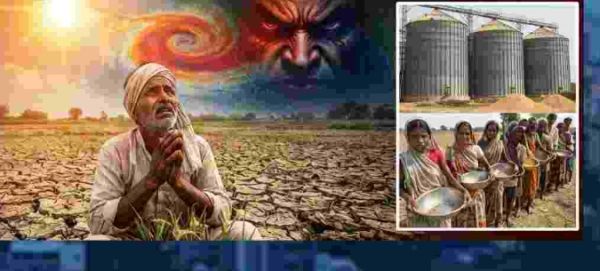
Every year, meteorologists and farmers keep an eye on the movements of the Pacific Ocean regarding the south-west monsoon, which is considered the lifeline of Indian agriculture and rural economy. In recent times, claims to possible activation of El Nino and increase in the risk of drought in the country by 70% have increased the concern of farmers and common citizens. However, looking at the actual principles of meteorology and official forecasts, the situation is not as dire as it is being portrayed on social media. What is El Nino and how is it to Indian monsoon? El Nino is a seasonal phenomenon of abnormal increase in sea surface temperatures in the equatorial Pacific Ocean. When the ocean surface warms, it affects the global atmospheric circulation.
According to historical data, whenever an intense El Nino develops, the monsoon winds over India are more likely to weaken, resulting in below normal rainfall over parts of central and northwest India. But this does not mean that every El Nino year will result in drought or starvation. Does El Nino always mean drought? According to meteorologists, the relationship between El Nino and the Indian monsoon is not one-way: Indian Ocean Dipole (IOD): A ‘Positive IOD’ formed in the Indian Ocean often completely neutralizes the negative impact of El Nino and ensures adequate rainfall in the country. Historical data: Data over the last 140 years show that India has recorded normal and even above normal rainfall in many El Nino years.
Spatial Distribution: The effect of monsoon is not uniform across the country; If there is lack of rain in one part, then there is abundant rainfall in other coastal and north-eastern areas. Impact on Agriculture Sector and Government’s Pre-Preparations Main crops of Kharif season like paddy, soybean, maize, cotton and pulses are directly dependent on monsoon rains. To deal with any possible seasonal changes, the Agriculture Ministry and the Indian Council of Agricultural Research (ICAR) already issue guidelines for sowing of climate-resilient seeds and low-water crops.
Moreover, Indian agriculture is now more capable and robust in dealing with seasonal uncertainties due to higher water storage levels in the country’s major reservoirs and expanded irrigation networks. India Meteorological Department (IMD) advisory and caution India Meteorological Department (IMD) has clarified that long-range forecasts are updated at regular intervals. Farmers should plan sowing and irrigation based on IMD’s official bulletin and local agricultural advisories available on government weather apps like ‘Meghdoot’ and ‘Damini’ instead of paying attention to sensational news and rumors spread on social media.