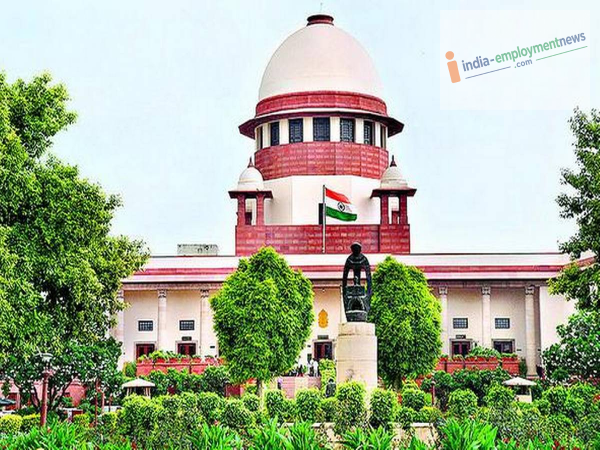
Supreme Court: While hearing a case on Thursday (August 20), the Supreme Court explicitly stated that a mere entry in revenue records neither creates nor extinguishes ownership rights over immovable property.
A bench comprising Justice Sanjay Karol and Justice Augustine George Masih delivered this verdict while hearing a dispute regarding the ownership of agricultural land belonging to a joint family.
What was the case?
The case primarily involved a land dispute where the original owner was a man named Bhagwan Singh. Upon Bhagwan Singh's death, the land was recorded in government records in the names of his two sons—Ramprasad and Vasudev. Later, the Madhya Pradesh High Court rejected the ownership claim of one party based solely on the fact that only one person's name was entered in the revenue records.
When the matter reached the Supreme Court, the Court set aside the Madhya Pradesh High Court's decision. The Supreme Court stated that property title cannot be determined solely based on revenue records; other evidence must also be considered.
What did the Supreme Court rule?
Setting aside the Madhya Pradesh High Court's order, the bench of Justice Sanjay Karol and Justice Augustine George Masih observed that an entry in revenue records neither creates nor extinguishes title and exists primarily for fiscal purposes. In other words, revenue records alone are insufficient to establish actual land ownership; the presence of a registered deed or other concrete evidence is also essential.
The Court noted that the purpose of recording a name in revenue records is to identify the person liable to pay land tax to the government. If there is a dispute regarding the actual ownership rights of a property, only the civil court has the authority to resolve it. Officials such as the Tehsildar or those from the Revenue Department do not possess the legal authority to determine ownership rights.
So, how are legal rights established?
Your actual legal right to the property is recognized only if your name appears in a registered sale deed (registry), gift deed, or lease deed; if there is a valid will in your favor; or if a civil court has declared you the owner of the property.