India must become a creator of artificial intelligence rather than remain merely a consumer, Delhi Chief Minister Rekha Gupta said on Saturday while addressing graduating students at VIT University in Vellore.
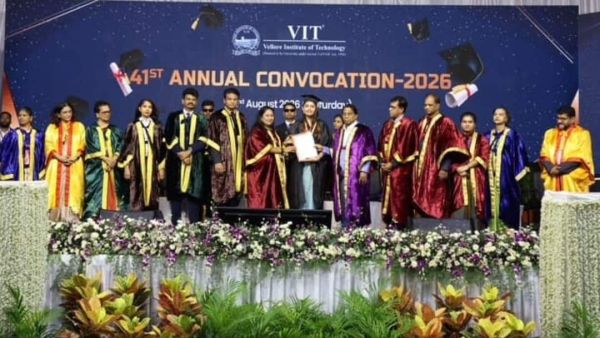
Gupta was the chief guest at the university's 41st convocation, presided over by VIT Chancellor G. Viswanathan. She conferred degree certificates on students graduating from various undergraduate and postgraduate programmes.
Calling on young professionals to contribute to solving real-world problems, Gupta said governments and graduates could work together to address some of the country's most pressing challenges. She cited Delhi's experience of working with IIT institutions to tackle issues including pollution, traffic congestion and waste management.
Gupta urged graduates to carry the same problem-solving approach into their professional lives and contribute to the development of their cities and the country.
"Don't just be users of artificial intelligence — build India's own AI," she said, pointing to investments made by the Union government under Prime Minister Narendra Modi through the India AI Mission.
She said the initiative covers areas including semiconductors, computing infrastructure, defence, space, drones, robotics and biotechnology. Moving from consuming AI technology to producing it, she said, would be among the most significant contributions graduates could make to their states and the country.
Gupta also urged students not to be discouraged by failure. Instead, she advised them to understand why something went wrong, identify the causes and keep working towards a solution rather than abandoning the challenge.
The Delhi chief minister stressed the importance of hard work and described the country's intellectual capital as its most valuable resource, with graduating students forming an important part of that pool.
She said India's growth should be guided by the principles of "Make in India", "Invest in India", "Design in India" and "Brand in India". While Indian engineers are already recognised globally for their talent, she said the world should now also see the strength of technology created in India.
VIT Chancellor G. Viswanathan, meanwhile, highlighted the need to expand access to higher education. He said India's Gross Enrolment Ratio in higher education is around 30 per cent, while the Union government's new education policy seeks to raise it to 50 per cent.
Viswanathan said India needs to compete with other Asian countries on higher education participation, citing enrolment ratios of 90 per cent in South Korea, 60 per cent in Japan, more than 60 per cent in China, 40 per cent in Malaysia and 45 per cent in Thailand.
He said India currently has around 1,400 universities, 54,000 colleges and 16,000 standalone higher education institutions, with about 4.5 crore students enrolled. Ensuring that students from poor and middle-class families can access higher education, he said, is a shared responsibility of the Centre and state governments.
Viswanathan also highlighted what he described as an imbalance between engineering and medical education. India has more than 50 lakh engineering seats, he said, but only around 1.3 lakh medical seats.
According to Viswanathan, around 22 lakh students appear for NEET every year for approximately 1.3 lakh medical seats across the country. He said only around 2,000 to 3,000 seats remain vacant after allotment.
The shortage, he said, contributes to nearly 1 lakh Indian students travelling abroad every year to study medicine. He cited destinations including China, Russia, the Philippines, Kyrgyzstan, France, Bangladesh, Georgia, Italy, Poland, Iran and Nepal.
Viswanathan said the World Health Organisation recommends one doctor for every 1,000 people. While southern states such as Tamil Nadu meet that benchmark, he said Bihar and Uttar Pradesh face shortages, with ratios of one doctor for every 2,000 to 2,300 people.
India has around 840 medical colleges offering approximately 1.3 lakh seats, he said. Individual colleges generally admit 100 to 150 students annually, compared with up to 400 in Britain and between 800 and 1,200 in China.
He suggested that increasing intake to 1,000 students per medical institution could potentially take India's total medical seats to around 8 lakh, provided sufficient faculty and infrastructure are developed.
Viswanathan also raised the issue of disputes between governors and state governments over the appointment of vice-chancellors. He said 17 universities in Tamil Nadu and more than 13 in Kerala currently have vacant vice-chancellor positions.
He appealed to newly appointed Union Education Minister Pralhad Joshi to help coordinate between governors and state governments so that disputes do not affect the education sector or students.
Viswanathan also said India, which was once the world's fourth-largest economy, had fallen to sixth place amid a decline in the value of the rupee. He called for greater production and exports through education-led growth.
The convocation also had a personal significance for Gupta, whose son Nikunj Gupta graduated alongside his batchmates.
The Delhi chief minister was seated below the stage as she watched her son receive his degree certificate, visibly proud during the ceremony.
Overall, 11,276 undergraduate and postgraduate students received degree certificates. Of these, 7,359 graduated from undergraduate programmes and 3,917 from postgraduate programmes.
The graduating cohort included 6,046 B.Tech students, 1,732 M.Tech students, 1,313 students from other undergraduate courses and 2,185 students from M.Sc. and other postgraduate programmes. A total of 781 students received Ph.D. degrees, while three were awarded integrated Ph.D. degrees.
Academic distinction certificates were presented to 248 top-ranking students, while 84 students received gold medals.
Earlier in the day, Gupta inaugurated the Centre for Advanced Research for Bacteriophage and Infectious Diseases at VIT.
Babu Unnikrishnan, Vice President and CTO at TCS, also addressed the gathering. The ceremony was attended by VIT Vice-Presidents Sankar Viswanathan and Sekar Viswanathan, G.V. Selvam, Executive Director Sandhya Pentareddy, Assistant Vice-President Kadhambari S. Viswanathan, Ramani Balasundaram, Vice-Chancellor V.S. Kanchana Bhaskaran, Pro-Vice-Chancellor Parthasarathy Mallik and Registrar T. Jayabharathi, along with faculty members, parents and students. The convocation concludes on Sunday.