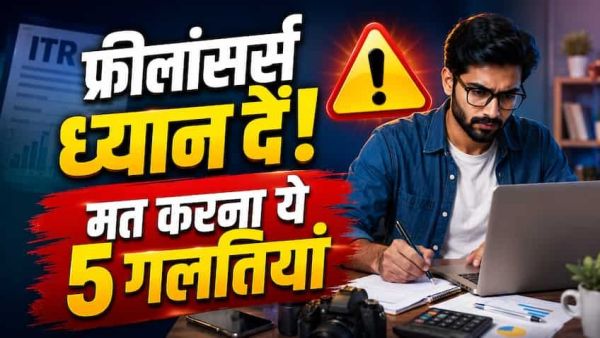
Amidst the growing trend of gig economy, consultancy and remote work in India, freelancing has become the main source of income for millions of youth. Professionals working in professions like software development, content writing, graphic designing, digital marketing, video editing and legal-medical consultancy earn revenue every month from various domestic and international clients. However, when it comes to filing Income Tax Returns (ITR), many freelancers get confused between the rules for salaried employees and the business class. As the ITR filing deadline for the financial year is approaching, even a small unintentional mistake can trigger the Income Tax Department's automated scrutiny system and a notice under section 143(1) or 148. Mistake 1: Selecting the wrong ITR form (Big mistake of filling ITR-1 or ITR-2) The first and most serious mistake of most freelancers is selecting the wrong return form. Many freelancers consider their earnings as normal income and file them in the simple form meant for salaried employees i.e. ITR-1 (Sahaj) or ITR-2. As per income tax rules, income from freelancing is counted in the 'Income from Business or Profession' (PGBP) category. If you are a freelancer, you are eligible for only two forms: ITR-4 (Sugam): If you are opting for presumptive taxation scheme under Section 44ADA and your gross business receipts are up to ₹50 lakh (or ₹75 lakh if 95% of transactions are digital). ITR-3: If your total receipts exceed the prescribed limit, you maintain books of accounts and want to pay tax on ordinary profits by claiming actual expenses. If the return is filed in the wrong form, the Income Tax Department can declare your return as 'Defective Return' (Defective Return under Section 139(9)), which has limited time to correct it. Mistake 2: Not matching bank accounts and TDS with AIS, TIS and Form 26AS The modern computerized system of the Income Tax Department is now fully equipped with Artificial Intelligence and Big Data Analytics. Whenever an Indian company pays more than ₹30,000 to a freelancer, it usually deducts TDS under section 194J (professional fees) or 194C (contract fees). This tax deducted is directly recorded in your Annual Information Statement (AIS), Taxpayer Information Summary (TIS) and Form 26AS. If there is even a slight mismatch between the total income declared in your return and the amount entered in AIS, the system automatically flags the mismatch. Apart from this, information about the total amount deposited in all your active savings bank accounts and current accounts, stock market trading or mutual fund redemptions is also available in AIS. Therefore, before filing returns, it is mandatory to download AIS and 26AS from the portal and match each entry closely. Mistake 3: Ignoring revenue and FEMA regulations from foreign clients Indian freelancers working for foreign clients often receive payments in US dollars, Euros or Pounds through international payment gateways such as PayPal, Stripe, Pioneer or direct wire transfer (SWIFT). Many times freelancers feel that foreign income will not be taxed in India or it comes under exemption. If you are a tax resident of India, your global income is taxable in India. When receiving foreign income you are required to have a 'Foreign Inward Remittance Certificate' (FIRC) or remittance advice issued by your bank. Additionally, if your total annual freelance income exceeds the GST registration limit (₹20 lakh for services), you must have a valid GST number and Letter of Undertaking (LUT) to carry out zero-rated export of services. If foreign payment is taken without LUT, notice of liability and interest may also come from the GST department. Mistake 4: Incorrect calculation of expenses and profits under Section 44ADA Section 44ADA of the Income Tax Act is a very convenient provision for small freelancers and professionals. Under this, eligible freelancers (like software engineers, designers, writers, lawyers, doctors etc.) are allowed to pay tax directly by considering at least 50% of their total gross receipts as net profit without getting regular balance sheets and audits done. The remaining 50% is considered business expense. However, there are two big mistakes that freelancers make: If your actual profit is more than 50% (say 80%), yet you arbitrarily save tax by showing only the minimum 50% and maintain a huge surplus balance in the bank account, this can get caught in scrutiny. After opting for the presumptive scheme, you cannot separately claim internet bill, laptop depreciation, office rent or travel expenses as deductions as all expenses are already included in the flat 50% discount. Mistake 5: Not paying advance tax installments: Every month, the employer deducts and deposits tax from the salary of salaried employees, but in the case of freelancers, despite deducting TDS, the final tax liability often turns out to be higher. According to the Income Tax Law, if your net tax liability after deducting TDS in a financial year is ₹ 10,000 or more, you are required to deposit advance tax in four instalments. These installments have to be deposited every year by 15th June (15%), 15th September (45%), 15th December (75%) and 15th March (100%) (those opting for Section 44ADA can deposit the entire amount in lump sum by 15th March). If you do not pay advance tax on time and pay full self-assessment tax only when filing ITR in July, you will have to pay huge penal interest at the rate of 1% per month under Section 234B and 234C. To avoid notice, do these things immediately. To avoid server slowness and technical problems in the last days, file your return on time. After completing the filing, complete the e-verification of your return through Aadhaar OTP or net banking within 30 days. Returns filed without verification are considered legally invalid, leading to the risk of both penalties and notices.