From derby matches staged on a ferry to Togolese imposters and even itching powder, Paul Watson’s new book is filled with extraordinary and delightful football stories from across the world.
In his new book, Paul Watson recounts some of the strangest tales in the global game, including a club with a suspected drug lord in midfield, supporters who turn up dressed as squirrels, and a team from Benin desperate for revenge.
Here are 20 scarcely believable stories from every corner of the planet...
Whenever teams watch a cup draw, they usually hope to avoid a potential upset, so Santiago Wanderers were unlikely to have been pleased when they were handed a trip to the distant Juan Fernandez Islands in the 2024 Copa Chile. The tie meant travelling to Robinson Crusoe Island, 400 miles off the coast of Chile, named after Daniel Defoe’s famous novel about an English merchant shipwrecked on a remote island for 28 years.
There were not enough commercial transport options for Santiago Wanderers to get there, so they had to rely on a Chilean navy supply vessel, the Aquiles, to take them to face unfamiliar opponents.
The Juan Fernandez side had been put together in a hurry from recreational teams on the island, and their preparations were disrupted because some players missed training due to lobster harvesting. Even so, they gave their professional opponents a real scare and only just lost 2-1.
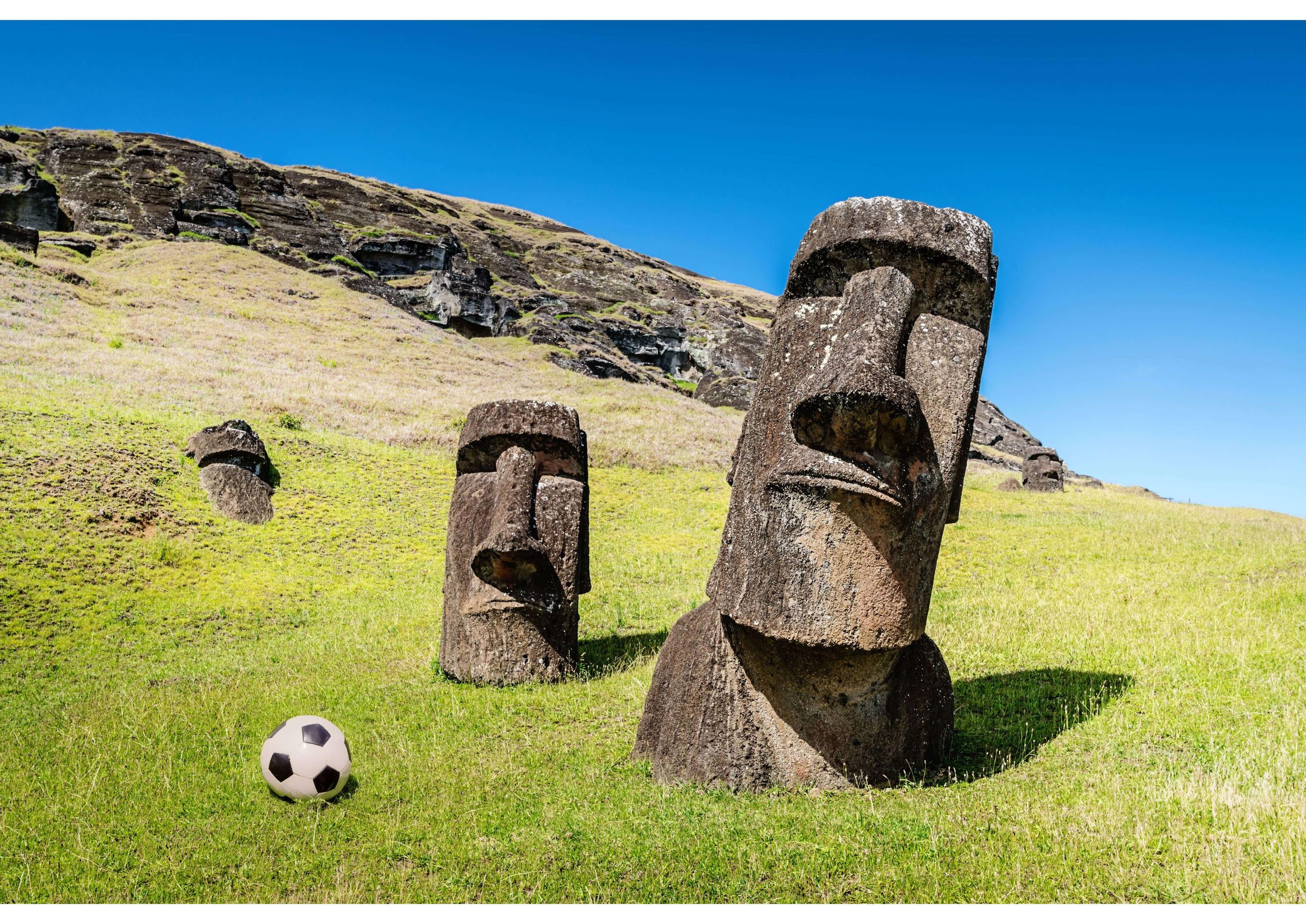
It was the second occasion on which a team from Chile’s remote islands had entered the Copa Chile. Back in 2009, a side from Rapa Nui, better known as Easter Island, hosted Colo-Colo, widely considered the country’s most successful club. Colo-Colo went back home with a 4-0 win, but the enduring image was Rapa Nui’s pre-match Polynesian war dance on a pitch bordered by two of the island’s famous Moai statues.
When a club is expelled from its league, the assumption is usually that they gained an unfair advantage. In the case of Sueca United, though, it was the exact opposite – they were removed from the lower tiers of Valencia’s league structure for being so poor that officials believed they were not even trying.
The club was the creation of eccentric actor Pau Codina and was intended to offer opportunities to players who may not have found a game elsewhere. Admirable though that idea was, it left Sueca hopelessly outclassed almost every week. Across 11 seasons, they lost more than 300 matches in succession and conceded over 4,000 goals. The average scoreline across the club’s existence was 24-0. By September 2023, the Valencian Football Federation had run out of patience and threw Sueca United out after only two matches, one of them ending in a 40-0 hammering. Enough was enough.
The Estonian islands of Saaremaa and Hiiumaa have long shared a fierce but friendly rivalry. When they arranged a football match in 2013, neither team wanted to give up home advantage, so they found an inventive neutral venue – the game was played aboard the M/S Muhumaa passenger ferry that links the two islands.
A strip of grass was laid on the deck of the boat, although there was space only for five-a-side, which probably helped reduce the chances of any tackles going, well, overboard if tempers rose. Hiiumaa won 4-1, which was a surprise because Saaremaa is home to FC Kuressaare, a club that competes in Estonia’s top division. Curiously, FC Kuressaare train in Tallinn but play their home fixtures on their own island, which means home matches can involve longer travel than away games.
Sudanese club Al Hilal recently achieved something unprecedented – winning the league in three different countries within the space of just two seasons. Forced out of their homeland by a brutal civil war, they and fellow Sudanese side Al Merrikh entered Mauritania’s Super D1 League for 2024-25. The two nations are far from neighbours, lying roughly 3,000 miles apart, but Al Hilal still finished top of the table, even if they were recognised only as “honorary champions”, with local side FC Nouadhibou officially recorded as title winners.
The two Sudanese clubs then briefly returned home, where Al Hilal won the Elite League, a shortened competition used to decide which clubs would represent Sudan in continental tournaments. Both sides then moved into the Rwanda Premier League for 2025-26, where Al Hilal comfortably completed a remarkable treble.
There was plenty of discussion about the impact of altitude before England’s World Cup triumph in Mexico City this year, but that was mild compared to a trip to Peruvian side Union Minas. From the 1980s into the early 2000s, the Cerro de Pasco club rose to the top level of Peruvian football with a squad made up largely of journeymen veterans and nearly men, helped greatly by a formidable home advantage.
The Estadio Daniel Alcides Carrion is the highest stadium in the world, sitting at around 14,000 feet above sea level – about 2,126 Dan Burns, and less than 4,000 feet below the base camps on Mount Everest. Visiting teams were so badly affected by the altitude that players were often left incapacitated, and oxygen masks were a common sight in the away dressing room at half-time.
Union briefly topped the first-division table during the 1998 season, but the decline of the local mining industry hit the region hard. The club then slipped down the divisions, stopped operating in 2011, and only returned last year.
Some clubs inspire deep hostility from rivals without any obvious reason. In other cases, the reason is much easier to understand. Maltese club Valletta FC are a perfect example.
The Lilywhites are among Malta’s most decorated clubs, with 25 league titles to their name, and in 2000-01 they brushed aside Gerard Houllier’s Liverpool cup treble by completing the almost unheard-of feat of a domestic sextuple, winning the Premier League, Rothmans Trophy, Super Five Cup, Lowenbrau Cup, Super Cup and Centenary Cup all in the same season.
What really irritates rival supporters, however, is the way Valletta celebrate. Whenever they win the league, their fans stage a mock funeral parade through the streets for the defeated opposition, carrying coffins bearing the insignia of rival clubs. So it was no surprise that when Valletta suffered the first relegation in their history in 2023-24, other clubs took considerable pleasure in it.
Since 1961, the Coupe de France has been open to teams from French territories around the world, creating some of the most epic away trips in football. The French Football Federation pays the travel costs, but amateur players still have to negotiate time away from their day jobs for what can be a very long journey.
In 2024-25, fourth-tier Normandy club US Avranches were handed an away tie against AS Dragon of Papeete in Tahiti – a journey of nearly 10,000 miles from wet northern France to a tropical Pacific island paradise, only to lose on penalties after a 2-2 draw.
Footballers often like to claim a transfer was inspired by lifelong affection for their new club, but the real reasons are frequently quite different. One of the oddest examples came with Congolese winger Thievy Bifouma’s move to Iranian side Esteghlal Khuzestan in 2024.
The former West Bromwich Albion loanee said he signed because he wanted the chance to face Cristiano Ronaldo in the Asian Champions League. “I reviewed the calendar and realised they had a game against Al Nassr – I said to myself this was where I wanted to go,” he told Iranian media.
The problem was that Al Nassr were due to play Esteghlal FC from Tehran, not Esteghlal Khuzestan, an entirely different club based hundreds of miles further south. “I had no idea there were two teams named Esteghlal,” Bifouma admitted. “When I arrived, my countryman Gael Kakuta called me and asked where I was.” Kakuta played for Esteghlal FC, and the two soon discovered they would not be team-mates after all.
There are quite a few prison football teams around the world, but Welsh club HMP Prescoed are unusual – their squad is not made up of guards or support workers, but inmates from the Category D, or open, prison.
The side plays in the Gwent Central League, and a quick look at the standings suggests they have an excellent home record but dreadful away form. The truth is that HMP Prescoed are not permitted to travel to away fixtures, for obvious reasons. They play those matches on their own ground but must forfeit each one 5-0 and accept a three-point deduction. That means the best possible outcome over a season is to finish on zero points. Last season they ended on minus five, despite recording five wins and one draw from 14 games.
When the small Caribbean island of Antigua was given the opportunity to place a club in the United Soccer League, the third tier of football in the United States, it looked like a wonderful chance. By the time of Antigua Barracuda’s disastrous third season in 2013, though, the dream had become a nightmare.
The league was supposed to be “international”, but three Puerto Rican teams were removed during the 2011 season, and by 2013 Barracuda had been forced to relocate to the US mainland simply to continue competing. Short of money, the team lived in a cramped hotel in Tampa, Florida, and travelled up to 10 hours in a tiny minibus to fulfil fixtures. At one stage they even had to train in the hotel car park because they had no access to a proper pitch. They lost all 26 of their 26 matches.
Japanese third-tier club FC Ryukyu come from Okinawa, an island known for its beaches, coral reefs and a famous Second World War battle. Okinawa was once the Ryukyu Kingdom, separate from Japan, and it still has its own distinct culture. It is also geographically detached from the rest of the country, which creates a major challenge for a football club – every away game FC Ryukyu play in the J3 League involves travelling at least 400 miles.
If the club wanted to encourage a sense of closeness, though, they perhaps chose an unusual route by taking Unko Museum as their 2025 back-of-shirt sponsor. The Unko Museum is devoted to the theme of poo, describing itself as “disgustingly cute” and, rather alarmingly, “highly interactive”.
Plenty of teams know the misery of getting back on the coach for a long journey home after a bad defeat. Very few, however, can match the experience of Bani Ganse.
The Benin side were already unhappy when they boarded their bus for the 10-hour journey home after facing Loto-Popo in the south-west of the country. Matters soon became much worse when players and staff started itching uncontrollably. It emerged that Loto-Popo fans had sprayed industrial itching powder on the seats in response to a belief that Bani Ganse had allegedly put “suspicious substances on the field”. Loto-Popo said they had “neutralised that with holy water” – but there was no such relief for the Bani Ganse squad as their team bus became increasingly unbearable.
When Baltika Kaliningrad were promoted to the Russian Premier League in 2023, nobody was happier than the fans of SKA-Khabarovsk, who no longer had to make the exhausting cross-country trip to play them.
Khabarovsk lies in Russia’s far east, close to China, Japan and North Korea, while Kaliningrad is an exclave on the Baltic Sea between Poland and Lithuania. The 9,000-mile round trip had become a dreaded regular assignment, but Baltika’s promotion – though they were relegated immediately before bouncing back up again in 2025 – at least reduced Khabarovsk’s travel burden a little. They still clock up around 70,000 miles a season, roughly the same as travelling a third of the way to the Moon.
When youth football coach Andrew Amers-Morrison went on holiday to the Seychelles in 2010, he could scarcely have imagined how dramatic that trip would become.
The Seychelles Football Federation mistakenly believed that former Manchester City player Andy Morrison was on the island and rushed to offer him the job of men’s national team coach. Surprised but delighted, Amers-Morrison accepted. Unfortunately, the situation collapsed when a journalist contacted the real Andrew Morrison to ask about his plans for the team, only for the baffled man on the other end to say he had never even been to the Seychelles.
The embarrassed federation first reduced Amers-Morrison’s contract to six months so he could try to prove himself, then withdrew the offer altogether, saying they “could no longer be certain he was the right person to head the coaching staff of the national team”. It was difficult to argue – they had literally handed the job to the wrong man. The real Andy Morrison has since gone on to manage Connah’s Quay Nomads and Sri Lanka.
Set in the middle of the South Atlantic, the British Overseas Territory of St Helena is best known as the place of Napoleon’s final exile. It also hosts one of the most remote football leagues in the world, played at the island’s scenic Francis Plain Playing Field.
It was in that league, in 2020, that Crystal Rangers were beaten 36-0 by Rovers and 30-0 by Bellboys. Those looked dreadful results for a side that had won the island’s cup four times and the league title once during the 1990s, but there were mitigating circumstances. On both occasions, the team could field only eight players because an emergency sea rescue meant several of them had to dash off to lifeboat duty during the pre-match warm-up.
Ceuta is an autonomous Spanish city on the North African coast, linked to Morocco, and it recently made global headlines when thousands of migrants arrived by sea within a matter of hours. It has no airport, which has also turned it into a logistical headache for visiting clubs since Ceuta reached the Segunda Division in 2025.
The normal route is by ferry from the southern Spanish port of Algeciras, but when Barcelona were drawn against Ceuta in the Copa del Rey in 2023, they took no risks – flying the matchday squad there in three separate helicopters.
Last season, Ceuta finished a respectable mid-table and were especially strong at home, but coach Jose Juan Romero described their long trip to FC Andorra for a dead-rubber fixture as “a pain in the ass” – a Spanish league game between a club from mainland Africa and another based in an entirely different country.
When people think of fan culture, landlocked Andorra is probably not the first place that comes to mind. Yet the world’s 17th-smallest country has a superb, if slightly eccentric, supporter tradition.
The town of Santa Coloma – just outside the country’s big smoke, the capital Andorra la Vella – is home to two rival clubs, FC Santa Coloma and UE Santa Coloma. The latter have embraced the town’s famously – or perhaps not quite famously – large squirrel population by adopting Esquirols, or the Squirrels, as their nickname.
To celebrate that identity, supporters traditionally attend the final home match of every season dressed as squirrels – a custom intended either to terrify opponents or, more likely, to cause immense embarrassment to the one supporter who forgets there is still another home game left and puts the costume on a fortnight too early.
There is an old pundit’s cliché that a result can depend on which version of a team turns up. In Togo’s case in 2010, that was literally true. When Bahrain beat them 3-0 in a friendly, Bahrain coach Josef Hickersberger was left more suspicious than pleased. Togo had appeared at the World Cup four years earlier, yet Emmanuel Adebayor was nowhere to be seen, and the players on the pitch seemed barely capable of lasting the full 90 minutes.
When Bahraini officials contacted the Togolese Football Federation, the truth came out – they had not sent a team at all, and the side that had played the match were imposters.
An investigation found that the entire fixture had been organised by one of football’s most notorious match-fixers, Singaporean Wilson Raj Perumal, with the fake team led by former Togo manager Bana Tchanile. At the very same time, the real Togolese squad were on a bus after having recently played 4,000 miles away in Botswana.
In South Korea, all able-bodied men are required to complete a period of military service before turning 30. For a fortunate few, that service can be combined with playing professional football.
Gimcheon Sangmu is the team of the Republic of Korea Armed Forces, and each season they recruit 15 players who spend between 18 months and two years with the club. Their results can fluctuate, but they finished third in South Korea’s top division in both 2024 and 2025, and would have qualified for the AFC Champions League had they not been barred from Asia’s continental competitions.
Those successful days are nearing an end, however. The club will leave the top flight at the end of this year regardless of where they finish, because an affiliation agreement between the K League, the Korea Armed Forces Athletic Corps and Gimcheon City is about to expire. Any new community-owned club in Gimcheon, or any armed forces team established in another city, is expected to start in the second tier.
Deportivo Capiata in Paraguay were already struggling in 2021, but one new midfielder looked especially short of the required level for a regular starter. That player was Sebastian Marset, accused of being one of the world’s most prolific cocaine traffickers as well as a failed semi-professional footballer.
Marset turned up at the club in one of his many Lamborghinis, spraying gravel across the car park. He quickly won over team-mates by handing out cash in return for backing his claim to a place in the starting XI. Although the coach initially tried to leave him out, he was soon made aware of just how important Marset supposedly was.
Remarkably, Marset was able to play for the club under his real name on the team sheet, living out his childhood ambition of becoming a professional footballer while allegedly laundering money, until he decided to move on. United States authorities later placed a substantial bounty on him, and Marset was arrested in Bolivia in March 2026 – moving into US custody, initially on loan with the possibility of a longer-term arrangement.
Paul Watson’s book Around the World in 80 Clubs is out now.