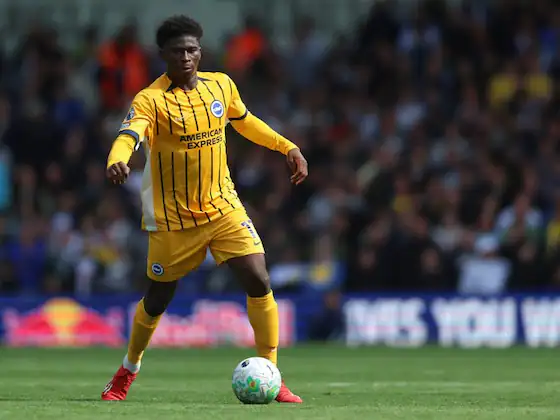
Manchester United officially confirmed the signing of Carlos Baleba on 25 August in a deal reported to be worth as much as £65 million.
The Cameroon international had been linked with the Red Devils since last summer, with his blend of physicality and technical quality fitting the club’s plans as part of their midfield rebuild.
So, why have Manchester United moved for Carlos Baleba?
Carlos Baleba was born on 3 January 2004 in Douala, one of Cameroon’s major cities.
His father, Eugene Balepa, instilled the value of hard work in him from an early age and also encouraged him to practise acrobatics while growing up so he could learn to judge the flight of the ball.
Baleba initially played as a right winger for the Douala-based club Futur Soccer FC. However, after spending a period out of the game because of injury, he returned as an attacking midfielder while featuring for several local teams in Cameroon.
When Baleba was 13, the Brasseries du Cameroun Football Academy held a youth tournament where he was spotted. After being recruited, he soon began training with their Under-18 side, where he was also able to develop the physical side of his game.
As he progressed towards becoming a professional footballer, Baleba looked up to Paul Pogba and also drew inspiration from Kevin De Bruyne and Thiago Alcantara.
Baleba’s breakthrough arrived during the 2024/25 season at Brighton & Hove Albion, when his performances established him as one of the most important players in Fabian Hürzeler’s side. But what exactly are the qualities that make him so effective?
Open body positioning is one of the main traits Baleba shows consistently when his team has possession. In simple terms, this means he regularly positions himself side-on to offer an active passing option for team-mates, which helps him open up the pitch and play forward progressively.
In one example, Brighton had a goal-kick against Tottenham and Baleba opened his body shape to make himself available as a passing option.
Although he did not receive the ball in that sequence, it was clear that he had drawn the attention of two nearby Tottenham players.
That happens because when a player is side-on while preparing to receive, it gives the opponent access to press and try to force a turnover, while at the same time creating spaces that can be used to progress play.
That links directly to another important quality in Baleba’s game: receiving on the back foot.
During matches, Baleba regularly looks to take the ball on his back foot. In other words, he aims to control it with the foot furthest away from the ball.
This can also act as a mechanism for creating space elsewhere on the pitch. If he receives on his back foot, it invites the opponent to step in and press him.
But Baleba is intelligent in the way he uses this technique, often taking advantage of the opponent’s momentum either to play through pressure or to turn away and go around it.
In another sequence, Baleba opened his body to receive in a tight area. He then controlled the ball with his back foot, invited pressure from the opponent and drove forward into space.
Playing with an open body shape and receiving on the back foot also connects with his passing ability.
When there is no immediate pressure from the opposition, Baleba looks for long-range passing options that can help his team move up the pitch quickly.
In one example, he received the ball from a team-mate and controlled it with his back foot, allowing him to turn and open up the pitch. He then wrapped his foot around the ball to send a long-range pass into space.
The way he wraps his foot around the ball is a crucial detail in his long-range distribution. By doing that while also leaning back slightly, he causes the ball to hang in the air for a few extra milliseconds.
That helps his team because it allows team-mates to make deeper runs, which can be useful in breaking an opponent’s offside trap. It is a technique similar to the one Paul Pogba used when he was at his peak.
For this technique to work properly, full-body rotation has to be synchronised from the upper body down through the legs. As the body rotates, weight can then be transferred efficiently to generate the right amount of power when the ball is struck.
Without the ball, Baleba is just as impressive. One of the first qualities that stands out is his ground coverage.
One reason he covers so much ground so effectively is his agility on his toes. By keeping light weight on his toes while running, he is able to travel large distances in a short amount of time.
In one example, Baleba had played a forward pass to a team-mate, but Wolverhampton Wanderers won the ball back and launched a counter-attack. Baleba managed to get across and stop Matheus Cunha from advancing.
When it comes to stopping attacks directly, defensive positioning is also vital. This refers to keeping the distances between the area you are covering and the player you are marking at an ideal, moderate level.
Baleba is particularly strong in this aspect because he reads the game well and can anticipate what the opponent is likely to do next.
For instance, if the opposition have the ball outside the penalty area in a wide channel, Baleba positions himself evenly between the ball and the player he is marking.
That allows him both to block the passing lane into that player and to step out if needed to stop the attack from progressing any further.
In open play, the same principle applies.
Defensive positioning is also crucial in the attacking third. In one sequence, Baleba was behind the play and therefore part of Brighton’s rest defence.
As part of Brighton’s high press, which forced Chelsea to clear the ball, Baleba had already stepped into a higher position, moving from blocking a possible Chelsea exit route to directly intercepting the ball.
Alongside his positional intelligence, physical strength in duels is another major feature of Baleba’s game.
Whether in defensive contests or in situations where he is shielding the ball, Baleba’s upper-body strength is outstanding, and that may well stem from the acrobatic work he did as a child.
In an interview with The Guardian in 2025, when asked about his backflip celebration, Baleba referred to the acrobatic training his father had encouraged him to do when he was young.
Outside his home in Akwa, Douala, there were abandoned truck tyres that he would run up to and back from. He would then jump on to the tyres to perform backflips and front flips.
His father also made him do gymnastic training on the beach, along with two hours of continuous running that included hill sprints and resistance work.
At first glance, those methods may not appear extraordinary, but they contributed directly to his physical development as he grew older because they constantly tested his core strength and agility. Over time, that helped him become stronger than those around him.
In another example, Newcastle United applied pressure on him, but Baleba was still able to protect the ball using different methods.
In the first case, Baleba bent his knees slightly and leaned back into the Newcastle player behind him. The advantage of that approach is that it creates greater separation between the defender and the ball.
In the second and third situations, he used both core strength and his arms to shield the ball from the defender while also creating leverage. Again, the benefit was increased separation between the opponent and the ball.
As a result, opponents are often left with two choices: go through Baleba in an attempt to win the ball back, or concede a foul.
One possible explanation may have been the early speculation surrounding Manchester United’s interest.
Another reason may have been his physical development. Compared to 2024/25, when Baleba had a slimmer frame with long limbs, he started the 2025/26 season looking noticeably bigger.
That was due to extra mass on his upper body, with a broader chest and wider shoulders.
While it cannot be said with certainty that this increase in body mass directly caused his struggles, it is clear that such physical changes would have required an adaptation period.
The mechanisms he had previously relied on were no longer working in exactly the same way, including full-body rotation with the ball. Because of the added weight, transferring weight effectively may have taken longer, simply because there was more mass to move.
That could explain why, in the opening months of the season, Baleba sometimes appeared more clunky when trying to rotate, as his brain may have been adapting to the extra mass around his body. It can be compared to a computer going through a major software update.
Alongside those issues with rotation, Baleba also had some difficulties with ball control. At times the ball got stuck under his feet, while on other occasions it ran away from him completely.
That may have been because his brain needed time to adjust to the new timing demands involved in rotating and playing. When the upper body and lower body are not fully synchronised, timing can become inconsistent, which may then lead to poor touches and eventually loss of possession.
Manchester United signed Carlos Baleba because they needed a midfield profile that combines physical, technical and positional intelligence.
Before Baleba’s arrival, United’s midfield was leaning more towards technical players with creative qualities, such as Andrey Santos and Youri Tielemans, who had joined earlier in the summer.
With Baleba, United gain not only technical quality but also a player who is physically strong in duels and positionally intelligent across different phases of play, allowing him to help shield the defence. Those physical and defensive aspects are different from what Tielemans and Santos offer, giving the midfield better balance.
With this type of profile in the side, United will be able to create space elsewhere on the pitch while in possession. That is because Baleba can invite opposition pressure and still help open up the pitch through his body positioning.
Baleba is also capable of carrying the ball progressively into the spaces that are created. His strong core makes it difficult for opponents to knock him off balance, while receiving on the back foot allows him to use the pressing momentum of opponents to his own advantage.
Manchester United can also take greater risks in the attacking phase by committing more players forward. That is because Baleba will likely operate behind the play as part of the rest defence, while he also has the ability to cover large distances if possession is lost.
Overall, Carlos Baleba gives Manchester United three essential qualities that every top midfielder needs: physicality, technical skill and positional intelligence.
What he offers can benefit both his own game and Manchester United as a team, with and without the ball.