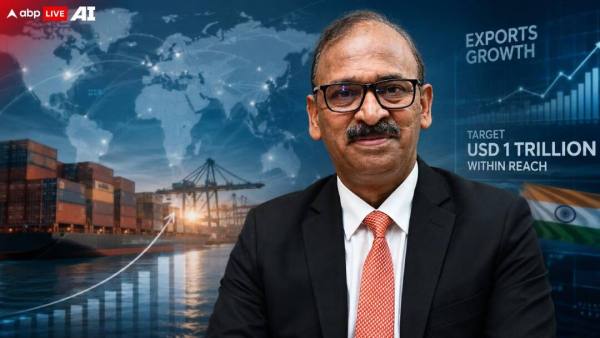
India’s exports have not only defied global headwinds with robust growth so far in FY 2027, but are poised to enter the $1 trillion lobby this fiscal, powered by sectors like electronics, a well mapped diversification strategy and dividends from FTAs, Ajay Sahai says in an exclusive interview to ABP Live English.
Q: India has again posted strong export figures in July despite worldwide economic uncertainties. What’s driving this growth?
Sahai: As the recent data shows, from January onwards we are having very good growth and it has picked up recently, with July recording 19.6 per cent growth, taking aggregate exports also to over USD 40 billion which is remarkable given the headwinds in the global economy.
It shows that to some extent India’s diversification strategy has started yielding results not only in terms of market but product diversification also has happened. For example last year we achieved electronics export of USD 48 billion, a substantial jump, which means over 11 per cent of my total exports are electronics and the way electronic exports are growing, I am pretty sure that in the next three years, electronics will have second position in India’s overall export basket only next to engineering.
So these are good signs and what is even better for India is that after a long time, merchandise exports are leading the export growth and it is not the services. Of course we are happy that services are providing much cushion to Indian exports but merchandise becomes important because it is creating a lot of jobs in the this sector and the kind of jobs that are required because it is not just the white collar jobs which are generally being produced in the services sector, probably more blue collar jobs are created in the manufacturing sector. That’s why I personally feel very good that manufacturing has taken the lead and performing so well.
So, it is very positive.
Q: India has set an ambitious target for exports this year. How much have we achieved this fiscal year?
Sahai: So if we are looking into an export target of 1 trillion dollars, quite possible this year. As we speak, in the first four months of the financial year, on the merchandise side, India has already done USD 174 billion and assuming that merchandise should be around USD 510 to 520 bn throughout the year.
So virtually we are on track having achieved one third in the first four months. In this fiscal, it is my view that merchandise should reach USD 520 to USD 525 billion and services exports should be around USD 475 billion to USD 480 billion. That will take it to a trillion dollars. If there are no major hiccups, having lived through many, I am sure we will be able to achieve this target.
Q: Which sectors are set to drive growth?
Sahai: Gems and jewellery are doing well but more importantly they have moved into other markets like Israel, China and the Middle East. What was happening earlier with tariffs in the US at zero duty, a lot of exports were going to the USA and from there it was getting redistributed to the rest of the world.
Now with a high tariff of 10 per cent coming on India under the Super 301, India is looking at directly exporting them. I think the process was started when the reciprocal tariff was imposed. So the gems and jewellery sector quickly moved into the new markets. Russia is emerging as a potential market.
Agri exports are doing well in some areas while some of the segments are not doing well. If you look at the plantation goods, they are lagging but value added agri goods like marine, meat are performing well. Overall, agri exports are demonstrating potential but I think the need of the hour is to push value added agri exports from the country.
We are moving into the snack market and it bodes well for exports but our value added export as a percentage of agricultural exports is well below 30 per cent. In many of the competing countries they have high value added agri exports of up to 50 per cent of their total production.
Q: How much have FTAs pushed this export growth?
Sahai: I think FTAs have also played an important role in that not just in terms of providing access to Indian exports but more so in making Indian manufacturing competitive because we have signed FTAs with many countries from where we are importing raw material intermediates which are making manufacturing competitive.
Once manufacturing is dynamic, exports will definitely grow. Secondly we are seeing much investment by global companies in India. While they are also looking to tap the domestic market they are also using India as a base for global exports which augurs very well for sustained growth in India’s exports in times to come.
In another positive sign, many labour intensive sectors though not doing very well, have started increasing their shipments out of the country. I am pretty sure that once some of the important FTAs, particularly with the EU and the US are rolled in, we will see much better growth in labour intensive areas because in these geographies the labour intensive sectors have a high tariff as compared to normal industrial goods so both EU and US will certainly push these industries for exports.
The UK FTA has become operational and I am very optimistic, more so for the labour intensive sectors. In leather, 16 per cent tariff comes to zero, in apparel 12 per cent tariff comes to zero, in handicrafts and carpets 10 per cent tariff comes to zero.
Moreover, with the augmentation of production under the PLI scheme also, many of these segments will have no option but to export as well because the domestic market will have a limitation and since this is linked with incremental production, the additional output will have to make its way into the global market. Despite these challenges and uncertainty about India being able to maintain whatever export growth it recorded last year, I am looking at atleast 15 per cent growth in India’s exports in 2026-27.
Q: How are you dealing with the current challenges as the war rages on?
Sahai: There is a huge shortage of space on the ship. Containers are short but I feel containers are released when there is space in the ship. In fact, had it not been for the logistics disruption, probably we may be touching on 25 per cent growth for exports. Freight is rising globally. It is not a India specific problem. Because of that buyers have a realisation that they have to incur higher costs. Wherever the shipment is on FOB terms it is the responsibility of the buyer to arrange for the freight.
Where it is on CIF or other terms, it is the responsibility of the exporter to do that. Please bear in mind that the freight rates have gone up by 300 per cent. We have flagged these concerns and have met with the shipping ministry also over these concerns.
Q: Do you see the fresh US move to empower Trump to impose tariffs of up to 100 per cent as risking Indian exports?
Sahai: Let us not prejudge the issue. The US has not imposed the penalty yet. The point is that the Act gives the US President authority to do so. (The legislation passed by the US Senate now goes to the House of Representatives as it reconvenes on 31 August for approval to become a law).
I am sure on the 31st the US Congress will also approve the bill which will be an Act. Let us see whether the US President will use the Act as a negotiating power to have a bilateral trade agreement (BTA) with India or impose a tariff. Maybe he uses that as a bargaining chip to have a BTA with India. If he chooses to levy a 100 per cent tariff on India, then in any case a BTA is out. There is no point in having a deal because BTA will not provide any respite to Indian exports.
After all India has to be assured that when they are going for a BTA, it will result in some gain to our exports. If we are giving the US a market where their goods will be entering at zero duty and then they are imposing 18 per cent tariff on India, we would like to see how the 18 per cent tariff plays out vis a vis our competitors. If my rival, let’s say, is at 10 per cent and India moves at 18 per cent, we are a net loser. So I think it’s good that the Indian negotiator has taken the line that only when tariffs are competitive for India, can we go ahead.
Q: What is the export status with China and Russia?
Sahai: Our export figures have been very good both with China and Russia. With China we have to look at the value added segment. Raw material continues to dominate with over 50 per cent of our exports whether that be pig iron, cotton or polymer. We have to look at in what way we can export finished goods. The good news is that we are importing some of the electronic segment items to China because global firms which have come to India are producing parts and components which are being exported to China.
That’s there but there is a need to look further into value added exports. Imports are high but that import is the demand of the Indian economy. The positive thing is that the Government is looking into what way we can reduce the major import items. So if we are in a position to do so, automatically over a period of time the inbound flow of products from China will come down. Not that India is targeting China but we are looking into one or two main sources of supply, be it China or some other country.
Q: How is the diversification strategy helping working and in which products?
Sahai: The remarkable diversification has been achieved by the marine sector. Before that, one third of India’s marine seafood was being exported to the US. When the 50 per cent tariff came from the US, the market was taken up by Mexico and Ecuador. Mexico was having zero duty with the US while Ecuador was having 5 per cent.
India quickly tapped the EU, China and Russia markets. Look at the strategy last year. Despite setbacks in the US market which was accounting for more than one third of India’s marine exports, India clocked 15 per cent overall export growth. This was a remarkable turnaround because diversification normally takes two to three years.
One of the positive fallouts of the US tariff war is that industry also has not realised that there is no point in having all eggs in one basket. They on their own have started looking into other markets and at the same time they would like to retain the US market because no other market can be as lucrative as the US, not only just because of the prices we get but also due to the volume.
One may get the volume in many of the Asian countries but not the value and you may get the value in Europe but not the volume. It becomes difficult for industry to move away from the US but they would not like to excessively leverage the US also.
(Mukherjee is a contributing writer for ABP Live English. A business journalist for more than 15 years, she has written extensively on the economy, policy, and international relations in Indian newspapers and magazines)