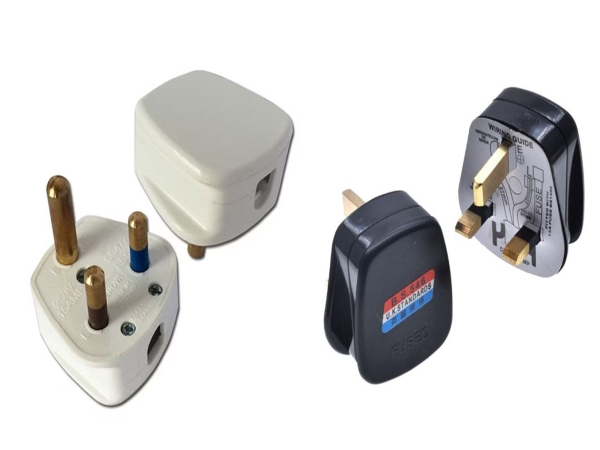
We plug devices like mobile chargers, TVs, refrigerators, or laptops into power outlets every day, yet we rarely pay attention to their design. In India, the plugs commonly used feature round pins. However, if you visit the US or Japan, you will find plugs with flat pins. Why do different countries require different types of plugs for the same kinds of electrical appliances? Let us try to understand the reason behind this difference.
**The reason dates back to the early days of electricity**
The story behind this difference begins in the early days of domestic electricity usage. In the late 19th and early 20th centuries, as electricity began reaching homes and offices, there were no established global standards for plugs and sockets.
Different companies and countries developed electrical systems and appliances based on their specific needs. Over time, household wiring and sockets were installed based on these systems. By the time the world considered establishing a unified standard, millions of homes had already been wired. Replacing such a vast infrastructure all at once was nearly impossible; consequently, each country adopted its own distinct plug system.
**The British connection behind India's round pins**
Technically, the round-pin plugs used in India are classified as Type D and Type M. This design is directly linked to British rule. India's initial power grid was established by the British, who implemented the 'BS 546' standard at the time. India retained this system even after independence because the country's wiring and grid infrastructure had already been configured to match it. Interestingly, while Britain adopted the flat-pin Type G plug after 1947, India continued using its existing round-pin plug system.
**Voltage and safety are also key factors**
Voltage is a major reason for the difference between plugs used in India and the US. In India and Europe, the power supply operates at 220–240V, which is significantly higher. High-voltage electricity carries a higher risk of electric shock. Round-pin plugs are designed so that a finger cannot easily enter the socket and come into contact with the live pin. Additionally, in Indian 3-pin plugs, the top earthing pin is longer and thicker, ensuring the device is safely grounded before the main current begins to flow.
In contrast, the power supply in the US and Japan operates at 110–120V. Delivering consistent power to appliances at lower voltages requires a higher current. Flat pins cover a larger surface area, allowing high currents to flow safely and easily. Furthermore, American plugs often feature pins of unequal widths, ensuring the plug can only be inserted into the socket in the correct orientation.
Ultimately, these designs are not merely aesthetic choices but the result of specific national safety standards and historical infrastructure; this is precisely why a universal travel adapter is essential when traveling abroad.
Disclaimer: This content has been sourced and edited from Amar Ujala. While we have made modifications for clarity and presentation, the original content belongs to its respective authors and website. We do not claim ownership of the content.